
When we talk about population pharmacokinetics, the study of how drugs move through groups of people, accounting for differences in age, weight, genetics, and organ function. It’s not just about what’s in the pill—it’s about what’s in you. Two people taking the same dose of the same drug can have totally different outcomes. One feels better. The other gets sick. That’s not a mistake. It’s biology.
pharmacogenomics, how your genes affect how you respond to drugs is a big part of this. Some people break down medications fast. Others hold onto them too long. That’s why a dose that works for a 30-year-old athlete might overload a 75-year-old with kidney trouble. drug metabolism, how your liver and kidneys process medicines changes with age, disease, and even what you eat. That’s why older adults are more likely to have bad reactions—and why doctors need to adjust doses based on more than just weight.
It’s not just genetics or age. medication dosing, the process of deciding how much of a drug to give has to consider kidney function, liver health, body fat, and even what other pills you’re taking. A blood thinner that’s safe for one person could cause bleeding in another because their body clears it slower. That’s why some meds come with warnings like "use with caution in elderly patients" or "avoid with kidney disease." These aren’t vague suggestions—they’re based on real data from population studies.
You’ve probably heard that generics are just as good as brand names. But what if your body reacts differently to the filler ingredients? Or if your liver can’t process the version your insurance picked? That’s where population pharmacokinetics comes in. It’s the science behind why some people need higher doses, why others need different drugs entirely, and why a pill that works for your neighbor might not work for you.
This isn’t theory. It’s daily practice in hospitals, clinics, and pharmacies. The posts here cover real-world cases: how liver changes in seniors affect drug safety, why some people react badly to generics, how ethnicity changes drug response, and what happens when you mix blood thinners with NSAIDs. These aren’t random stories—they’re all connected by one truth: your body is unique, and your meds should be too.
Below, you’ll find practical guides on how to spot when a drug isn’t working right for you, how to talk to your doctor about dosing, and what to do when side effects don’t match the pamphlet. You’ll learn what to ask, what to watch for, and how to push back when the system treats you like a number instead of a person. This isn’t just about understanding science—it’s about taking control of your treatment.
Posted by Ian Skaife with 9 comment(s)
Dec
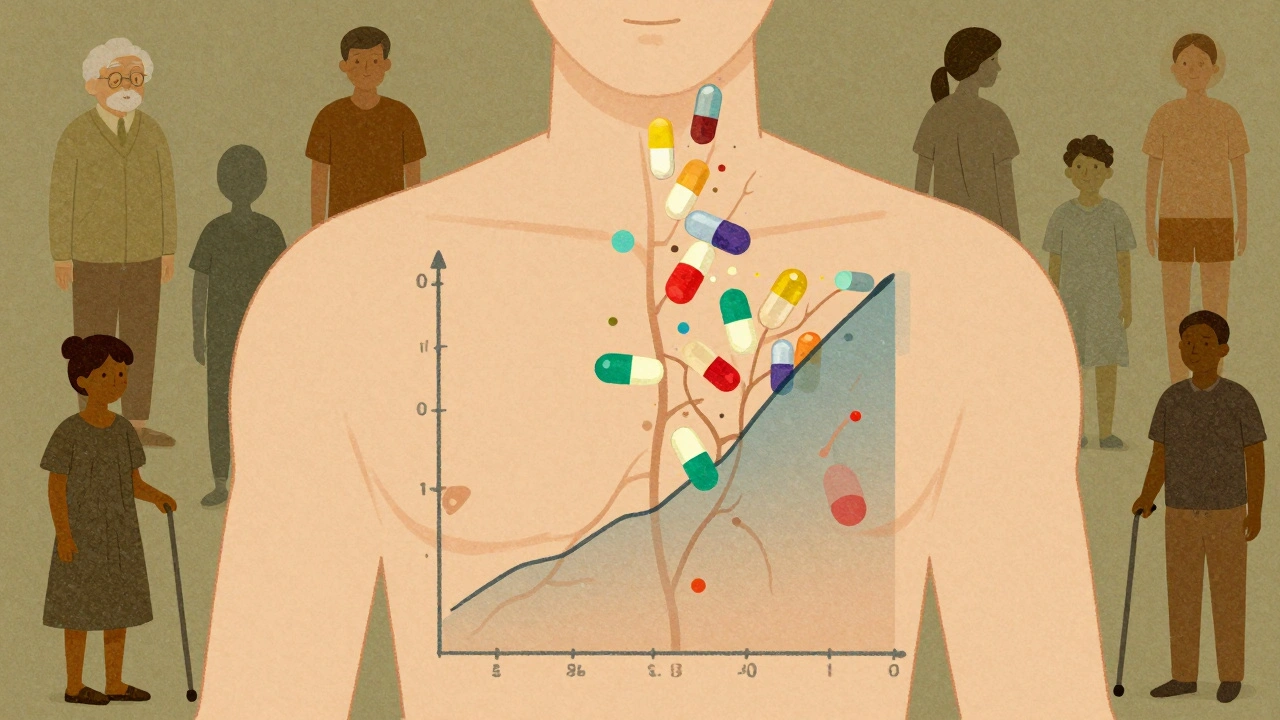
Population pharmacokinetics uses real-world data to prove drug equivalence across diverse patient groups, offering a smarter alternative to traditional bioequivalence studies - especially for complex drugs and vulnerable populations.
view more