
Medication Risk Checker for Hyponatremia
Medication Risk Assessment Tool
Check if your medications may be putting you at risk for severe hyponatremia (low sodium levels). Based on data from the article about medication-related hyponatremia.
Select Medication Types (if applicable):
Contributes to 28% of medication-related cases
Linked to 22% of cases
Responsible for 18% of cases
Less common but still dangerous
Major cause in younger people
Low sodium isn’t just a lab number-it’s a silent emergency. When medications throw off your body’s sodium balance, confusion can turn to seizures in hours. And too often, it’s missed until it’s too late.
What Exactly Is Severe Hyponatremia?
Hyponatremia means your blood sodium is below 135 mmol/L. Severe hyponatremia hits when it drops below 120 mmol/L. At that point, your brain starts swelling. Sodium keeps fluids in balance. When it drops too fast, water floods into brain cells. That’s when symptoms go from mild to life-threatening.
It’s not rare. About 1 in 5 hospitalized patients with low sodium got it from a medication. And it’s climbing. As more people take SSRIs, diuretics, or seizure drugs, cases are rising 4.2% every year. The worst part? Many doctors don’t check sodium levels until someone ends up in the ER.
Which Medications Cause This?
Not all drugs are equal when it comes to sodium. Some carry a much higher risk.
- Diuretics (like hydrochlorothiazide) - cause 28% of medication-related cases. They flush out sodium and water, but sometimes too much water stays behind.
- SSRIs (sertraline, citalopram, fluoxetine) - linked to 22% of cases. These antidepressants trigger SIADH-your body holds onto water like a sponge.
- Antiepileptics (carbamazepine, oxcarbazepine) - responsible for 18%. Carbamazepine has over five times the risk compared to non-users.
- MAOIs, ACE inhibitors, NSAIDs - less common, but still dangerous, especially in older adults.
- MDMA (ecstasy) - not a prescription drug, but a major cause in younger people who drink too much water while using it.
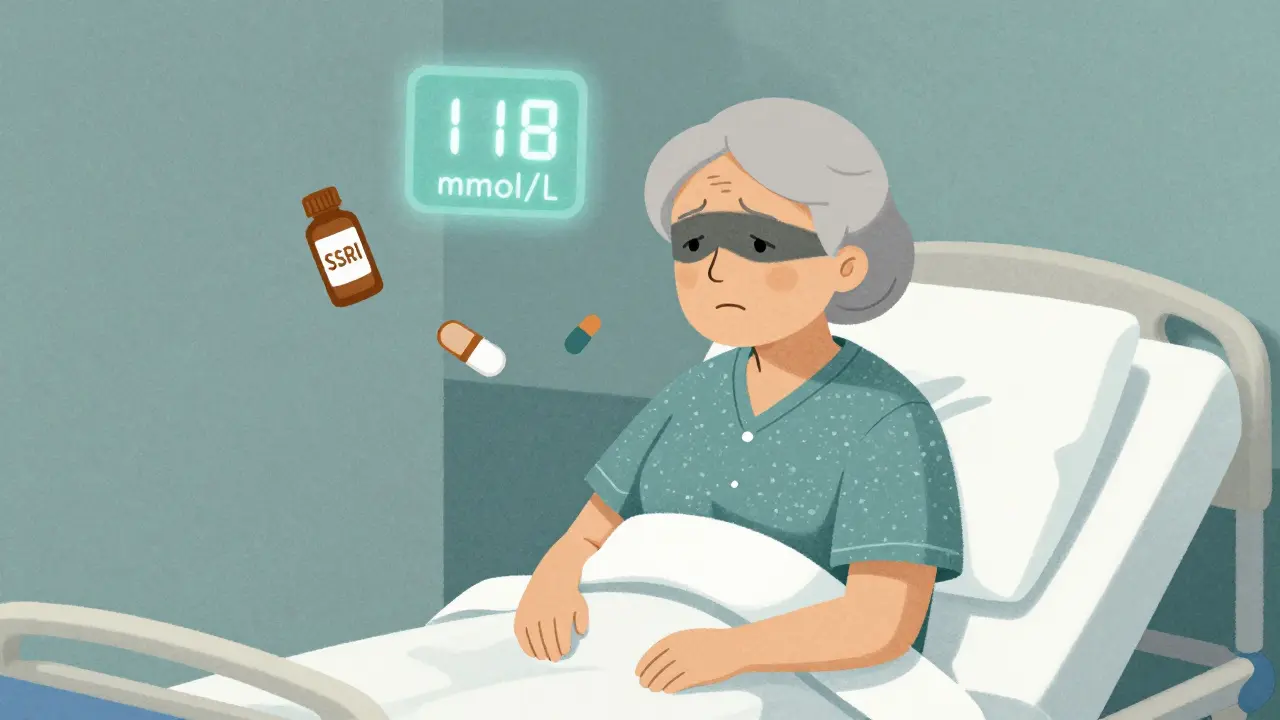
Here’s the catch: You don’t need to be on all of them. Just one can do it. And it often happens within the first month. A 72-year-old woman on sertraline saw her sodium drop 0.8 mmol/L per day-until she had a seizure. Her doctor thought it was just "side effects."
Confusion, Seizures, Coma: The Warning Signs
These aren’t random symptoms. They’re red flags.
- Confusion - happens in nearly 7 out of 10 severe cases. It’s not just "being forgetful." It’s disorientation, trouble following conversations, or not recognizing family members.
- Seizures - occur in 22% of people with sodium below 115 mmol/L. These aren’t minor twitches. They’re full-body convulsions, often mistaken for strokes or epilepsy.
- Nausea, headaches, fatigue - early signs. Often dismissed as the flu, stress, or aging.
- Coma or death - if sodium stays below 115 for more than 48 hours, mortality jumps to 37%.
One patient on Drugs.com wrote: "I was hospitalized for five days after my citalopram dropped my sodium. No one warned me. I thought I was just getting sick." That’s the pattern. Sixty-eight percent of cases are misdiagnosed at first-usually as anxiety, dementia, or a viral illness.
Why Do Medications Do This?
It’s mostly about SIADH-Syndrome of Inappropriate Antidiuretic Hormone. Normally, your body makes just enough ADH to keep water balanced. Medications like SSRIs and carbamazepine trick your brain into making too much. Your kidneys hold onto water. Blood gets diluted. Sodium drops.
It’s worse in older adults. People over 65 make up 61% of severe cases. Their kidneys don’t handle fluid shifts as well. Women are more affected too-57% of cases. Hormones, body size, and medication metabolism all play a role.
And here’s the irony: The brain adapts to slow sodium drops. But when a drug causes a fast drop-like within days-the brain doesn’t have time to adjust. That’s why symptoms hit hard and fast.
How Is It Diagnosed?
It’s not a guess. It’s a blood test.
If you’re on a high-risk drug and start feeling off, ask for a serum sodium level. That’s it. No MRI. No spinal tap. Just a simple blood draw. But most doctors don’t order it unless symptoms are severe.
There’s a tool called the Hyponatremia Algorithm from the European Hyponatremia Network. It helps doctors sort out if it’s a drug, a heart problem, or something else. When used within 24 hours, it’s 89% accurate.
Key clues:
- Did symptoms start 1-4 weeks after starting a new drug?
- Is there no other explanation (like kidney failure or heart disease)?
- Does sodium go back up after stopping the drug? (It does in 78% of cases.)
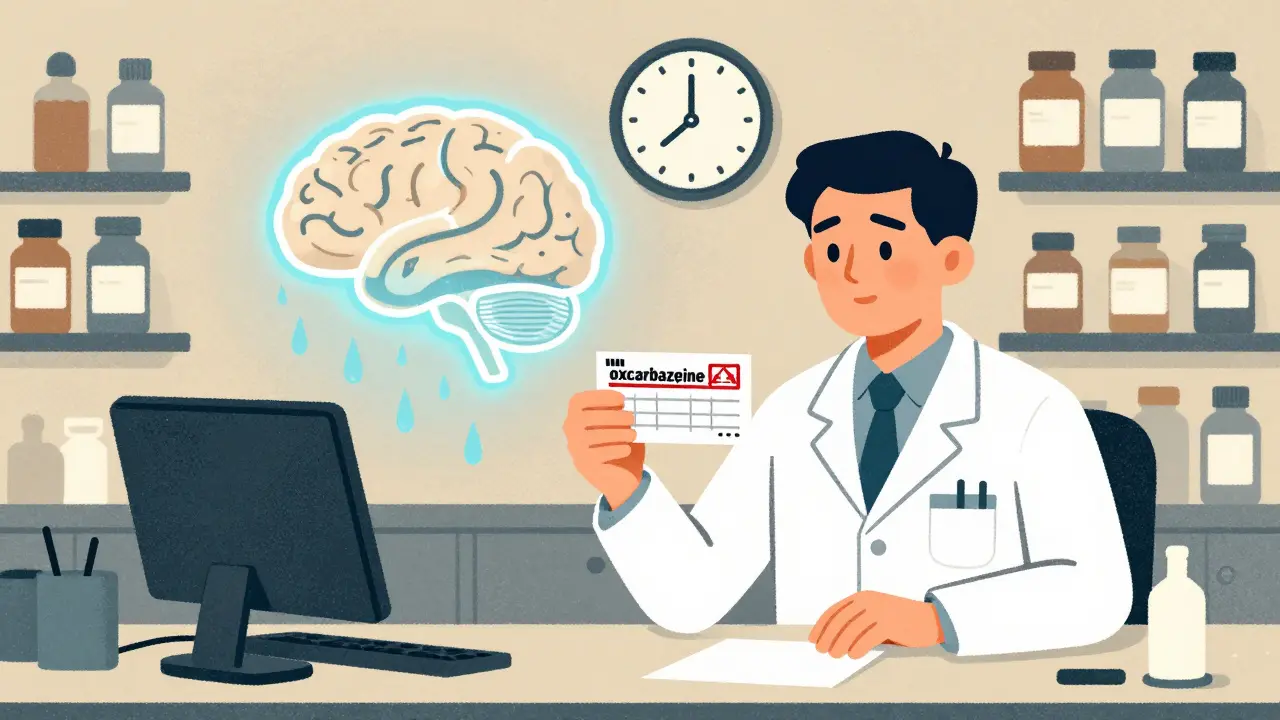
One pharmacist caught a potential interaction before a patient filled their oxcarbazepine script. "Saved me from what happened to my sister," the patient wrote. That’s the difference.
How Is It Treated?
Fast correction is dangerous. Too quick, and you risk osmotic demyelination-permanent brain damage.
The goal? Raise sodium slowly: 4-8 mmol/L in the first 24 hours. That’s the sweet spot.
- Mild cases: Stop the drug. Restrict fluids. Monitor.
- Severe cases (with seizures or coma): Hospitalization. IV saline. Sometimes tolvaptan (Samsca), a new drug approved in late 2023 that helps the body flush water without losing sodium. Clinical trials show it cuts correction time by 34%.
Doctors in Europe say max 6 mmol/L in 24 hours. In the U.S., some allow up to 10 mmol/L if the patient is monitored closely. Either way-no rushing.
Can It Be Prevented?
Yes. But it takes action.
Here’s what works:
- Check sodium within 7 days of starting high-risk drugs-especially for anyone over 65.
- Repeat every 3-5 days for the first month.
- Warn patients: "If you feel dizzy, nauseous, or confused, get your sodium checked. Don’t wait."
- Pharmacists should flag high-risk combinations at pickup. In Australia, NPS MedicineWise has flagged 12 key drugs since 2023.
Only 63% of doctors follow monitoring guidelines. Academic hospitals do better-82% screen. Community clinics? Just 47%.
AI is starting to help. Mayo Clinic’s algorithm predicts hyponatremia risk 72 hours before symptoms by scanning EHR data. Accuracy? 87%. It’s not mainstream yet-but it’s coming.
What Happens If It’s Not Treated?
Permanent damage. Brain swelling can kill. Even if you survive, you might lose motor control, speech, or memory.
And recurrence? It’s high if you must keep the drug. For example, if you need an SSRI for depression, stopping it isn’t an option. Recurrence rates jump to 33% in those cases. For diuretics? You can switch to another pill-recurrence drops to 12%.
Dr. Habash-Bseiso says it plainly: "Permanent brain damage can occur if hyponatremia is not corrected by medical providers."
Real Stories, Real Risks
Reddit user r/medicine shared a case: a 72-year-old man started sertraline. Within 10 days, sodium dropped to 118. He had a grand mal seizure. His PCP called it "normal side effects."
On Patient.info, 427 cases were logged. 68% were misdiagnosed. Most thought it was the flu or anxiety.
On Drugs.com, SSRIs average 2.3 stars-not because they don’t help depression, but because of this hidden risk. "My doctor didn’t warn me about this" appears in 41% of negative reviews.
But there’s hope. One woman’s pharmacist caught a dangerous combo before she even filled her prescription. She didn’t end up in the hospital. Her sister did.
What Should You Do?
If you’re on one of these drugs:
- Ask your doctor: "Should I get my sodium checked?"
- Know the symptoms: confusion, nausea, headache, fatigue.
- Don’t wait for seizures. If you feel off, get tested.
- Keep a log: When did you start the drug? When did symptoms begin?
- Don’t drink excessive water. Especially if you’re on SSRIs or MDMA.
If you’re a caregiver for an older adult: Check their meds. Ask if sodium was tested. Push for it if not.
This isn’t about fear. It’s about awareness. A simple blood test can prevent a seizure, a coma, or worse.
Looking Ahead
By 2028, cases will rise 22% as the population ages. But better monitoring could cut severe complications by 38%.
The FDA now requires warning labels on 27 high-risk drugs. The EMA says pharmacists must educate patients at pickup. That’s progress.
But the biggest gap? Routine screening. Why isn’t sodium checked automatically after starting a high-risk drug? Dr. Robert Stern asked in JAMA: "Why are we waiting for someone to have a seizure?"
The answer? Because we can. And we should.
Comments
Lisa Rodriguez
My grandma was on hydrochlorothiazide and started acting like she didn't know who we were. We thought it was early dementia until her pharmacist flagged it. Sodium was 117. She had a tiny seizure in the kitchen. Turned out it was the diuretic. They stopped it, she bounced back in a week. Why isn't this routine? I'm so mad no one told us.
Doctors act like low sodium is just "old age" but it's not. It's a red flag you can catch before it kills.
January 31, 2026 AT 16:12
Chris & Kara Cutler
OMG YES. My sister took citalopram and thought she had the flu for 3 days. Then she collapsed. ICU. Now she's on a different med and they check her sodium every 2 weeks. This needs to be on every prescription label. 🚨💊
February 1, 2026 AT 14:04
Donna Macaranas
I work in a nursing home. We see this all the time. Older folks on SSRIs and diuretics, confused, lethargic, no one thinks to test sodium. It’s not dementia-it’s a drug reaction. We started doing monthly labs on anyone on high-risk meds. Big drop in ER visits. Simple fix. Why isn’t everyone doing this?
February 2, 2026 AT 03:50
Aditya Gupta
Bro i had a friend on carbamazepine and he got super dizzy and started slurring. Doc said "stress". He had a seizure 2 days later. Sodium was 112. He’s fine now but scared to take any med. This is wild how common it is and how no one talks about it. Test your sodium bro. Just test it.
February 3, 2026 AT 06:42
Lu Gao
Actually, the data here is misleading. The 4.2% annual increase? That’s mostly because we’re testing more, not because drugs are getting more dangerous. And yes, MDMA causes hyponatremia-but that’s not a medication, it’s a recreational drug. Don’t conflate the two. Also, tolvaptan is expensive and has liver risks. It’s not a magic bullet. This post is alarmist with cherry-picked stats.
February 4, 2026 AT 07:32
Angel Fitzpatrick
They don’t test sodium because they’re paid to keep you sick. Pharma owns the FDA, the AMA, the hospitals. They want you dependent on SSRIs and diuretics. They know this kills. That’s why they bury the warnings in 200-page inserts. You think your doctor cares? He’s on their payroll. They’d rather you end up in the ICU than admit their drugs are toxic. This isn’t negligence-it’s genocide by prescription. And they call it "standard of care."
February 4, 2026 AT 09:22
Jamie Allan Brown
I’m a pharmacist in London. We’ve been flagging high-risk meds for years. One of our biggest wins? Getting the NHS to require sodium checks before dispensing carbamazepine to patients over 60. We’ve prevented at least 15 hospitalizations since 2022. It’s not glamorous work. But it saves lives. And yes-patients are often surprised. They think "meds are safe." But medicine isn’t magic. It’s chemistry. And chemistry needs monitoring.
February 4, 2026 AT 16:14
Nicki Aries
Thank you for writing this. I’ve been trying to tell my sister for months that her confusion isn’t "just stress"-she’s on sertraline and has been drinking a gallon of water a day. I printed this out and handed it to her. She cried. She went to her doctor yesterday. Sodium was 121. They stopped the med. She’s already feeling better. This is exactly the kind of information that should be in every primary care office. Please keep speaking up.
February 4, 2026 AT 23:58