
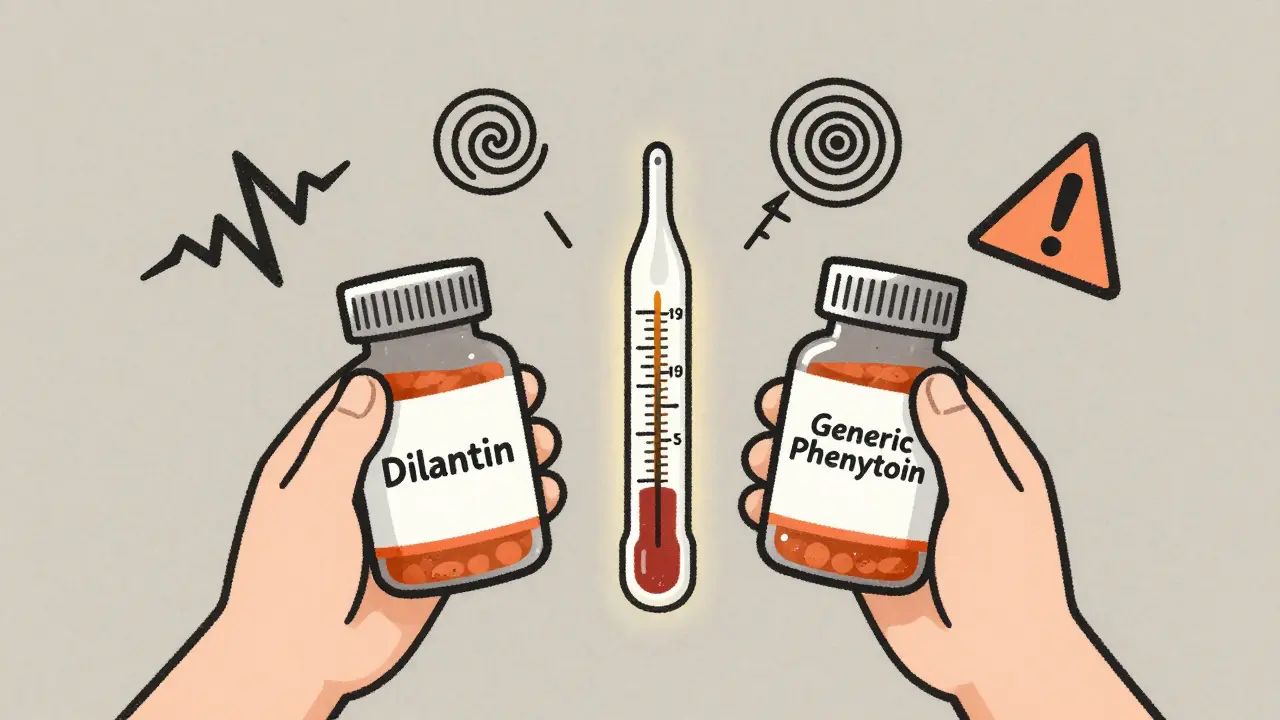
Switching from brand-name Dilantin to a generic version of phenytoin might seem like a simple cost-saving move. But for patients taking this drug, it can be anything but simple. Phenytoin isn’t like most medications. Even small changes in how much of the drug gets into your bloodstream can lead to seizures-or worse, toxicity. That’s why therapeutic drug monitoring isn’t optional when you switch generics. It’s essential.
Why Phenytoin Is Different
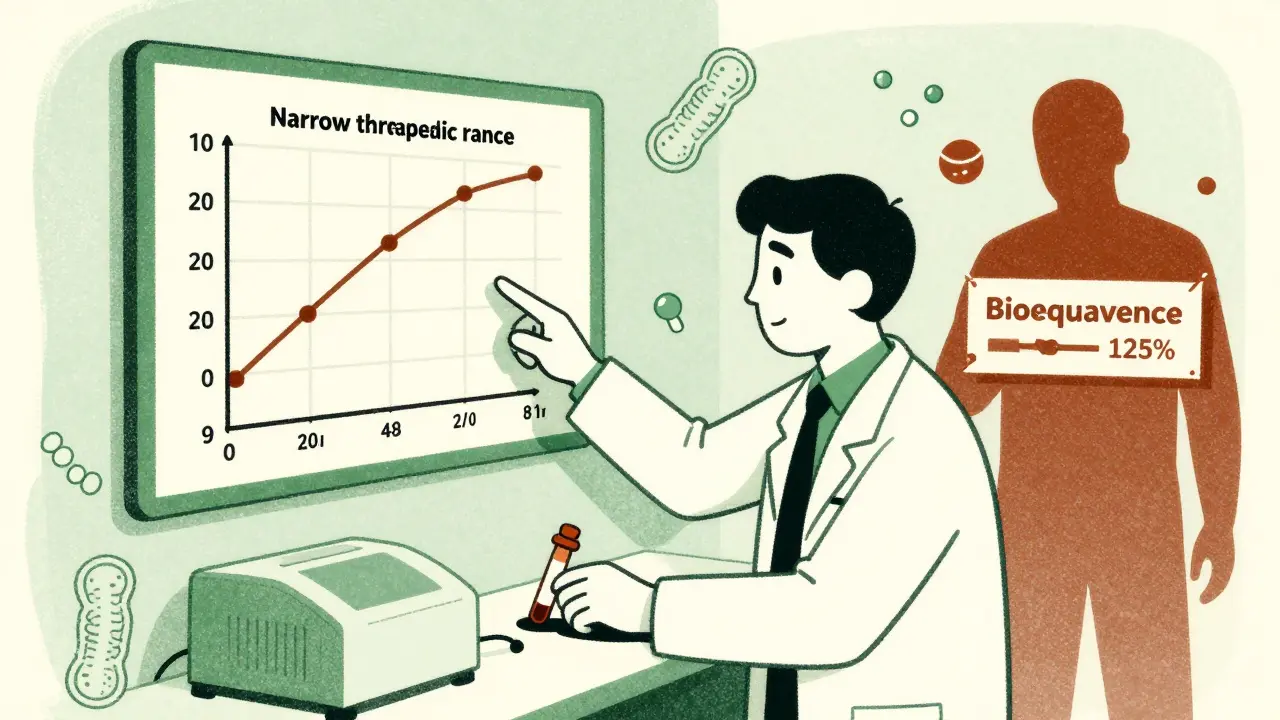
Phenytoin has been used since the 1930s to control seizures. It’s cheap, effective, and still widely prescribed. But its behavior in the body is unpredictable. The therapeutic range is narrow: 10 to 20 mcg/mL. Go below 10, and seizures may return. Go above 20, and you risk dizziness, loss of coordination, confusion, or even coma. At levels over 50 mcg/mL, death can occur. What makes phenytoin especially tricky is its non-linear pharmacokinetics. That means if you increase the dose by just 25-50 mg, the drug concentration in your blood might jump way more than expected. Your body’s ability to clear it gets overwhelmed. This isn’t like taking a painkiller, where doubling the dose roughly doubles the effect. With phenytoin, it’s like turning a dimmer switch into an on/off button. Add to that: phenytoin is 90-95% bound to proteins in your blood. Only the small unbound fraction (about 10%) actually works to prevent seizures. If your protein levels drop-because you’re sick, malnourished, or have liver disease-more of the drug becomes unbound. Even if your total blood level looks normal, you could be getting too much active drug. That’s why a "normal" level doesn’t always mean safe.Generic Switches Aren’t Always Safe
The FDA says generic drugs must be bioequivalent to the brand. That means their absorption must fall within 80-125% of the original. Sounds fair, right? But for phenytoin, that 20% variation is dangerous. Imagine you’ve been stable on brand-name Dilantin for years. Your level is 15 mcg/mL. You switch to a generic that’s on the high end of bioequivalence-125% absorption. Your new level might jump to nearly 19 mcg/mL. Still in range? Maybe. But now you’re close to the top. A slight change in diet, a new antibiotic, or even dehydration could push you over 20. Suddenly, you’re at risk. Or worse: you switch to a generic that absorbs only 80% as well. Your level drops from 15 to 12. You feel fine. But then you miss a dose. Now you’re at 9.6. Your seizure control slips. No warning. No symptoms until it’s too late. This isn’t theoretical. Clinicians have documented cases where patients had breakthrough seizures after switching to a different generic-sometimes even between two generics made by different companies. The FDA’s standards were designed for drugs with wide safety margins. Phenytoin doesn’t have one.When to Monitor Levels
You don’t need to check phenytoin levels every month. But you absolutely must check them at key moments:- Before switching formulations-Get a baseline level right before you switch from brand to generic, or from one generic to another.
- 5 to 10 days after switching-That’s when steady-state levels are reached. A level taken too early won’t tell you anything.
- After any dose change-Even if you’re staying on the same brand, changing your dose requires a follow-up level.
- If you start or stop another medication-Many drugs interact with phenytoin. Antibiotics like trimethoprim-sulfamethoxazole, antifungals like fluconazole, and even alcohol can spike or drop your levels.
- If you develop symptoms-Tremors, slurred speech, dizziness, or nausea? Don’t wait. Get a level checked.
What the Level Doesn’t Tell You
A total phenytoin level is just part of the picture. If you’re low on albumin-common in older adults, people with liver disease, or those who are malnourished-you need a free phenytoin level. That measures only the active, unbound drug. There’s a formula to estimate free levels from total levels and albumin: Corrected phenytoin = Total level / ((0.9 × Albumin / 42) + 0.1). But here’s the catch: it’s only a rough estimate. The best practice? If your albumin is below 3.5 g/dL, ask for a free phenytoin test. Don’t rely on the math. Also, don’t assume your level is stable just because you haven’t changed your dose. Your liver metabolism can shift over time. Your kidney function can decline. You might start eating differently. All of these affect how phenytoin moves through your body.Other Things to Watch For
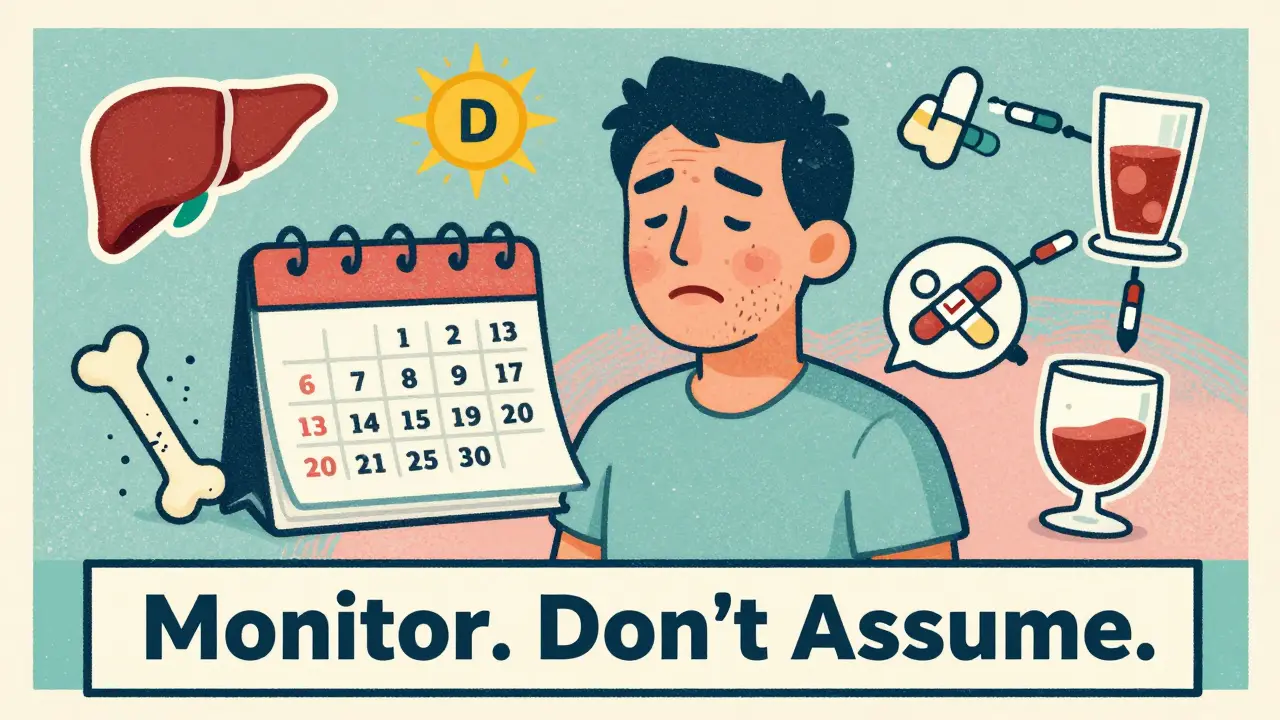
Phenytoin doesn’t just affect your brain. Long-term use can cause:- Gingival hyperplasia (swollen, overgrown gums)
- Hirsutism (excessive hair growth)
- Vitamin D deficiency and bone loss
- Folic acid deficiency
- Peripheral neuropathy
- Full blood count (to check for low white cells)
- Liver function tests
- Electrolytes and kidney function
- Vitamin D and calcium levels
- Albumin levels
What Patients Should Do
If you’re on phenytoin:- Know your current level. Ask your doctor for a copy.
- Ask if your pharmacy is switching your prescription to a different generic. If they are, insist on a follow-up level.
- Don’t accept a new generic without checking with your neurologist or pharmacist.
- Keep a list of all your medications-including over-the-counter drugs and supplements. Many interact with phenytoin.
- Report any new symptoms, no matter how small. Dizziness, clumsiness, or odd eye movements could be early signs of toxicity.
What Doctors Should Do
Clinicians need to stop treating phenytoin like any other drug. Routine monitoring isn’t needed for everyone-but switching formulations? That’s a red flag. The American Academy of Family Physicians says monitoring during formulation changes is "clinically useful"-even if evidence is limited. That’s the best we’ve got. And in practice, it’s the only way to prevent harm. When switching phenytoin:- Document the exact product being switched from and to.
- Check a level before and 5-10 days after the switch.
- For patients with low albumin, order a free phenytoin level.
- Warn patients about signs of toxicity and when to seek help.
- Don’t assume bioequivalence means interchangeability.
Bottom Line
Generic phenytoin is not the same as brand-name Dilantin-not in clinical practice. The FDA’s bioequivalence standards were never meant for drugs with phenytoin’s narrow window and non-linear behavior. For patients, the stakes are high: seizures, toxicity, even death. Therapeutic drug monitoring isn’t a luxury. It’s a lifeline. If you’re on phenytoin, don’t let a pharmacy change your medication without checking your level. If you’re prescribing it, don’t assume a switch is safe. Track your numbers. Watch your patients. And never treat phenytoin like an ordinary pill.Is it safe to switch between different generic phenytoin products?
Switching between different generic phenytoin products carries risk. Even though they meet FDA bioequivalence standards (80-125% absorption), phenytoin has a narrow therapeutic range and non-linear metabolism. Small changes in absorption can push levels into toxic or ineffective ranges. Always check serum phenytoin levels before and 5-10 days after switching generics.
What’s the difference between total and free phenytoin levels?
Total phenytoin measures all drug in the blood-both bound to proteins and free. Only the free (unbound) portion is active and causes effects. When protein levels are low (like in liver disease or malnutrition), more phenytoin becomes unbound, even if the total level looks normal. In these cases, a free phenytoin level gives a more accurate picture of what’s happening in your brain.
How often should phenytoin levels be checked?
Not every month. But check levels after starting therapy, after any dose change, after switching formulations, or if you develop symptoms of toxicity or seizure breakthrough. For steady-state monitoring, check every 3-6 months if stable. More often if you’re elderly, have liver or kidney disease, or take interacting drugs.
Can I take phenytoin with other medications?
Many drugs interact with phenytoin. Antibiotics like trimethoprim-sulfamethoxazole, antifungals like fluconazole, and seizure drugs like valproate can raise phenytoin levels. Alcohol, rifampin, and carbamazepine can lower them. Always review all medications-prescription, over-the-counter, and supplements-with your doctor or pharmacist before starting anything new.
What are the long-term side effects of phenytoin?
Long-term use can cause gum overgrowth, excessive hair growth, vitamin D deficiency, low calcium, bone thinning, folic acid deficiency, and nerve damage. Regular blood tests for liver function, vitamin D, calcium, and full blood count are recommended at least yearly to catch these early.
Comments
Martin Spedding
ph3nyt01n is a nightmare. one day u r fine, next day u r drooling and can't walk. generics? lol. the fda doesn't know shit.
December 17, 2025 AT 04:25
CAROL MUTISO
Y'know, I used to think generics were just as good-until my aunt went from Dilantin to some no-name capsule and started having seizures in the grocery store. Turns out, the 'same' drug doesn't mean the same *effect*. Phenytoin isn't aspirin. It's a tightrope walk with a razorblade underfoot. And yeah, I'm salty. I lost three years of her life because someone thought 'bioequivalent' meant 'safe'.
It’s not about cost. It’s about survival. The body doesn't care about FDA paperwork. It cares about unbound fractions, albumin levels, and whether your liver is having a bad day. And if your doctor doesn’t get that? Find a new one.
December 19, 2025 AT 01:59
Raven C
While I appreciate the general sentiment expressed herein, I must insist that the colloquial tone employed throughout this post undermines its clinical authority. One cannot casually refer to phenytoin as 'a dimmer switch turned into an on/off button'-this is neither scientifically precise nor semantically rigorous. The therapeutic window demands lexicon commensurate with its peril.
December 20, 2025 AT 21:41
Donna Packard
I'm so glad someone finally wrote this. I've been telling my neurologist for years that switching generics is a gamble. I didn't say anything until I started having tremors. Then I begged for a level check. Thank you for validating what we patients know in our bones.
December 21, 2025 AT 20:01
Sam Clark
As a pharmacist who's dispensed phenytoin for over 20 years, I can confirm: switching between generics without monitoring is negligence wrapped in a prescription label. I've seen patients crash into toxicity because the new batch had a different filler. The FDA’s 80-125% range is a legal loophole, not a safety guarantee. Always check levels. Always document the manufacturer. Always educate the patient. This isn't optional-it's the standard of care.
December 22, 2025 AT 02:27
Jessica Salgado
Wait-so if I'm on a generic and my gums start swelling, is that the drug... or just my dentist being lazy? I've been getting my teeth cleaned every 3 months and still look like I swallowed a sea urchin. Is this normal? Should I be scared? I'm just trying to survive without looking like a walking coral reef.
December 23, 2025 AT 19:02
Chris Van Horn
Wow. Another anti-generic rant. Let me guess-you're one of those people who still thinks brand-name insulin is 'better' too? The FDA doesn't lie. If it's bioequivalent, it's equivalent. You're just scared of saving money. People die from overdoses because they're paranoid, not because generics are dangerous. Stop fearmongering.
December 25, 2025 AT 00:00
Steven Lavoie
As someone who grew up in a country where generics are the only option and people still live long, seizure-free lives, I want to say: context matters. In places without routine TDM, we rely on clinical observation. Maybe the problem isn't the generic-it's the lack of follow-up. In the U.S., we have the tools. Why aren't we using them? Not all countries have the luxury of checking levels every time. But we do. So we should.
December 25, 2025 AT 20:10
Brooks Beveridge
Hey, I just wanna say-this post saved my life. I switched generics last year, didn't check my level, and woke up feeling like I was drunk without drinking. I thought I was just tired. Then I found this thread. Got tested. My level was 24. I almost died. Now I check every 3 months. I'm alive because someone wrote this. Thank you. 🙏
December 26, 2025 AT 10:20
Josh Potter
bro phenytoin is the reason i can't get a drivers license. i switched generics and blacked out on the highway. my mom cried. my neurologist shrugged. now i carry a vial of my old pill bottle like a holy relic. never trust a generic again. ever.
December 28, 2025 AT 08:10
Evelyn Vélez Mejía
The FDA's bioequivalence standard for phenytoin is a grotesque parody of regulatory science. It assumes linearity, homogeneity, and patient compliance-all of which are absent in real-world phenytoin use. The drug's non-linear kinetics, protein-binding variability, and metabolic plasticity render the 80-125% window not just inadequate, but ethically indefensible. This isn't about 'cost-saving.' It's about institutionalized risk transfer onto vulnerable patients. We are not guinea pigs. We are people with brains that cannot afford to be treated like statistical noise.
December 30, 2025 AT 08:05
Patrick A. Ck. Trip
I agree with the concerns raised, but I think we need to be careful not to demonize generics entirely. Many patients rely on them for survival. The real issue is access to monitoring. If we could make TDM free, universal, and mandatory during switches, we wouldn't need to avoid generics-we'd just need better systems. Maybe the solution isn't banning switches, but demanding better care infrastructure.
December 31, 2025 AT 13:36
Michael Whitaker
Interesting. But I’ve been on generic phenytoin for 12 years. No issues. Levels stable. No seizures. No toxicity. So maybe it’s not the generic. Maybe it’s the doctors who don’t monitor properly. Or the patients who don’t take it consistently. Or maybe… you’re just overreacting?
January 1, 2026 AT 21:26