
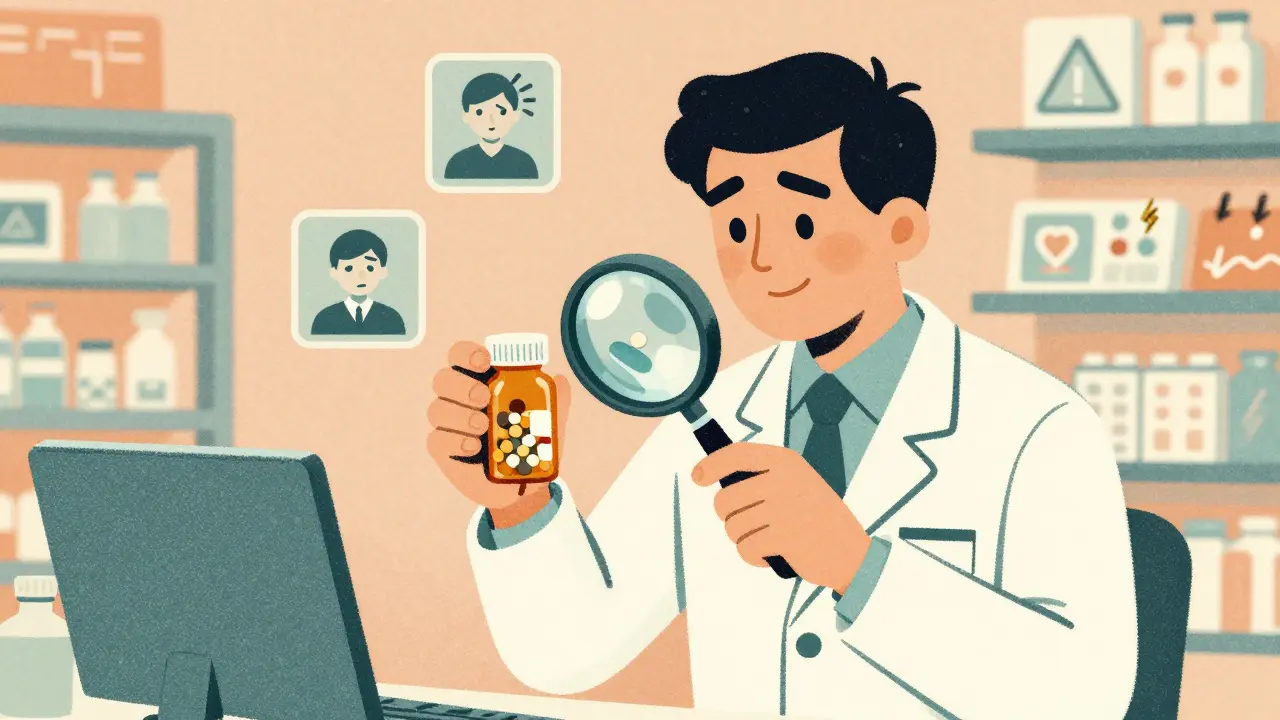
Every day, pharmacists dispense millions of generic drugs. In fact, generic drugs make up 90% of all prescriptions filled in the U.S. They’re cheaper, widely available, and often just as effective as brand-name versions. But what happens when a generic drug doesn’t work the way it should? When a patient gets sick after switching from one generic to another? When the same medication suddenly stops controlling seizures or blood pressure? That’s where the pharmacist’s responsibility begins.
Why Pharmacists Are on the Front Line
Pharmacists are the last healthcare professionals a patient interacts with before taking a medication. They see the patient’s full history, know what they’ve been taking, and can spot changes that others miss. A patient might say, “This new pill makes me dizzy,” or “My blood pressure spiked after I got my refill.” These aren’t just complaints-they’re red flags.
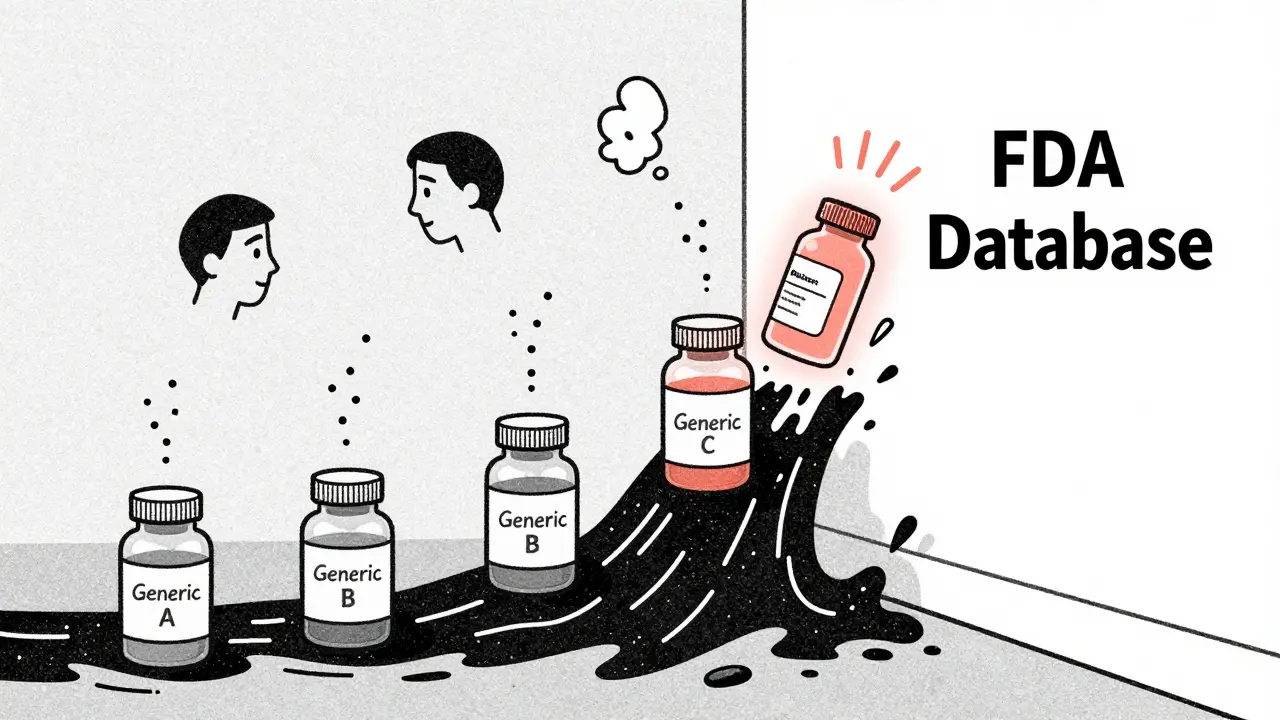
Unlike doctors who prescribe, or patients who take, pharmacists see patterns. One patient reports nausea after switching to Generic A. Then another. Then three more. That’s not coincidence. That’s a signal. And the FDA needs to hear it.
The U.S. Food and Drug Administration (FDA) doesn’t require pharmacists to report adverse events, but it strongly encourages it. The agency’s MedWatch program exists to catch problems that clinical trials miss. Generic drugs go through an abbreviated approval process. They’re tested for bioequivalence-meaning they release the same amount of active ingredient at the same rate as the brand. But real-world use? That’s different. Patients get different fillers, coatings, or manufacturing batches. Sometimes, those differences matter.
What Counts as a Problem Worth Reporting?
Not every side effect needs a report. The FDA defines serious adverse events as those that are:
- Life-threatening
- Result in hospitalization
- Cause permanent disability
- Lead to congenital anomalies
- Require medical intervention to prevent lasting harm
But there’s another category that’s unique to generics: therapeutic inequivalence. This happens when a generic drug works differently in practice-even though it meets FDA’s lab standards. A patient on a stable dose of generic levothyroxine suddenly develops fatigue, weight gain, or heart palpitations after switching brands. Or a patient with epilepsy has a seizure after a refill from a different manufacturer. These aren’t side effects. They’re signs the drug isn’t doing what it’s supposed to.
The FDA added therapeutic inequivalence as a reportable issue in 2015. Since then, reports mentioning it have jumped from 12,450 in 2015 to over 28,000 in 2022. And guess who’s noticing these patterns? Pharmacists. But only 3% of all reports come from them.
The Reporting Gap: Why So Few Pharmacists Report
Here’s the uncomfortable truth: most pharmacists don’t report. A 2022 study in the Journal of the American Pharmacists Association found that only 2.3% of adverse event reports submitted to the FDA came from pharmacists-even though they dispense 75% of all prescriptions, most of them generic.
Why?
- Lack of time (68.4% of pharmacists cite this)
- Uncertainty-Is this really the drug’s fault? Or is it the patient’s other meds? Or just bad luck?
- Confusion over manufacturer-The pill bottle says “Generic A,” but the pharmacy’s supplier might have switched brands without telling anyone. The pharmacist doesn’t know which company made it.
- No clear definition-What exactly counts as therapeutic inequivalence? The FDA says “a clinical response different from expected,” but that’s vague.
There’s also a legal blind spot. In 2011, the Supreme Court ruled in PLIVA v. Mensing that generic manufacturers can’t be sued for failing to update warning labels. Why? Because federal law forces them to use the same label as the brand-name drug. That means they can’t warn patients about new risks-even if they know about them. So, who’s left to speak up? Pharmacists.
What You Need to Report: The Must-Have Details
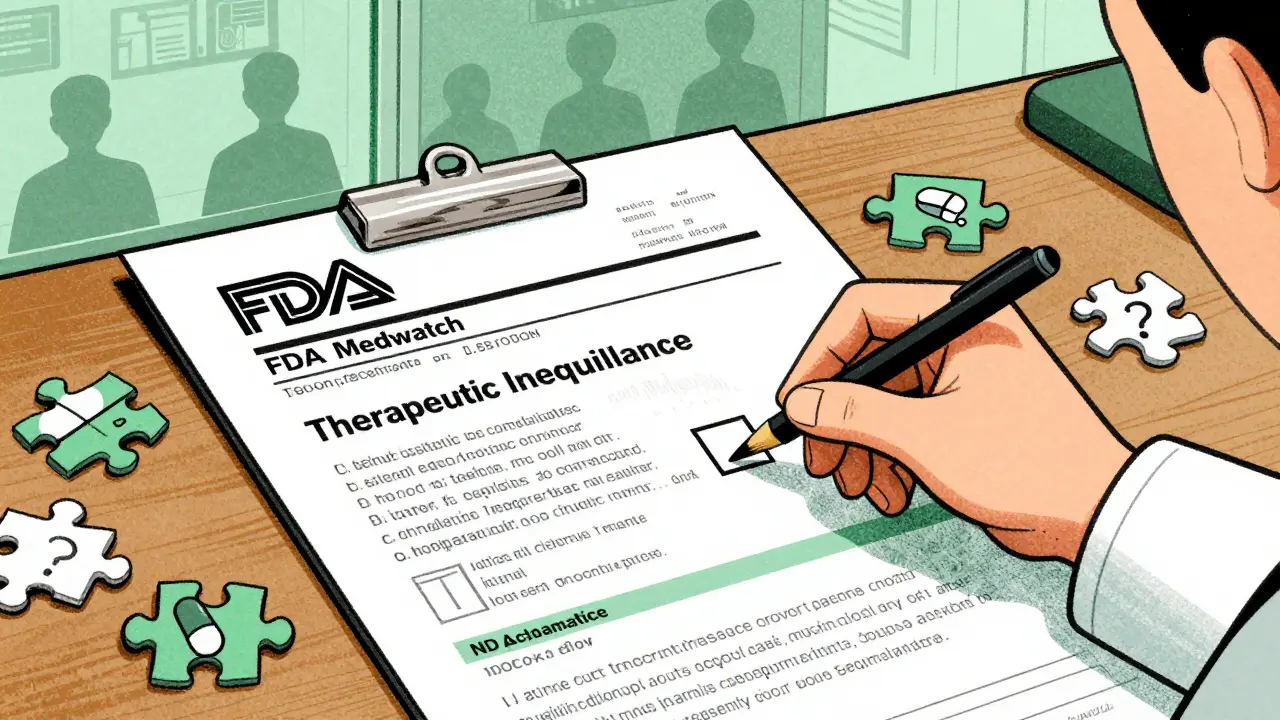
Reporting isn’t complicated, but incomplete reports get ignored. The FDA needs four things:
- An identifiable patient (age, gender, initials-no full name needed)
- The suspect drug (exact name, dose, formulation)
- The adverse event (what happened, when, and how severe)
- An identifiable reporter (your name, license number, pharmacy)
Don’t just write “patient had a reaction.” Be specific:
- “68-year-old female, history of atrial fibrillation. Switched from Brand X to Generic Y (NDC: 54868-0445-01, Lot #B729). Within 48 hours, heart rate dropped to 42 bpm, required emergency pacing.”
- “32-year-old male, epilepsy. Generic levothyroxine changed from Manufacturer A to Manufacturer B. Seizure frequency increased from 1/month to 3/week. No other changes in meds or lifestyle.”
Include the National Drug Code (NDC), lot number, and manufacturer name. The FDA’s updated MedWatch Form 3500 (version 4.1, released Jan 2023) has a specific checkbox for “generic drug concern.” Pick the right category: therapeutic inequivalence, manufacturing defect, or labeling error.
State Laws and Professional Standards
Federal law doesn’t force you to report. But some states do.
California, Illinois, Massachusetts, and New York have mandatory reporting rules for serious adverse events. The California State Board of Pharmacy’s 2022 Standard of Care Report says pharmacists “must maintain a system for identifying, documenting, and reporting adverse drug reactions.”
Even if your state doesn’t require it, professional guidelines do. The American Society of Health-System Pharmacists (ASHP) says adverse event reporting is a “fundamental professional responsibility.” The Institute for Safe Medication Practices (ISMP) includes it in their 2023 Medication Safety Self Assessment. Pharmacies scoring below 75% on reporting are flagged for “significant safety concerns.”
And here’s the kicker: pharmacists who report therapeutic inequivalence are being heard. The FDA’s Therapeutic Equivalence Working Group, formed in 2019, has reviewed 147 generic products based on pharmacist reports. Twelve of those led to direct communications to prescribers and patients.
How to Report: Simple Steps
It takes less than 15 minutes.
- Go to FDA’s MedWatch website (or download Form 3500)
- Fill in patient info (no full name-use initials or age/gender)
- Enter the drug: name, dose, NDC, lot number, manufacturer
- Describe the event: what happened, when, severity, outcome
- Check “generic drug concern” and pick the subtype
- Submit. You can do it online or by fax.
For serious events, report within 15 days. For non-serious but unusual events, report anyway. The FDA says: “Even if you’re not sure, report it.”
Why Your Report Matters
A 2023 study in JAMA Internal Medicine found that 63% of potential safety signals for generic drugs were first spotted by pharmacists who noticed patterns across multiple patients. One pharmacist in Ohio reported 12 cases of unexplained hypotension after switching to a new generic version of lisinopril. The FDA investigated. Turns out, a new filler was causing unexpected absorption issues. The batch was recalled.
Without pharmacist reports, those signals stay hidden. Manufacturers don’t report because they’re legally blocked from updating labels. Doctors don’t know what the patient actually took. Patients don’t know how to report. Pharmacists are the only ones who see the full picture.
Every report adds to the data. More reports mean faster detection. Faster detection means fewer people get hurt.
What You Can Do Today
- Keep a log of any unusual reactions after generic switches-even if you think it’s unrelated
- Ask patients: “Has anything changed since you switched to this version?”
- Check the lot number on the bottle. Write it down.
- Use the FDA’s free MedWatch training module (Module 4: Reporting for Healthcare Professionals)
- Make reporting part of your workflow. Add a checkbox to your patient counseling form: “Any new side effects since last refill?”
You don’t need to be a hero. You just need to be consistent. One report might not change anything. But 100? 1,000? That’s how safety systems improve.
The system isn’t perfect. But you’re the missing piece.
Do pharmacists have to report generic drug problems by law?
No, federal law does not require pharmacists to report adverse events or generic drug problems. However, the FDA strongly encourages reporting through the MedWatch program, and some states-like California, Illinois, Massachusetts, and New York-have made it mandatory for serious events. Professional organizations like ASHP and ISMP also consider it a core ethical responsibility.
What kind of generic drug problems should I report?
Report serious adverse events-those that are life-threatening, cause hospitalization, disability, or require medical intervention. Also report therapeutic inequivalence: when a generic drug doesn’t work the same way as the brand or previous generic version, even if lab tests say it’s bioequivalent. Examples include seizures returning after a switch, blood pressure spiking, or thyroid levels becoming unstable without other changes.
How do I know which manufacturer made the generic drug?
Check the NDC number on the prescription label. The NDC includes the manufacturer code. You can look it up on the FDA’s NDC Directory online. If the label doesn’t list the manufacturer, call your wholesaler or pharmacy distributor. Always document the lot number and manufacturer name in your records-even if you’re not reporting yet.
Can I report anonymously?
Yes, you can report without giving your name. But the FDA encourages including your contact information because they may need to follow up for more details. You can use your pharmacy’s name and license number instead of your personal name. Anonymous reports are accepted but are less useful for investigation.
What if I report and nothing happens?
Don’t assume nothing happened. The FDA reviews every report. Many safety signals are only detected after dozens of similar reports pile up. A single report might not trigger an immediate recall, but it adds to the evidence. The FDA’s Therapeutic Equivalence Working Group has reviewed over 140 generic products based on pharmacist reports, leading to 12 direct safety communications to providers. Your report matters-even if you don’t see immediate results.
Comments
Kerry Howarth
Just reported my third case this month. NDC, lot number, symptoms-all documented. Took 12 minutes. FDA doesn’t care if you’re busy. Patients do.
January 2, 2026 AT 19:37
Brittany Wallace
It’s wild how we’re the only ones who see the full picture-patients walk in, pick up their meds, and leave. But we’re the ones who notice the tremor, the fatigue, the silence where there used to be laughter. We’re the quiet witnesses.
And yet, we’re told to ‘just dispense.’
Maybe the system doesn’t need more rules.
Maybe it just needs more of us to speak up.
🙂
January 4, 2026 AT 18:33
Liam Tanner
For those wondering how to start: I added a checkbox to my counseling form: 'Any changes since last refill?'
Simple. Non-intrusive. Now I catch 3-4 cases a week I’d have missed before.
Documentation is half the battle. Reporting is the other half.
January 6, 2026 AT 17:39
Palesa Makuru
Oh please. You think your little report is going to change anything? The FDA’s got a backlog longer than my last shift. And let’s be real-most of these ‘therapeutic inequivalences’ are just patients being dramatic or non-compliant.
Meanwhile, I’m running on 4 hours of sleep and 2 coffee shots. Do you really think I’m going to fill out a 15-minute form for a guy who says ‘this pill tastes weird’?
January 8, 2026 AT 09:35
Hank Pannell
Let’s deconstruct the epistemological framework here: bioequivalence ≠ therapeutic equivalence. The FDA’s approval paradigm is rooted in pharmacokinetic metrics-Cmax, AUC, t½-but clinical outcomes are emergent properties of complex biological systems.
When a patient’s TSH fluctuates 30% after a generic switch, despite identical lab parameters, we’re not observing ‘side effects’-we’re witnessing system-level failure in drug delivery dynamics.
And yet, the MedWatch form doesn’t have a field for ‘microstructural excipient variance.’
We’re fighting a regulatory architecture designed for the 1980s with 2024 data. The gap isn’t in awareness-it’s in ontology. We need a new taxonomy for therapeutic failure.
Until then? Report anyway. Even if it’s noise. Noise is data waiting for a pattern.
January 8, 2026 AT 19:54
Sarah Little
Just checked my pharmacy’s dispensing logs. Last week, 17 patients got Generic Y for levothyroxine. 5 came back with palpitations. 3 said their meds ‘just don’t feel right.’
I didn’t report any of them.
Why? Because I don’t know which manufacturer made the batch. The label says ‘Generic Y.’ The invoice says ‘ABC Pharma.’ The FDA’s NDC directory says ABC Pharma doesn’t make levothyroxine.
So who’s lying? The wholesaler? The label printer? Me?
Reporting requires certainty. We don’t have it.
January 9, 2026 AT 00:21
innocent massawe
Here in Nigeria, generics are all we have. No brand names. No choices. If the pill works, you take it. If it doesn’t, you pray.
I wish we had a system like this. Maybe then, someone would listen when a child stops sleeping after a new batch.
Thank you for speaking up. We need more of this.
🙏
January 10, 2026 AT 03:20
veronica guillen giles
Oh wow. So now pharmacists are superheroes? You’re not a doctor. You’re not a researcher. You’re the person who hands out pills and says ‘take with food.’
But sure, let’s put the entire burden of drug safety on the guy who’s being yelled at because his insurance won’t cover the brand.
Meanwhile, the manufacturers? They’re off sipping margaritas in Bermuda.
Pathetic.
January 11, 2026 AT 13:57
erica yabut
Let’s not sugarcoat this: the FDA’s MedWatch program is a dumpster fire wrapped in a PowerPoint. You report a case? It vanishes into the void. You report 10? Still nothing. You report 100? Maybe a footnote in a quarterly report no one reads.
Meanwhile, the same generic manufacturers keep recycling the same toxic fillers-microcrystalline cellulose laced with trace aluminum, anyone?-and we’re supposed to be grateful they’re ‘bioequivalent’?
This isn’t safety. It’s corporate negligence dressed in regulatory jargon.
And you? You’re just the janitor cleaning up the mess while they charge you $12 for a bottle of pills.
Report if you must. But don’t pretend it matters.
January 12, 2026 AT 03:25
Vincent Sunio
There is a fundamental flaw in the premise of this article. The notion that pharmacists are uniquely positioned to detect therapeutic inequivalence assumes a level of clinical competence and longitudinal patient tracking that is, in practice, non-existent in community pharmacy settings.
Pharmacists are not diagnosticians. They are dispensers. The onus for clinical evaluation rests with the prescriber. To suggest otherwise is a dangerous overreach of professional scope.
Furthermore, the FDA’s own data shows that 89% of adverse event reports contain insufficient information to establish causality. To encourage reporting without standardized diagnostic criteria is to invite noise, not signal.
Professional responsibility does not equate to administrative burden.
Recommendation: Repeal state mandates. Reinforce prescriber accountability. And cease the romanticization of pharmacists as pharmacovigilance frontline operatives.
January 14, 2026 AT 01:56