
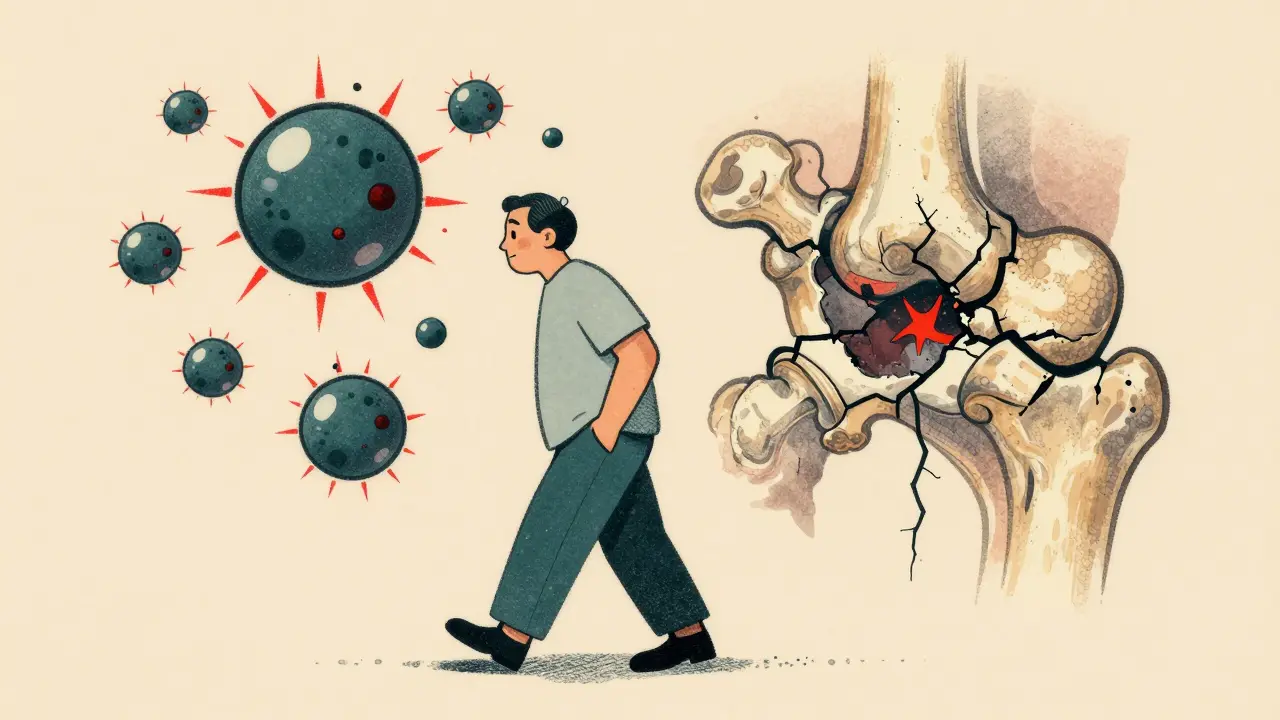
When your hip starts hurting with every step, it’s not just about aging. For many people over 50, especially those carrying extra weight, the real culprit is osteoarthritis of the hip-a slow, grinding breakdown of the cartilage that cushions the joint. Unlike knee osteoarthritis, where weight loss is often seen as a clear fix, hip OA has been more confusing. Some studies say losing weight helps. Others say it doesn’t. So what’s the truth? And if it does help, how much weight do you actually need to lose to feel better?
Why Your Hip Hurts (And Why Weight Matters)
Your hip joint is built like a ball-and-socket. The ball (top of the thigh bone) fits into a cup (part of the pelvis), both lined with smooth cartilage that lets them glide without friction. Over time, that cartilage wears down. Bone starts to rub on bone. Bone spurs form. Inflammation creeps in. The result? Pain that gets worse with activity, stiffness in the morning, and difficulty walking even short distances.
Obesity doesn’t just add pressure-it changes how your body works. Fat tissue isn’t just storage. It releases chemicals that fuel joint inflammation. And every extra pound puts more stress on your hip. For every pound of body weight, your hip joint experiences about 3 to 4 pounds of force during walking. That means someone who weighs 220 pounds instead of 170 pounds is putting an extra 150 to 200 pounds of pressure on that joint with every step.
The Evidence: Does Weight Loss Really Help Hip OA?
Here’s where things get messy. For knee osteoarthritis, the link between weight loss and pain relief is solid. Lose 10% of your body weight? Pain drops. Function improves. It’s textbook. But for the hip? The data isn’t as clean.
A 2023 randomized trial published in PubMed compared two groups: one on a very-low-calorie diet plus exercise, and another doing exercise only. After six months, the group that lost more weight didn’t report significantly less hip pain. That led NEJM Journal Watch to declare, “Osteoarthritis of the Hips Is Unaffected by Weight Loss.” It sounded definitive.
But wait. That same study followed participants for a full year. By month 12, the group that lost weight showed clear improvements-not just in pain, but in how well they could walk, climb stairs, and do daily tasks. The benefit was delayed. Not absent.
Meanwhile, a major 2024 study in Nature looked at 65 adults with hip OA and obesity. Those who lost more than 10% of their body weight saw a 31% improvement in hip-related quality of life. Pain scores dropped. Stiffness eased. Even their ability to play sports or stay active improved. The bigger the weight loss, the better the outcome. And it wasn’t just a little improvement-it was clinically meaningful.
So why the contradiction? One theory: the hip joint is deeper and more stable than the knee. It doesn’t bear weight the same way. That means the mechanical stress from extra pounds might not be the whole story. Inflammation from fat tissue could play a bigger role. That’s why losing weight might not fix pain overnight, but it still changes the environment inside the joint over time.
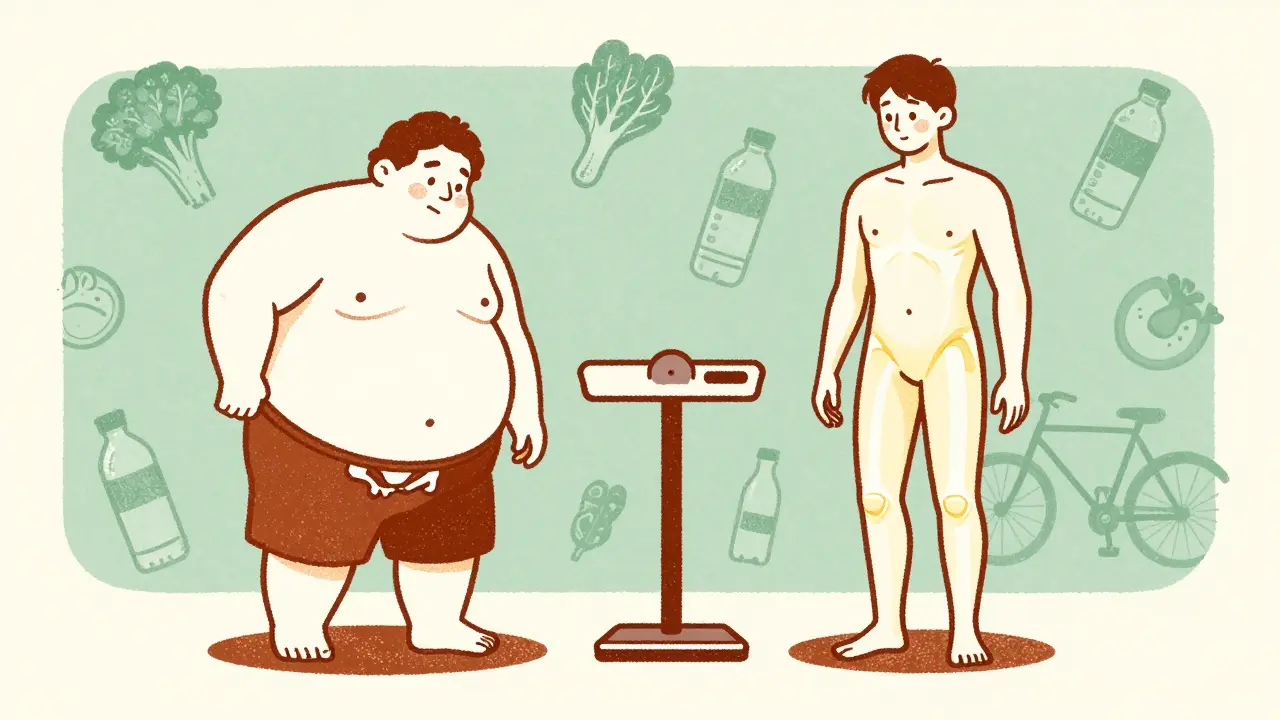
How Much Weight Should You Lose?
Most guidelines say lose at least 5%. That’s based on knee OA research. But for the hip? The evidence points higher.
- 5% weight loss: May help a little, but often not enough to make a real difference in hip OA symptoms.
- 7-10% weight loss: This is where most people start feeling better. The Nature study showed the biggest gains happened here, especially in quality of life and function.
- 10-20% weight loss: No additional benefit beyond 10% in most cases. You don’t need to become skinny. Just get out of the obese range.
Australia’s Osteoarthritis Healthy Weight For Life (OAHWFL) program, originally designed for knee OA, was adapted for hip OA. It targets 7-10% weight loss over 18 weeks using structured diet plans and weekly exercise sessions. Participants who finished the program saw improvements in pain and mobility that lasted over a year. The key? Consistency. Not speed.
What Works: Diet, Exercise, and How to Stick With It
You can’t just starve yourself and hope your hip gets better. You need the right mix.
Diet: Focus on Real Food
Low-carb diets have shown strong results in studies. A 2023 review in the Journal of Metabolic Health found that people who lost 10-20% of their weight using low-carb eating plus movement had better outcomes than those losing less than 5%. Why? Lower carbs often mean fewer processed foods, less sugar, and reduced inflammation.
But you don’t need to go keto. Just cut out sugary drinks, refined carbs (white bread, pastries), and fried foods. Eat more vegetables, lean protein, beans, nuts, and whole grains. Drink water instead of soda. Simple changes, done daily, add up.
Exercise: Protect the Joint, Not Just Burn Calories
Walking is good. Swimming is better. Cycling on a stationary bike? Even better. Why? These activities strengthen the muscles around your hip without pounding the joint. You want to build strength in your glutes, quads, and core-not just lose weight.
A 2012 study of 35 people with hip OA found that after eight months of combined diet and exercise, participants saw a 32.6% improvement in physical function. They could walk farther, climb stairs easier, and stand longer without pain. The exercise wasn’t intense. It was consistent: 30 minutes, 3-4 times a week.
Avoid high-impact sports like running or jumping. Stick to low-impact options. Tai chi and yoga are great too-they improve balance, which reduces fall risk, and help with joint awareness.
Support Matters
People who succeeded in losing weight for hip OA didn’t do it alone. They had coaching, meal plans, and weekly check-ins. Telehealth programs now offer this. A dietitian helps you adjust portions. A physiotherapist designs a safe exercise routine. A support group keeps you motivated.
One big reason people drop out? They feel discouraged early on. If your pain doesn’t improve in the first month, you might think it’s not working. But the data shows: benefits take time. Six months in, you’ll likely feel better. Twelve months? Even more.
What About Weight Loss Medications or Surgery?
Weight loss drugs like semaglutide (Wegovy) or tirzepatide (Zepbound) are approved for people with BMI over 30 who haven’t succeeded with lifestyle changes. They’re not magic pills-they work best when paired with diet and movement. And they’re not first-line. Doctors usually wait until you’ve tried for six months with lifestyle changes.
Surgery? Total hip replacement is highly effective. But it’s not a weight loss solution. If you’re overweight, you’re more likely to have complications, need revision surgery, or wear out the implant faster. Losing weight before surgery improves outcomes. Losing weight after? It helps you recover faster and stay active longer.
The Bottom Line
Yes, weight loss helps with hip osteoarthritis-even if it’s not as dramatic as with knee OA. You don’t need to lose 50 pounds. You don’t need to be thin. But if you’re carrying extra weight, losing 10% of it could mean the difference between struggling to get out of a chair and walking to the store without pain.
The goal isn’t perfection. It’s progress. Start with one change: swap soda for water. Add a 15-minute walk three times a week. Get a food journal and track what you eat for a week. Small steps build momentum.
And remember: your hip joint doesn’t just need less weight on it. It needs less inflammation. Less stress. More movement. More strength. Weight loss gives you all three.
Comments
Christina VanOsdol
I lost 12% of my body weight last year and my hip pain? Gone. Like, *gone*. 🎉 I used to need a cane to walk to the mailbox. Now I hike. I didn’t even realize how much my hips were screaming until they stopped. Low-carb + walking 3x/week. That’s it. No magic. Just consistency. Also-yes, inflammation is REAL. My CRP levels dropped like a rock. 💥
February 23, 2026 AT 04:16
Brooke Exley
Y’all, I’m so proud of you. Seriously. This isn’t about being skinny. It’s about reclaiming your life. One step. One meal. One day at a time. You don’t have to crush it. Just show up. 🌱 I’ve seen people go from barely able to tie their shoes to dancing at their grandkid’s wedding. It’s not about the number on the scale-it’s about the joy you get back. You’re already winning by reading this. Keep going. I believe in you. 💪❤️
February 24, 2026 AT 22:03
Alfred Noble
so i read the study again and honestly the 12 month data is the real deal. i lost 11% and my pain didn’t drop till month 8. i thought it wasn’t working. then one day i realized i’d walked to the store without thinking about it. weird. also-don’t ignore the muscle stuff. glutes are everything. my PT said if you don’t strengthen the hip rotators, you’re just carrying weight around like a backpack. oof. 🤷♂️
February 26, 2026 AT 11:40
Matthew Brooker
I’ve been doing this for 18 months. Started at 240 lbs. Now I’m 195. I didn’t lose weight to fix my hip-I lost it because I wanted to play with my niece without gasping. The hip pain? It faded slowly. But the energy? The ability to stand up from the couch without groaning? That came first. And honestly? The diet stuff is easier than people say. Cut out soda. Add veggies. Walk after dinner. That’s it. No fancy plans. Just habits. You don’t need to be perfect. Just present.
February 27, 2026 AT 15:58
Emily Wolff
This article is dangerously oversimplified. The Nature study had a sample size of 65. That’s not a population. It’s a focus group. And ‘clinically meaningful’ is a buzzword used to sell supplements. Real data? The Cochrane review says no significant effect on hip OA pain with weight loss. Period. Stop giving false hope.
February 28, 2026 AT 02:55
Lou Suito
You’re all missing the point. Weight loss doesn’t fix hip OA. It just makes you less of a burden on the system. The real issue? The pharmaceutical industry. They don’t want you to know that a 15-minute walk and some broccoli beats a $1000/month drug. And don’t get me started on telehealth coaches-they’re just glorified salespeople. I lost 15% by eating like my grandma: no processed crap, no sugar, no lies. You don’t need a program. You need discipline.
March 1, 2026 AT 01:10
Joseph Cantu
They don’t want you to know this-but fat isn’t the enemy. The government is. The FDA. Big Pharma. They profit off your pain. They push weight loss because it’s easier than fixing the real problem: inflammation from processed seed oils and glyphosate in your food. I lost 20% on a carnivore diet. My hip pain vanished. But they’ll call me a ‘conspiracy theorist.’ LOL. Wake up. The system is rigged. And your hip? It’s just collateral damage.
March 2, 2026 AT 04:43
Lisandra Lautert
The study didn’t show statistically significant pain reduction at six months. That’s it. End of story. You’re conflating function with pain. They’re not the same. And ‘quality of life’ is a subjective metric. I’ve seen too many people waste years on this. Save yourself. Get the hip replacement. It’s better than starvation.
March 4, 2026 AT 03:41
Cory L
I was skeptical. Then I did the 7-10% thing. Took me 7 months. Didn’t track calories. Just ate slower. Stopped eating in front of the TV. Walked after dinner. No gym. No shakes. And one day-I stood up from the floor without using my hands. That’s when I knew. It’s not about weight. It’s about movement. Your body remembers how to move. You just gotta give it a chance.
March 4, 2026 AT 20:26