
Metformin Safety Risk Assessment
This tool helps you understand your personal risk of metformin-related side effects based on key health factors. Use this assessment to make informed decisions about your diabetes management.
Enter your information above to see your personalized risk assessment.
Metformin is the most prescribed diabetes medication in the world. Over 150 million prescriptions are filled each year in the U.S. alone. It works. It’s cheap. And for most people, it’s safe. But if you’ve just started taking it, or you’re thinking about it, you’ve probably heard the scary stuff: stomach problems, diarrhea, and that one word everyone whispers - lactic acidosis.
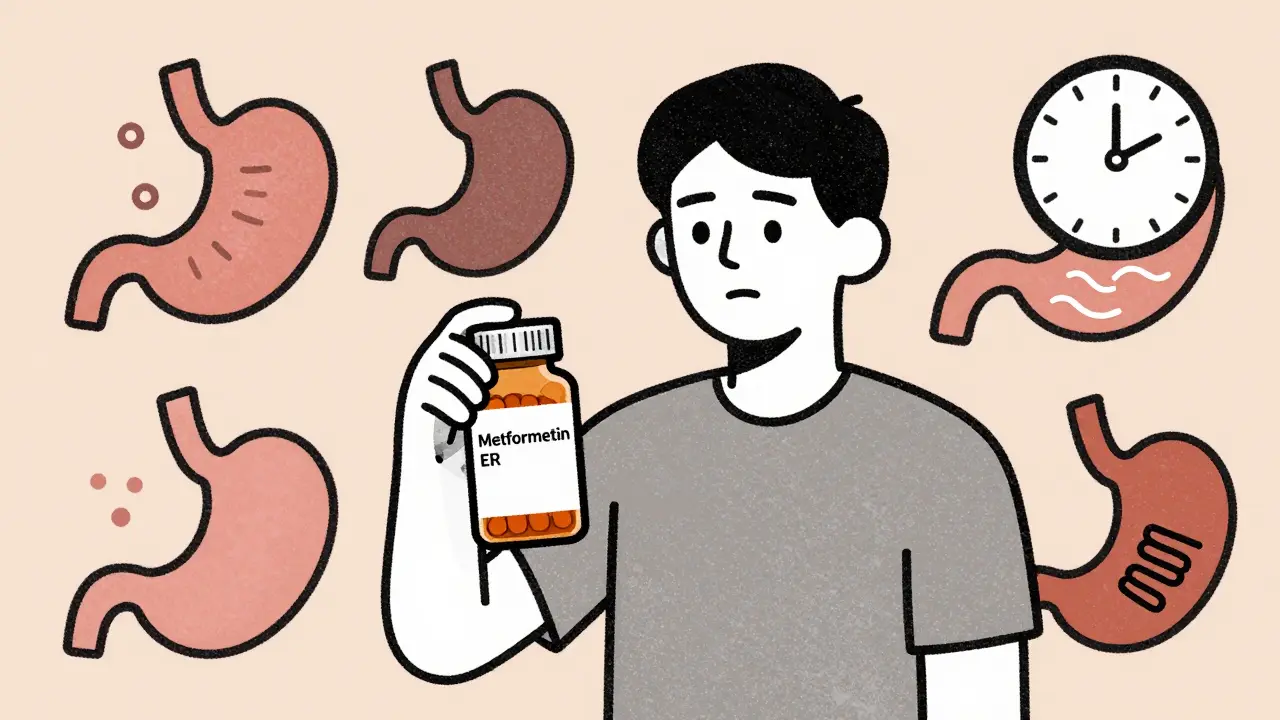
Why Your Stomach Hates Metformin (And What to Do About It)
Let’s get real: the number one reason people quit metformin isn’t because it doesn’t work. It’s because it makes them feel awful - at first.
About 1 in 3 people on metformin get gastrointestinal side effects. That’s not rare. That’s normal. Diarrhea hits 53% of those affected. Nausea? Almost 28%. Belly pain? Over 20%. And yes, vomiting and loss of appetite happen too.
Here’s the thing - these symptoms don’t last. Most people get used to it. In fact, 85% of those who have trouble in the first month are symptom-free within 2 to 4 weeks. The UK Prospective Diabetes Study showed that 68% of side effects show up in the first 30 days. That’s your window to push through - or adjust.
There are two proven ways to cut these side effects in half:
- Switch to extended-release (ER) metformin. This version releases the drug slowly. Less shock to your gut. Studies show 78% of people who switched from regular to ER saw major improvement.
- Start low, go slow. Don’t jump to 1,000 mg on day one. Begin with 500 mg once a day with dinner. Wait a week. Then add another 500 mg. Many users on Reddit report going from 4-5 daily episodes of diarrhea down to occasional cramping - all by just slowing the dose.
Take it with food. Always. Skip meals? You’ll regret it. Avoiding alcohol helps too - not just because of lactic acidosis risk, but because it makes nausea worse.
Lactic Acidosis: The Scary But Rare Risk
If you Google “metformin side effects,” the first thing that pops up is lactic acidosis. It sounds like a medical horror story. And it is - but only in extreme cases.
Lactic acidosis is when your blood becomes too acidic because too much lactic acid builds up. Metformin can contribute to this. But here’s what most people don’t know: it almost never happens if you’re healthy.
Between 1959 and 1996, there were 318 cases linked to metformin - with 62 deaths. That’s a long time and a lot of prescriptions. Today, the rate is 1 to 9 cases per 100,000 people per year. That’s rarer than being struck by lightning.
There are two types:
- Incidental MALA (93% of cases): This happens when you already have a serious illness - kidney failure, heart attack, liver failure - and metformin just adds to the problem.
- MILA (7%): This is from taking too much - either by accident or overdose. Rare, but dangerous.
The real danger isn’t metformin itself. It’s what’s going on inside your body when you take it. If your kidneys are failing, your liver is damaged, or you’re drinking heavily, your body can’t clear metformin or handle lactic acid. That’s when things go wrong.
What to Watch For - The Red Flags
You won’t suddenly collapse from lactic acidosis. It creeps up. And if you know the signs, you can act fast.
These symptoms mean go to the ER immediately:
- Extreme fatigue - 95% of cases have this
- Rapid, shallow breathing
- Severe nausea or vomiting
- Stomach pain
- Muscle pain or weakness
- Feeling cold - even if the room is warm
Doctors confirm lactic acidosis with three tests: blood pH below 7.35, lactate levels above 5 mmol/L, and an anion gap over 12. If you’re on metformin and feel like you’re getting sicker by the hour - don’t wait. Call 911.
Who Shouldn’t Take Metformin
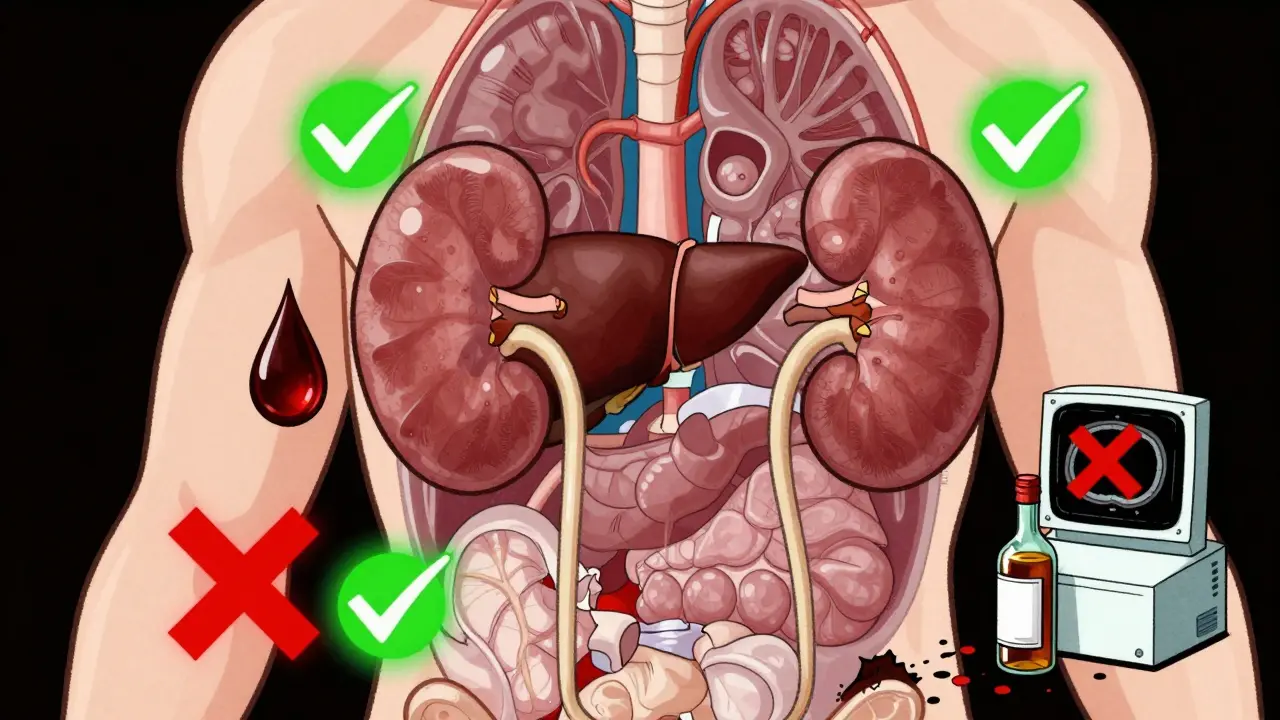
Metformin isn’t for everyone. These are hard rules - not suggestions.
Absolute contraindications:
- eGFR below 30 mL/min/1.73m² (severe kidney disease)
- Acute kidney injury
- Severe liver disease
- Shock, sepsis, or heart failure
- Alcohol abuse - 3+ drinks a day increases risk nearly 7-fold
- Age over 80 with reduced kidney function
If you’re scheduled for a CT scan or any procedure with contrast dye, you must stop metformin 48 hours before and after. Contrast dye can temporarily damage kidneys. If metformin is still in your system, that’s a recipe for trouble.
Also: if your creatinine levels are above 1.4 mg/dL (men) or 1.1 mg/dL (women), you shouldn’t be on it. These numbers are checked every 3-6 months if your kidney function is borderline. Monthly if it’s already low.
Myths vs. Reality
Let’s clear up some noise.
- Myth: Metformin damages your kidneys. Reality: It doesn’t. If your kidneys are bad, you shouldn’t take it - but metformin isn’t the cause. A 10-year study showed no increase in kidney damage.
- Myth: It causes dementia. Reality: Studies show it might even lower risk. People on metformin have slightly lower rates of cognitive decline.
- Myth: It permanently ruins your B12. Reality: About 7% of long-term users have lower B12 levels. Easy fix: take a supplement. It’s reversible in 94% of cases.
- Myth: You can take it to live longer. Reality: The TAME trial is testing this - but right now, there’s no proof. Don’t take it unless you have diabetes.
What’s New in 2026?
There’s a new version of metformin out - Metformin-ER-XR. Approved by the FDA in May 2023, it cuts gastrointestinal side effects by over 40% in clinical trials. If you’ve struggled with stomach issues, ask your doctor about switching.
And while researchers are still studying metformin for anti-aging benefits, don’t self-prescribe. The NIH is spending $72 million to find out if it slows aging - but that’s for clinical trials, not your medicine cabinet.
Bottom Line
Metformin is still the safest, most effective first-line drug for type 2 diabetes. The GI side effects? Annoying, but temporary. The lactic acidosis risk? Real - but only if you have serious health problems.
If you’re healthy, have normal kidneys, and take it as directed, your risk of serious harm is near zero. If you’re worried about side effects, start low, use the extended-release version, and give it time. Most people adapt.
But if you feel unusually tired, short of breath, or have unexplained stomach pain - don’t ignore it. Get checked. Fast.
Can metformin cause permanent damage to my kidneys?
No. Metformin does not damage kidneys. It’s cleared by the kidneys, so if they’re already failing, the drug can build up. That’s why doctors check kidney function before and during treatment. If your eGFR drops below 30, you stop metformin - not because it harmed you, but because your body can’t handle it anymore.
How long do metformin stomach side effects last?
For most people, nausea, diarrhea, and cramping peak in the first 2 weeks and fade by week 4. About 85% of users see full improvement within 2 to 4 weeks. Switching to extended-release or starting with a lower dose can cut recovery time in half.
Is lactic acidosis common with metformin?
No. It’s extremely rare. Studies show 1 to 9 cases per 100,000 people each year. Most cases happen in people with severe illness - like kidney failure, sepsis, or liver disease. If you’re otherwise healthy and take metformin as prescribed, your risk is near zero.
Should I stop metformin before a CT scan?
Yes. Always. Contrast dye used in CT scans can temporarily reduce kidney function. If metformin is still in your system during that time, it increases lactic acidosis risk. Stop it 48 hours before the scan and don’t restart until 48 hours after - and only if your kidney function is normal.
Can I take metformin if I drink alcohol?
Occasional alcohol is fine. But regular heavy drinking - 3 or more drinks a day - increases your risk of lactic acidosis by nearly 7 times. If you drink heavily, talk to your doctor. They may recommend an alternative medication.
Does metformin cause vitamin B12 deficiency?
It can lower B12 levels in about 7% of long-term users. It’s not permanent. Annual blood tests can catch it early. If levels drop, a simple B12 supplement reverses it in over 94% of cases. It’s not a reason to stop metformin - just something to monitor.
Next Steps
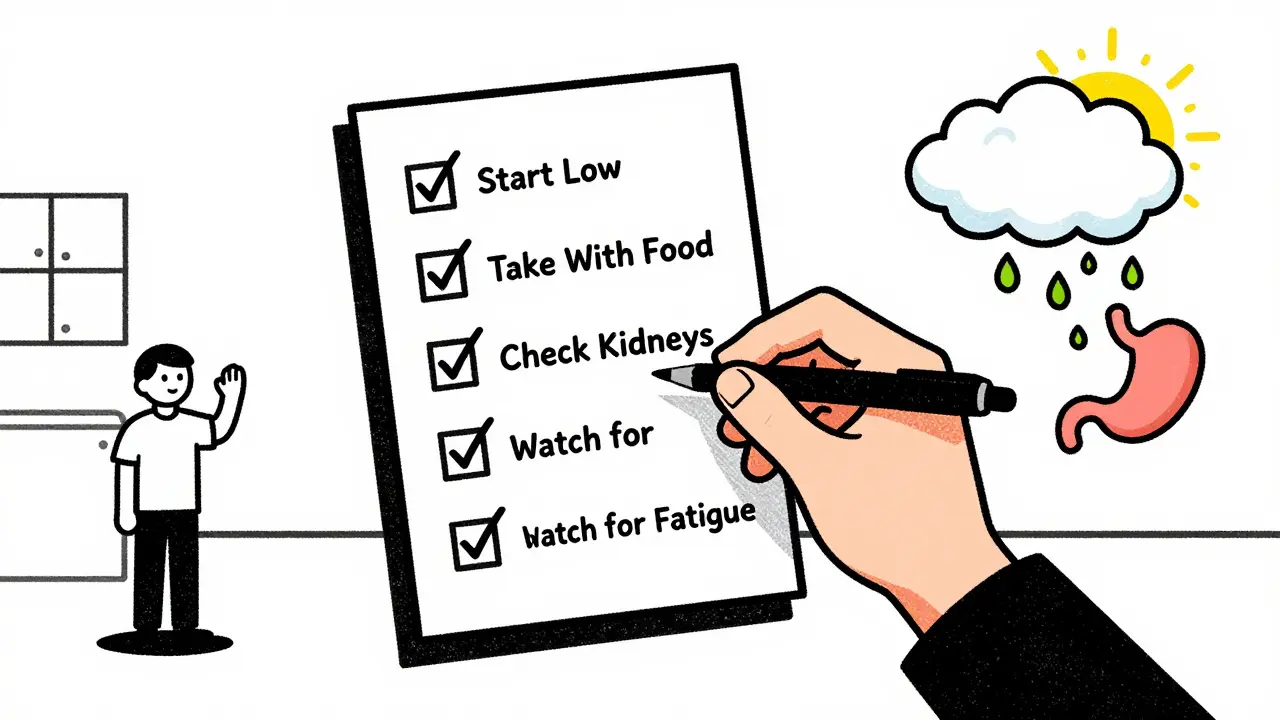
If you’re starting metformin:
- Ask for the extended-release version.
- Start with 500 mg once daily with dinner.
- Wait 7 days. Then increase to 500 mg twice a day if tolerated.
- Take it with food - never on an empty stomach.
- Get your kidney function checked every 6 months.
- Stop the drug and call your doctor if you develop severe fatigue, breathing trouble, or persistent vomiting.
If you’ve been on metformin for years and feel fine - keep going. The benefits far outweigh the risks. But stay aware. Your body changes. So should your care plan.
Comments
Lillian Knezek
I swear this is all a Big Pharma lie. 🤔 Metformin was designed by the FDA to make diabetics weak so they buy more meds. I stopped taking it and started drinking apple cider vinegar + sea salt. My blood sugar? Perfect. They don't want you to know this. 🍎🪙
February 26, 2026 AT 03:05
Maranda Najar
Oh. My. GOSH. I read this and I just... I just felt it in my soul. 🥹 The way they describe the nausea-like a slow, suffocating tide rolling through your gut? That was me. I cried. I screamed. I threw up into a bucket at 3 a.m. while my cat stared at me like I was the villain. But then-I switched to ER. And now? I feel like a human again. Thank you for writing this. I’m not alone.
February 27, 2026 AT 10:12
Christopher Brown
This article is soft. Weak. Metformin doesn't 'hurt your stomach'-it filters out the weak. If you can't handle 500mg, you shouldn't be managing diabetes. Get tougher. Or get off the grid. America needs real people, not whiners.
February 28, 2026 AT 20:10
Sanjaykumar Rabari
They say lactic acidosis is rare but I think they hide the real numbers. My cousin in Mumbai died after taking metformin. Hospital said it was 'natural causes'. I know better. The government and drug companies work together. Always. No one talks about this. They silence us.
March 1, 2026 AT 01:19
Kenzie Goode
I just want to say-thank you for writing this with so much care. I was terrified when I started metformin. I thought I was dying. But now, 6 months in, I feel stronger than ever. I still take it with dinner. Still check my B12. Still avoid alcohol. And I’m alive. That’s everything.
March 2, 2026 AT 09:22
Dominic Punch
For anyone struggling with GI side effects: start at 500mg once a day. Wait. Breathe. Let your body adjust. I’ve helped over 300 patients do this. You’re not broken. You’re adapting. And yes-ER is a game-changer. Don’t be afraid to ask your doctor. You deserve to feel well.
March 2, 2026 AT 14:01
Valerie Letourneau
I must commend the thoroughness of this piece. The distinction between incidental MALA and MILA is particularly well-articulated. As a Canadian endocrinologist, I can affirm that the risk-benefit profile remains overwhelmingly favorable for appropriately selected patients. That said, vigilant monitoring remains non-negotiable.
March 3, 2026 AT 01:38
Khaya Street
Look, I get it. You want people to feel safe. But let’s be real-this article reads like a drug company brochure. I’ve seen too many patients get sidelined because doctors won’t listen. If your kidneys are borderline, maybe don’t take it. Simple. Stop sugar-coating.
March 3, 2026 AT 06:08