
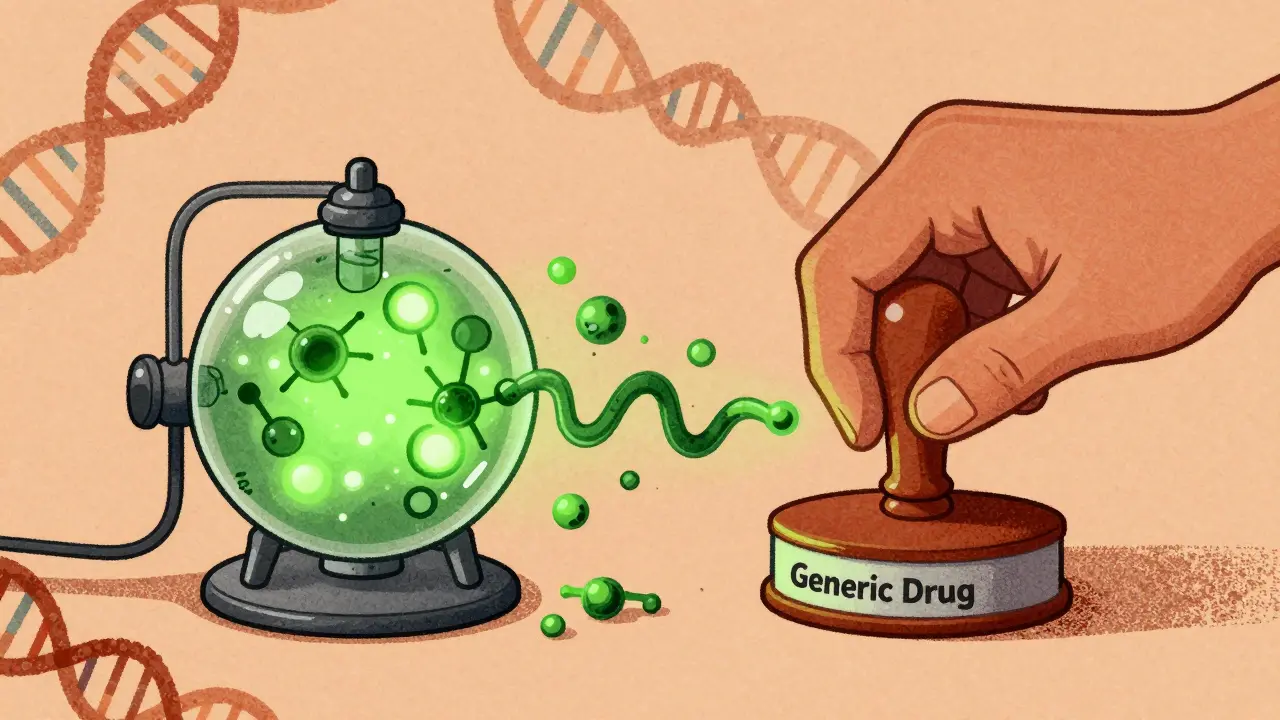
When you think of a generic drug, you probably picture a small, cheap pill that does the same thing as the brand-name version. That’s straightforward. But when it comes to biosimilars, nothing is straightforward. These aren’t just copies of pills-they’re copies of living molecules, made inside living cells. And that changes everything.
The Big Difference: Biosimilars Aren’t Like Generics
A generic aspirin is made from simple chemicals. Mix the right ingredients in a reactor, and you get the exact same molecule every time. It’s like baking cookies from a recipe-same flour, same sugar, same oven, same result. Biosimilars? They’re more like trying to clone a chef’s signature dish… without knowing the recipe, the ingredients, or even what stove they used. The original biologic-say, a drug like Humira or Enbrel-is produced by genetically engineered cells in a bioreactor. These cells are tiny biological factories. They make complex proteins that fold, twist, and attach sugar molecules in ways no chemist can fully control. That’s why you can’t just reverse-engineer a biosimilar the way you would a generic. The molecule itself is huge-up to 1,000 times larger than a small-molecule drug. And even tiny changes in how it’s made can change how it works in the body.The Process Defines the Product
This is the golden rule in biosimilar manufacturing: the process defines the product. That means the way you grow the cells, feed them, control the temperature, and purify the final molecule directly shapes the drug’s structure and function. Even if two labs use the same cell line, differences in the culture media, oxygen levels, or how fast the bioreactor stirs can alter the final product. One batch might have slightly more sugar chains (glycans) attached to the protein. Another might have a slightly different shape. These differences sound tiny-but they can change how long the drug lasts in your bloodstream, how well it binds to its target, or even whether your immune system reacts to it. Think of it like making a handmade ceramic mug. Two mugs might look identical, but if the clay was fired at 1,200°C instead of 1,180°C, one might be more porous, more fragile, or absorb water differently. In biosimilars, those invisible differences matter.Glycosylation: The Silent Killer of Consistency
One of the biggest headaches for manufacturers is glycosylation-the attachment of sugar molecules to the protein backbone. These sugars aren’t just decoration. They affect stability, half-life, and how the immune system sees the drug. The original manufacturer spent years optimizing this. They used a specific cell line, fed it a custom blend of nutrients, controlled pH with precision, and timed harvests to the minute. The biosimilar maker? They have to guess their way there. Even a 5% shift in glycosylation patterns can make a biosimilar behave differently in the body. That’s why regulators demand hundreds of analytical tests-mass spectrometry, chromatography, NMR-to map out every sugar variation. If the biosimilar’s glycan profile doesn’t match the reference drug within strict limits, the whole batch gets rejected.Scaling Up: From Lab to Factory Without Breaking the Molecule
Getting a biosimilar to work in a 50-liter bioreactor is one thing. Getting it to work in a 2,000-liter tank is another. The physics change. Mixing becomes uneven. Oxygen doesn’t distribute the same way. Temperature gradients form. Cells stress out. Protein quality drops. Manufacturers call this the “scale-up cliff.” Many promising biosimilars fail here-not because the science is wrong, but because the factory doesn’t behave like the lab. A small change in agitation speed can cause shear stress that breaks apart delicate protein structures. And it’s not just equipment. Not every facility has the space, power, or budget for large-scale bioreactors. Smaller companies often have to outsource production, adding layers of risk and cost. A single failed batch at commercial scale can cost millions.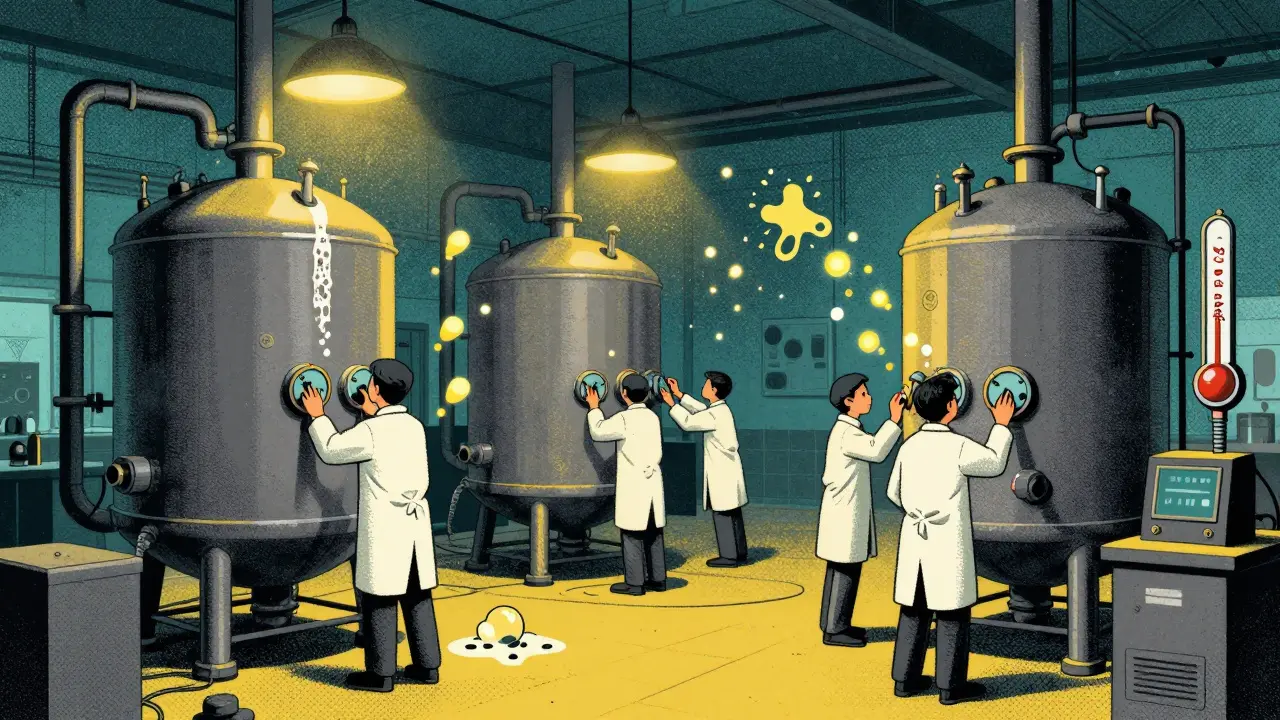
Cold Chain Nightmares
Biosimilars are fragile. They can’t sit in a warehouse like a bottle of ibuprofen. They need to be kept cold-from the moment they’re harvested until they’re injected into a patient. One broken refrigerated truck, one power outage, one mishandled container, and the whole shipment can degrade. That’s why cold chain logistics are a make-or-break part of biosimilar manufacturing. Temperature excursions as small as 2°C can trigger protein aggregation-where molecules clump together and become ineffective or even dangerous. This isn’t theoretical. In 2022, a major biosimilar recall happened because a batch was exposed to mild heat during transport. The product looked fine. Tests showed no contamination. But the protein had subtly changed shape. It was no longer safe.Regulatory Maze: More Than Just Paperwork
Getting a biosimilar approved isn’t like submitting a form for a generic. It’s a multi-year, multi-million-dollar marathon. Regulators like the FDA and EMA require:- Extensive analytical data comparing over 100 quality attributes
- Preclinical studies to show similar biological activity
- Clinical trials proving equivalent safety and efficacy
Technology Is Helping-But It’s Not a Magic Fix
The industry is turning to new tools to fight these challenges. Single-use bioreactors are replacing stainless steel tanks. They eliminate cleaning validation, reduce contamination risk, and let manufacturers switch products faster. That’s huge for small companies trying to stay agile. Process Analytical Technology (PAT) lets them monitor critical parameters in real time-pH, dissolved oxygen, nutrient levels-so they can tweak conditions before a batch goes bad. Automation is cutting human error. Closed systems mean less chance of contamination during filling. Robots handle vials, not people. And AI? It’s starting to help predict which process changes will cause quality issues before they happen. Machine learning models analyze decades of manufacturing data to spot patterns humans miss. But none of this makes biosimilars easy. It just makes them slightly less impossible.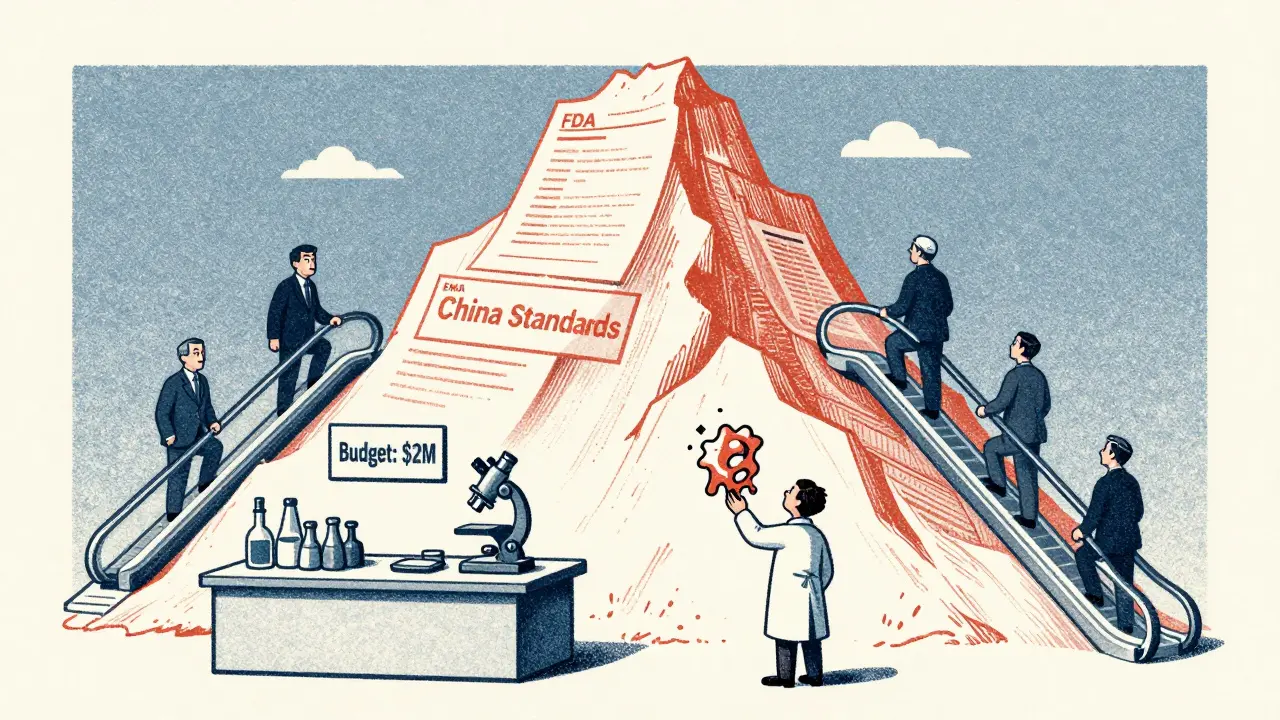
Why Only Big Players Are Winning
The global biosimilars market is expected to hit $58 billion by 2030. Sounds like a gold rush, right? But here’s the catch: only companies with deep pockets, advanced labs, and decades of biologics experience are surviving. The cost to develop one biosimilar? $100 million to $250 million. The time? 7 to 10 years. Smaller firms can’t afford the analytical equipment needed to map glycosylation. They can’t build 10,000-liter bioreactors. They can’t staff teams of 50+ scientists to handle regulatory filings. That’s why the market is consolidating. Big pharma companies are buying up biosimilar startups. Contract manufacturers with scale are becoming the backbone of the industry.The Future: More Complexity, Not Less
The next wave of biosimilars won’t be simple monoclonal antibodies. They’ll be bispecific antibodies, antibody-drug conjugates, fusion proteins-molecules with multiple functions, multiple parts, and multiple points of failure. Each adds another layer of complexity. A bispecific antibody needs two different chains to fold correctly and link together. A drug conjugate needs the toxin attached at just the right spots. One wrong step, and the molecule doesn’t work-or worse, it becomes toxic. The future belongs to manufacturers who treat biosimilars not as copycats, but as new drugs that happen to look like old ones. That means investing in science, not just cost-cutting.Final Thought: It’s Not About Copying. It’s About Matching.
Biosimilars aren’t generics with fancy names. They’re precision-engineered biological products that require the same level of scientific rigor as the original. The goal isn’t to make the same molecule-it’s to make a molecule that behaves the same way in a human body. That’s why manufacturing them is so hard. And why, despite the hype, only a handful of companies have truly cracked the code.Are biosimilars the same as generics?
No. Generics are exact chemical copies of small-molecule drugs, made using standardized reactions. Biosimilars are highly similar-but not identical-to complex biologic drugs made in living cells. Even tiny differences in manufacturing can change how they work in the body.
Why is glycosylation such a big deal in biosimilar production?
Glycosylation-the attachment of sugar molecules to proteins-affects how long a biosimilar lasts in the bloodstream, how well it binds to its target, and whether it triggers an immune response. Even small changes in sugar patterns can make a biosimilar less effective or unsafe. Manufacturers must match the reference product’s glycan profile within strict limits, which requires advanced lab equipment and deep expertise.
Can biosimilars be made cheaper than the original biologics?
Yes-but only after massive upfront investment. While biosimilars cost less to produce at scale than the original biologic, the R&D, regulatory, and manufacturing costs are still extremely high. Most biosimilars are priced 15% to 35% lower than the originator, not 80% like generics, because the production complexity doesn’t allow for the same cost savings.
What’s the biggest barrier to entry for new biosimilar manufacturers?
The biggest barrier is the combination of technical complexity and regulatory burden. You need state-of-the-art analytical labs to prove similarity, massive bioreactors to scale up, and teams of experts to navigate global regulations. Most startups can’t afford this without partnering with big pharma or contract manufacturers.
Are biosimilars safe?
Yes, when properly developed and approved. Hundreds of thousands of patients have used biosimilars safely for over a decade. Regulatory agencies require extensive testing to prove they work the same way as the original. However, because they’re complex, ongoing monitoring for rare side effects is still required.
Comments
Michael Patterson
Man, this post is like a 10-page essay written by a grad student who just found out glycosylation exists. I read it twice and still don’t know if I’m supposed to be impressed or scared. Biosimilars sound like the biological version of trying to recreate your ex’s cooking after they ghosted you-same ingredients, totally different vibe. And don’t even get me started on the cold chain. One power outage and suddenly your $200k batch is just expensive soup. I’m just glad I don’t work in this field. Also, typo: ‘bioreactor’ was spelled ‘bioreactor’ twice. I’m not even mad. I’m impressed.
January 10, 2026 AT 05:07
Priscilla Kraft
This was so well explained 😊 I’ve been trying to understand biosimilars for my job and this finally clicked! The ceramic mug analogy? PERFECT. I work in pharma logistics and the cold chain part hit home-we had a shipment get delayed last winter and the whole thing had to be scrapped. It’s wild how something so tiny-a 2°C spike-can ruin everything. Kudos to the teams grinding through this stuff. We need more clear explanations like this!
January 10, 2026 AT 17:28
Christian Basel
Let’s be real-this is just a glorified case study in why Big Pharma doesn’t want biosimilars to succeed. The regulatory maze? That’s not science-it’s rent-seeking. The ‘process defines the product’ mantra is just corporate doublespeak to justify $200M R&D budgets. PAT? Single-use bioreactors? All just fancy ways to delay generic competition. If you can’t reverse-engineer it, maybe it’s not a drug-it’s a black box. And we all know who owns the keys.
January 10, 2026 AT 21:23
Adewumi Gbotemi
Simple version: Making a copy of a living thing is hard. Like copying a bird’s song by listening to it once. You can get close, but not exact. And if you mess up, people get sick. So yeah, it’s expensive. But good thing someone is trying. We need cheaper medicine.
January 11, 2026 AT 01:35
Jennifer Littler
Reading this made me realize how little I knew about the actual manufacturing side of biologics. I thought biosimilars were just ‘generic biologics’-turns out they’re more like re-creating a symphony with a new orchestra, no sheet music, and half the instruments are broken. The glycosylation part? Mind-blowing. I work in regulatory compliance and even I didn’t grasp how granular the analytics need to be. This isn’t paperwork-it’s forensic science.
January 11, 2026 AT 12:10
Vincent Clarizio
Oh wow. So we’re spending billions to make something that’s ‘very similar’ but not identical… and we call it science? 🤔 I mean, if I tried to clone my dog by feeding another dog the same food and yelling at it the same way, I’d be locked up. But here? We get FDA approval. The whole thing feels like a metaphysical joke: ‘We don’t know how it works, but we know it works… sort of.’ And don’t get me started on AI predicting ‘quality issues’-as if machines can understand the soul of a protein. This isn’t manufacturing. It’s alchemy with a PhD.
January 13, 2026 AT 10:41
Sam Davies
So let me get this straight: you’re telling me we’ve spent 15 years and $200M to make a drug that’s ‘functionally equivalent’… but only if you use the exact same cell line, the exact same stirrer speed, and pray to the god of glycans? And this is considered innovation? I mean, congrats, you’ve turned biology into a 10,000-step IKEA manual written in Sanskrit. The real biosimilar? The one that doesn’t exist: a cheap, simple, reliable version. We’re not making medicine-we’re making art installations with side effects.
January 15, 2026 AT 02:34
Alex Smith
Sam, you’re not wrong-but you’re also missing the point. Biosimilars aren’t about copying. They’re about access. That $200M isn’t wasted-it’s the price of letting a diabetic in rural India get insulin for $20 instead of $200. The ‘alchemy’ you’re mocking? That’s the only thing standing between poverty and survival. Yes, it’s messy. Yes, it’s over-engineered. But it’s working. And before you roll your eyes, ask yourself: who benefits when the only option is the $10k-a-year original? The answer isn’t more sarcasm. It’s more people who care enough to build the damn thing.
January 16, 2026 AT 21:27
Priya Patel
Love this thread!! 😭 I’m from India and my dad’s on a biosimilar for RA. He pays 1/10th of what it’d cost in the US. I cried reading the cold chain part-my aunt’s shipment got delayed once, and they had to rush it with ice packs in a taxi. It’s not perfect, but it’s life-changing. Let’s keep pushing for better, not perfect. And yes, glycosylation is wild… but so is love. We just gotta keep trying.
January 17, 2026 AT 23:23