
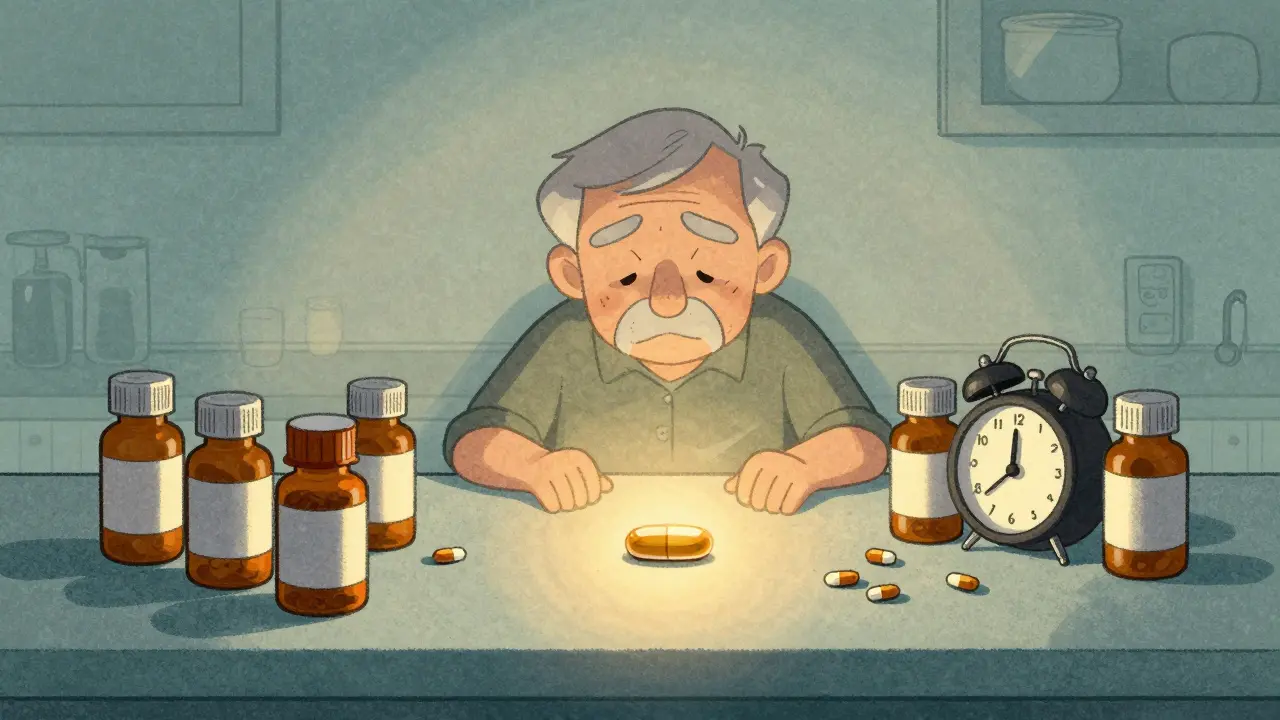
Why Your Medication Schedule Feels Like a Full-Time Job
Imagine waking up at 6 a.m. to take three pills, then again at noon for two more, followed by three more at 6 p.m., and one before bed. That’s eight doses in one day. For many older adults and people managing chronic conditions like diabetes, heart disease, or HIV, this isn’t unusual. It’s exhausting. And it’s why so many people miss doses-even when they know it matters.
The truth? Medication adherence drops sharply as the number of daily doses goes up. Studies show that people taking four or more pills a day are far more likely to skip, mix up, or forget their meds than those on simpler schedules. But here’s the good news: you don’t have to live like this. There are proven ways to cut down the number of times you need to take medicine each day-without losing effectiveness.
How Fewer Doses Actually Help You Stick to Your Plan
It’s not just about convenience. Reducing daily doses directly improves health outcomes. When people take fewer pills at fewer times, they’re more likely to stay on track. One study of over 1,500 older adults found that 41% of their medication regimens could be simplified-meaning they were taking more doses than medically necessary.
Why does this work? Because human behavior doesn’t change just because a doctor says so. We forget. We get busy. We travel. We feel fine and think, “I don’t need this today.” But if you only have to remember to take your meds once a day-say, with breakfast-you’re far more likely to do it. In fact, switching to once-daily dosing can boost adherence by 15% to 30%, especially for conditions like high blood pressure and HIV.
And it’s not just about remembering. Fewer doses mean fewer opportunities for errors. Mixing up morning and evening pills? That’s common when you’re juggling six different bottles. One organizer with four compartments cuts that risk dramatically.
The Four Main Ways to Cut Down Daily Doses
There’s no single fix, but four strategies are backed by solid research and used daily in clinics and pharmacies across the country.
1. Fixed-Dose Combinations (FDCs)
This is when two or more medications are combined into one pill. For example, instead of taking a blood pressure pill and a cholesterol pill separately, you might get them merged into one tablet. About one-third of all simplification efforts use this method.
It works best when the drugs are meant to be taken together anyway. FDCs cut pill count, reduce packaging waste, and make refills easier. But they’re not always possible. If one drug needs to be taken at night and the other in the morning, or if doses don’t match up, combining them isn’t safe or effective.
2. Once-Daily Dosing
Some medications come in extended-release versions that last a full day. Your doctor might switch you from a twice-daily version to a once-daily one. This is common with antidepressants, statins, and antiretrovirals.
But not every drug can be converted. Some have short half-lives-they leave your system too fast. If you stretch the timing too far, the medicine won’t work properly. Always check with your pharmacist before changing timing on your own.
3. Medication Synchronization
This one’s simple: get all your prescriptions due on the same day each month. Instead of running to the pharmacy every week for different meds, you pick them all up at once. It cuts down trips by 60% and prevents gaps in treatment.
Most pharmacies offer this for free if you’re on a maintenance medication plan. Ask your pharmacist to sync your refills. It’s especially helpful if you’re on Medicare or have multiple prescriptions from different doctors.
4. Multi-Dose Compliance Packaging
Think of these as weekly pill organizers, but professionally packed. Each compartment is labeled: Morning, Noon, Evening, Bedtime. You open one section and take everything you need at that time.
Studies show patients using these systems improve adherence by 22% compared to loose pills. For someone with memory issues or a caregiver helping an aging parent, this is often a game-changer. But there’s a catch: it costs extra. Some insurance covers it. Others don’t. Ask your pharmacist about cost and coverage.

What You Need to Do to Get Started
Simplifying your regimen isn’t something you do alone. It takes a team: you, your doctor, and your pharmacist.
- Make a full list of everything you take. Include vitamins, supplements, and over-the-counter meds. Write down the dose and time for each.
- Bring it to your pharmacist. Pharmacists are trained to spot duplication, unnecessary doses, and timing conflicts. They can flag what can be changed.
- Ask your doctor if any meds can be switched. Request extended-release versions or fixed-dose combos. Don’t assume it’s not possible-many doctors don’t know all the newer options.
- Request medication synchronization. Most pharmacies can do this within one visit. Ask if they offer it.
- Try a pill organizer. Start with a simple weekly one from the drugstore. If it helps, ask your pharmacist about professional packaging.
Don’t try to do it all at once. Pick one thing to change first-maybe syncing your refills or switching to a once-daily version of your most bothersome pill.
What Can Go Wrong (And How to Avoid It)
Simplification sounds easy, but mistakes happen. Here are the top three pitfalls:
- Combining meds that shouldn’t be mixed. Some drugs can’t be taken together-even if they’re in the same pill. For example, mixing certain blood thinners with NSAIDs can increase bleeding risk. Always confirm with your pharmacist before combining anything.
- Insurance won’t cover the new version. Extended-release or combo pills are often more expensive. Your insurer might deny coverage or require you to try cheaper options first. Ask your pharmacist to help with prior authorization.
- You think “simpler” means “less important.” Some people stop taking meds they think are no longer needed. If your doctor removes a pill, make sure you understand why. Don’t assume.
One survey found that 42% of patients incorrectly consolidated meds they thought were similar-like taking two different blood pressure pills at the same time. That’s dangerous. Always double-check.
Real Stories: What Works in Real Life
On Reddit, a nurse shared how switching HIV patients to once-daily antiretrovirals dropped missed doses from 12% to 4% monthly. But 30% of patients faced insurance denials for the new pills. That’s the reality: success isn’t guaranteed unless you fight for access.
A caregiver on AgingCare.com said her mother went from 12 separate bottles to one organizer with four compartments. “Her confusion dropped. She started remembering meals, too.” That’s not just adherence-it’s quality of life.
But not everyone has it easy. In a Medicare study, 45% of patients were denied the once-daily versions their doctors recommended. Insurance formularies don’t always align with medical best practices. That’s why it’s critical to have your pharmacist advocate for you.
What’s Changing in 2026
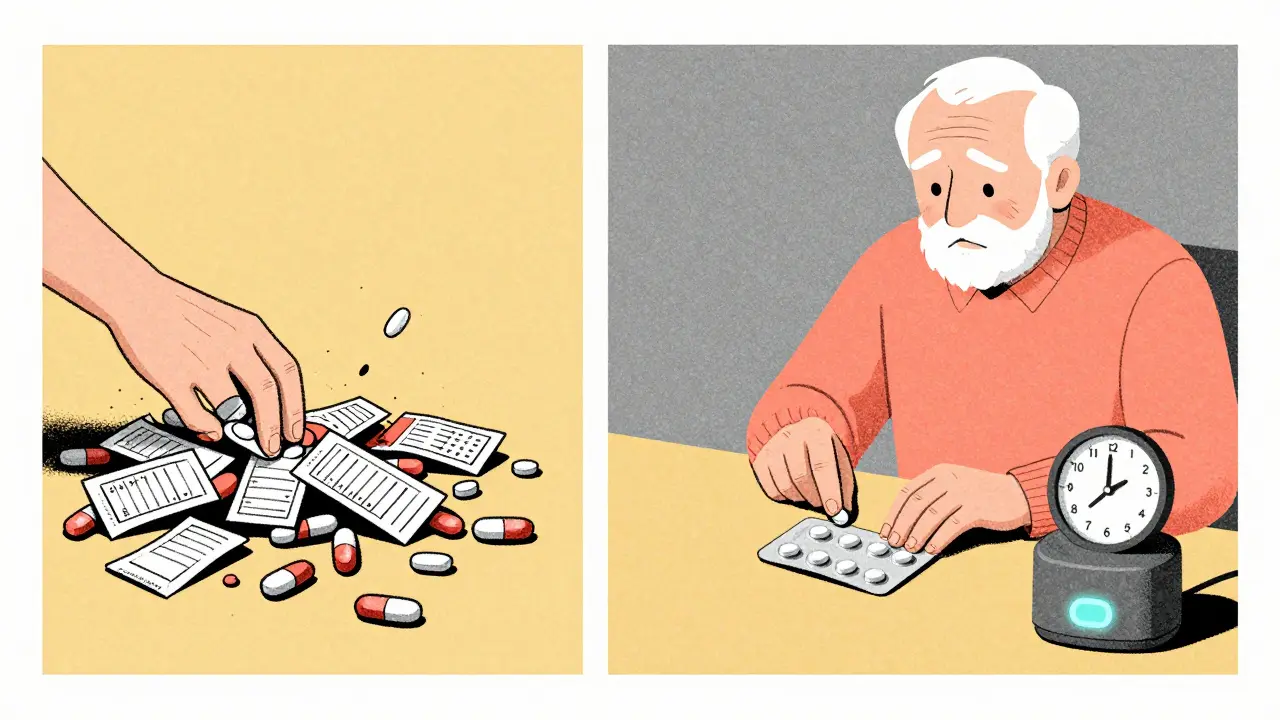
The tools are getting smarter. New AI systems now analyze your entire medication list and suggest simplifications based on drug interactions, half-lives, and even your daily routine. Some pharmacies are testing smart pill dispensers that send alerts to your phone-and even to your care team-if you miss a dose.
Medicare now covers annual medication reviews as part of the Annual Wellness Visit. That means your doctor is supposed to ask about your pill schedule. If they don’t, bring it up. You’re entitled to it.
And the industry is responding. In 2022 alone, the FDA approved 12 new fixed-dose combinations-a 25% jump from 2020. More options mean more chances to simplify.
When Simplification Won’t Work
It’s not magic. Some medications simply can’t be combined or delayed. Diabetic pills like metformin often need to be taken with meals, and some blood pressure drugs must be split across morning and night to control spikes. In those cases, you can’t force simplification.
But even then, you can still reduce complexity. Maybe you can switch from three daily doses to two. Or use a pill organizer to reduce the mental load. The goal isn’t always one pill a day-it’s fewer doses, fewer errors, and less stress.
Final Thought: Your Health Is Worth the Effort
It’s easy to feel overwhelmed. You’ve got appointments, labs, diets, exercise plans-and now this mountain of pills. But simplifying your regimen isn’t about cutting corners. It’s about working smarter. Every dose you remove is one less thing to worry about, one less chance to make a mistake, one more moment of peace.
Start small. Talk to your pharmacist. Ask your doctor. You don’t have to do this alone. And you don’t have to live with a schedule that’s too heavy to carry.
Can I just combine my pills myself?
No. Crushing, splitting, or mixing pills without professional guidance can be dangerous. Some medications are designed to release slowly, and breaking them can cause too much drug to enter your system at once. Others can become inactive or toxic when mixed. Always consult your pharmacist before changing how you take your meds.
Will my insurance pay for a pill organizer or once-daily pills?
It depends. Many Medicare Part D plans cover multi-dose packaging if prescribed by your doctor. Extended-release or fixed-dose combo pills are often covered, but you may need prior authorization. Check your plan’s formulary or ask your pharmacist to verify coverage before switching.
How do I know if my regimen can be simplified?
If you take five or more medications daily, or if you’re taking the same drug more than twice a day, there’s a good chance your regimen can be simplified. A pharmacist can review your list and identify opportunities using tools like the Medication Regimen Complexity Index. Don’t wait for your doctor to bring it up-ask for a review.
Is once-daily dosing safe for everyone?
Not always. Some drugs have narrow therapeutic windows-meaning the difference between an effective dose and a harmful one is small. Others are metabolized quickly and need to be taken multiple times to maintain levels. Your pharmacist will check pharmacokinetics (how your body processes the drug) before recommending any change.
What if my doctor doesn’t know about simplification options?
Many doctors are focused on treating conditions, not managing pill schedules. Bring printed information from your pharmacist or suggest specific alternatives like “Is there a once-daily version of this?” or “Could these two pills be combined?” Most are open to it when you come prepared with options.
Comments
doug b
Been there. Took 8 pills a day for years. Switched to one combo pill for blood pressure and cholesterol, and now I just take two things in the morning. Life changed. No more pill boxes, no more panic when I travel. Pharmacist did the legwork-ask yours.
January 28, 2026 AT 13:10
SRI GUNTORO
People these days think medicine is a game of convenience. You don't get to pick and choose when your body needs its meds. If your doctor prescribed it, take it. No excuses. This 'simplify' nonsense is just another way to avoid responsibility.
January 30, 2026 AT 12:33
Rhiannon Bosse
Ohhh so NOW the pharmaceutical companies are suddenly 'helping' us? 😏 Let me guess-they made a combo pill that costs 3x more and your insurance won't cover it unless you jump through 14 hoops. Classic. They don't want you to be healthy, they want you to be dependent. And don't even get me started on those 'smart pill dispensers'-who's watching your data? NSA? Amazon? The same folks who know you bought toothpaste at 2 a.m.? 🤔
February 1, 2026 AT 06:40
Timothy Davis
Let’s be real-most of these 'simplification' strategies are only viable for people on Medicare with good pharmacy benefits. If you’re on a high-deductible plan or in a rural area with one pharmacy that doesn’t sync refills, good luck. The data cherry-picks the ideal cases. Real-world adherence? Still garbage for 60% of people. Also, FDCs often omit dose flexibility-what if you need to adjust one component? You’re stuck. Bad design disguised as innovation.
February 1, 2026 AT 08:57
Lexi Karuzis
I. Am. So. Tired. Of. People. Telling. Me. To. Simplify. My. Meds. My. Doctor. Doesn't. Listen. My. Pharmacist. Is. Overworked. And. My. Insurance. Denies. Everything. I. Take. 11. Pills. A. Day. And. I. Still. Show. Up. For. My. Appointments. So. Don't. You. Dare. Tell. Me. I. Just. Need. A. Pill. Organizer.
February 2, 2026 AT 01:39
Brittany Fiddes
Frankly, Americans have no concept of discipline anymore. In the UK, we’ve had medication reconciliation programs since the 90s. We don’t whine about 'convenience'-we follow protocols. You want simplification? Then follow the system. Don’t demand your doctor rewrite your prescription because you ‘forgot’ your pills. We don’t do that here. Discipline is not optional.
February 3, 2026 AT 13:22
Colin Pierce
Biggest win? Syncing refills. I didn’t even know pharmacies did that until my grandma’s caregiver asked. Now all her meds come in one box every 30 days. No more running to CVS every Tuesday and Thursday. Also, the pill organizer? Worth every penny. Even if your insurance doesn’t cover it, buy the basic one. It’s cheaper than ER visits from missed doses. Talk to your pharmacist-they’re your secret weapon.
February 5, 2026 AT 02:38
Amber Daugs
Oh wow, so now we’re supposed to trust Big Pharma’s 'new' combo pills? And who’s to say they’re not just pushing expensive generics with a fancy label? Also, what if your body reacts differently to the combo? What if one component makes you nauseous but the other doesn’t? You’re stuck with the whole thing now. And don’t even get me started on how they hide the side effects in the fine print. This isn’t simplification-it’s a trap.
February 5, 2026 AT 14:47
Ambrose Curtis
just want to say… i had a friend who took 14 pills a day. switched to 2 combo meds + one once-daily. now she’s sleeping through the night, not forgetting stuff, and even started gardening again. it’s not magic. it’s just smart. yeah, insurance sucks. yeah, docs are busy. but if you bring a printed list to your pharmacist and say 'can we cut this down?'-they’ll help. seriously. they’re not just filling scripts. they’re lifesavers. don’t be shy. ask. you got this.
February 5, 2026 AT 16:53