
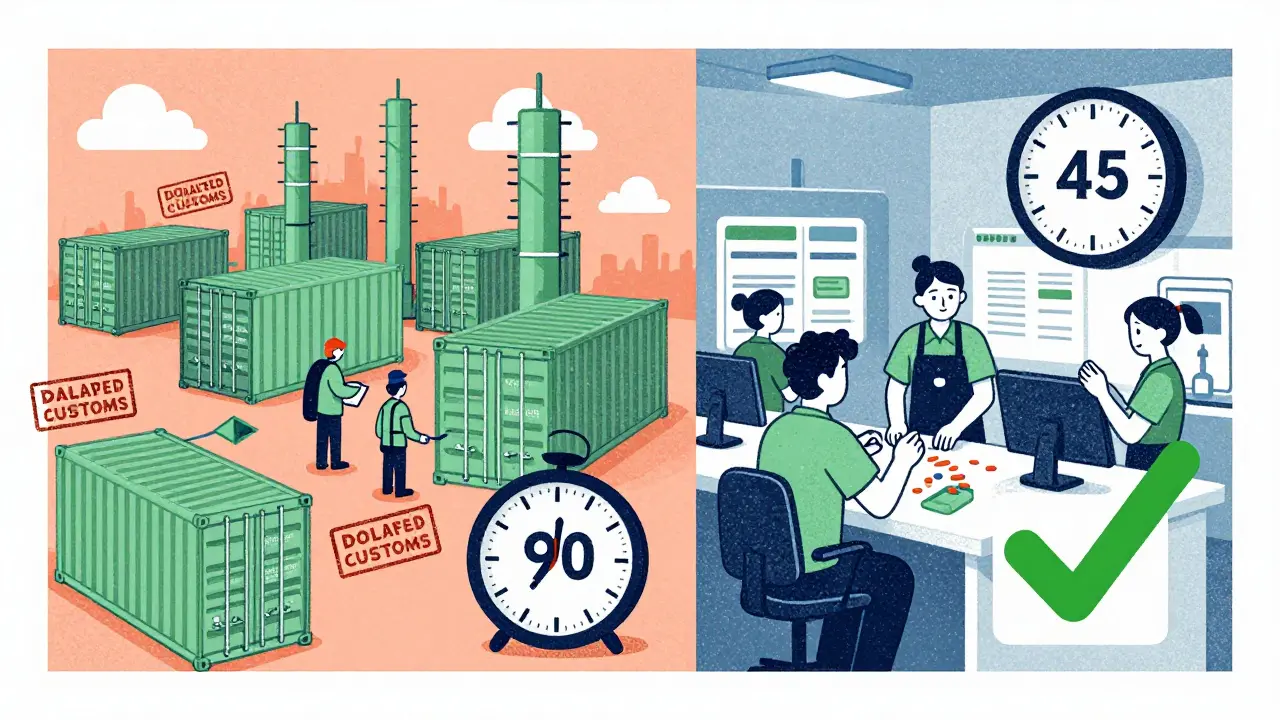
When you’re producing generic medications, every decision about where to make them matters-not just for your bottom line, but for patient safety, speed to market, and long-term reliability. The choice between overseas and domestic manufacturing isn’t about picking one over the other. It’s about matching your production needs to the right location. For many companies, the lure of cheaper labor overseas seems obvious. But what happens when a shipment gets stuck in customs for six weeks? Or when a batch of pills fails inspection because the factory didn’t follow the same quality standards as your U.S. lab? These aren’t hypotheticals. They’re daily realities for generic drug makers navigating global supply chains.
Cost Isn’t Just the Price Tag
It’s true: manufacturing in Vietnam, Mexico, or China can cut your unit cost by 40-60%. A 10,000-unit run of generic tablets might cost $2.10 per unit in Yiwu, versus $8.75 in Ohio. That’s a massive difference. But that’s only the sticker price. Hidden costs pile up fast. Shipping from Asia takes 45 to 60 days just to get to port, then another 30 to 45 days for customs, inspections, and inland delivery. That’s three months before your product even hits the warehouse. Meanwhile, domestic manufacturers can deliver in 45 to 60 days total-including production. For time-sensitive generics, like seasonal allergy meds or flu treatments, that delay can mean lost sales and frustrated patients.Then there are tariffs. Section 301 duties on Chinese goods add 7.5% to 25% to the cost of many pharmaceutical inputs. Add in third-party quality inspections ($300-$500 per shipment), language delays (22% of overseas orders face communication bottlenecks), and inventory carrying costs for stock you can’t move quickly, and your 60% savings shrinks to 12-15%. Dr. Emily Chen from MIT found that for many generic drugs, the real cost advantage has collapsed-not because overseas prices rose, but because domestic operations became more efficient and predictable.
Quality Control: Seeing Is Believing
Generic drugs must meet the same FDA standards as brand-name versions. But how you ensure compliance changes drastically based on location. Domestic factories let you walk the floor. You can watch the mixing process, check calibration logs, and review batch records in real time. Overseas? You rely on third-party inspectors-people you’ve never met, working on a schedule you didn’t set. One Reddit user, FactoryOwner87, lost $48,000 on a single Alibaba order because 37% of the tablets failed potency tests, even though the inspector signed off. That’s not rare. Trustpilot data shows 68% of negative reviews for overseas manufacturers cite communication breakdowns or inconsistent quality.Domestic manufacturers average 4.3 out of 5 stars on review platforms, with customers praising responsiveness and consistency. Overseas manufacturers score 3.8, with cost being the only bright spot. For generics, where purity and dosage accuracy are non-negotiable, direct oversight isn’t a luxury-it’s a legal and ethical requirement. The FDA conducts far more frequent inspections of U.S.-based facilities than those overseas. That doesn’t mean overseas factories are all bad. Some, especially in Mexico and Vietnam, have ISO 14001 certifications and FDA-compliant lines. But the burden of proof falls on you. And that proof takes time, money, and constant vigilance.
Minimum Orders and Flexibility
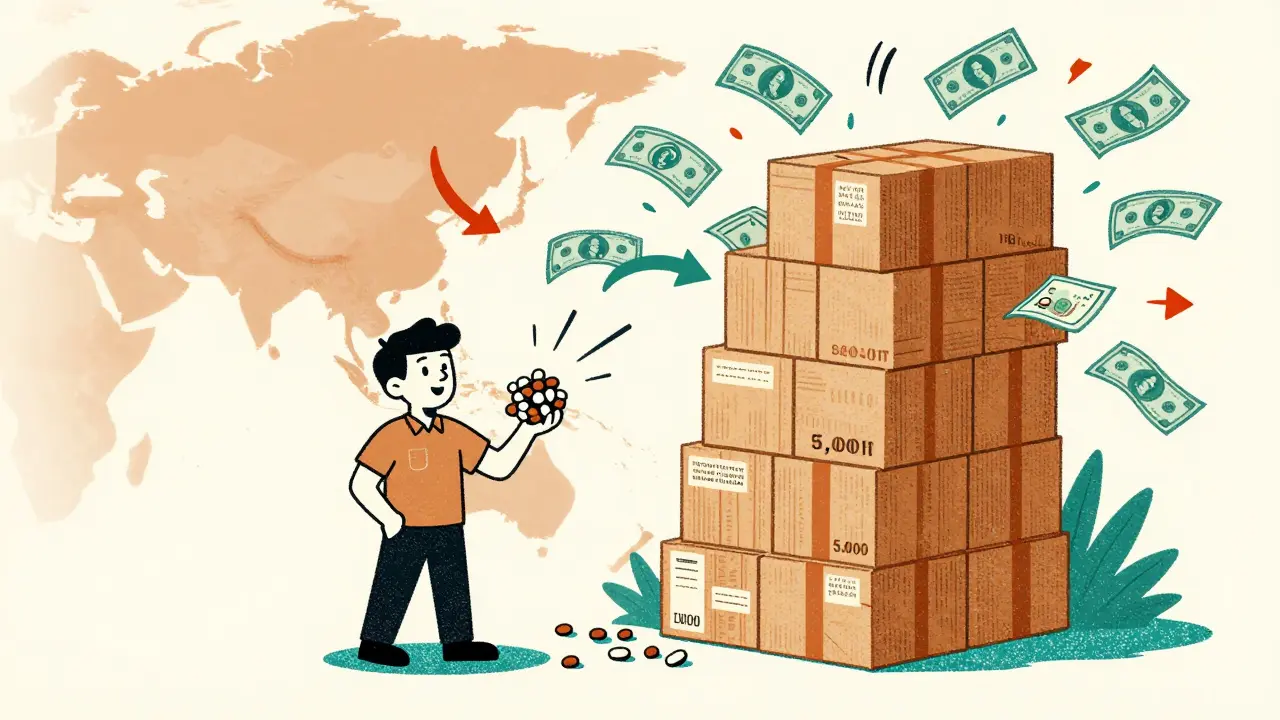
If you’re a small generic drug startup, you can’t afford to order 5,000 units of a new formulation just to get a price break. Domestic manufacturers routinely accept runs as small as 100-500 units. That lets you test market demand, tweak formulas, or respond to sudden spikes in prescriptions. Overseas factories? Most require 1,000-5,000 units minimum. That’s fine if you’re producing a high-volume drug like metformin. But if you’re launching a niche generic for a rare condition, that minimum can tie up your capital and lock you into a product you can’t return.Flexibility matters too. Need to change the tablet coating because of a patient allergy? Domestic manufacturers can adjust the formula in 3-5 days. Overseas? You’re looking at 14-21 days just to get a revised sample. That’s a week longer than the average time it takes for a new prescription to reach pharmacies. For fast-moving generics, that lag can kill momentum.
Supply Chain Risk and Reshoring Trends
The pandemic exposed how fragile global supply chains are. One port strike. One customs backlog. One factory shutdown in China-and your entire supply of a critical generic vanished. Since 2020, over 356,000 manufacturing jobs have returned to the U.S., according to the Reshoring Initiative. Companies aren’t just reacting to disruption-they’re planning for it. The Inflation Reduction Act and CHIPS Act have poured billions into domestic production capacity. Even pharmaceutical suppliers are investing in U.S.-based API (active pharmaceutical ingredient) manufacturing, something that was nearly abandoned over the last 20 years.Meanwhile, the “China Plus One” strategy is now standard. Most Fortune 500 companies now split production across multiple countries-China, Vietnam, Mexico, India-to avoid overreliance on any single source. Mexico, in particular, is gaining traction. With shipping times of just 7-10 days and labor costs at 12-15% of U.S. levels, it’s becoming the sweet spot for nearshoring. For U.S.-based generic manufacturers, Mexico offers a middle ground: lower cost than domestic, faster than Asia, and better regulatory alignment.
Sustainability and Consumer Expectations
Patients aren’t just buying pills-they’re buying values. A 2024 NielsenIQ survey found 68% of consumers are willing to pay 5-12% more for products made in the U.S. That’s not just patriotism. It’s about trust. Locally made drugs mean fewer shipping miles, lower carbon emissions (62% less than Asia-sourced), and fewer intermediaries in the supply chain. For generics, which are often seen as “commodity” products, this is a rare chance to build brand loyalty. A company that highlights domestic production can differentiate itself in a crowded market, especially when paired with transparent sourcing and quality reports.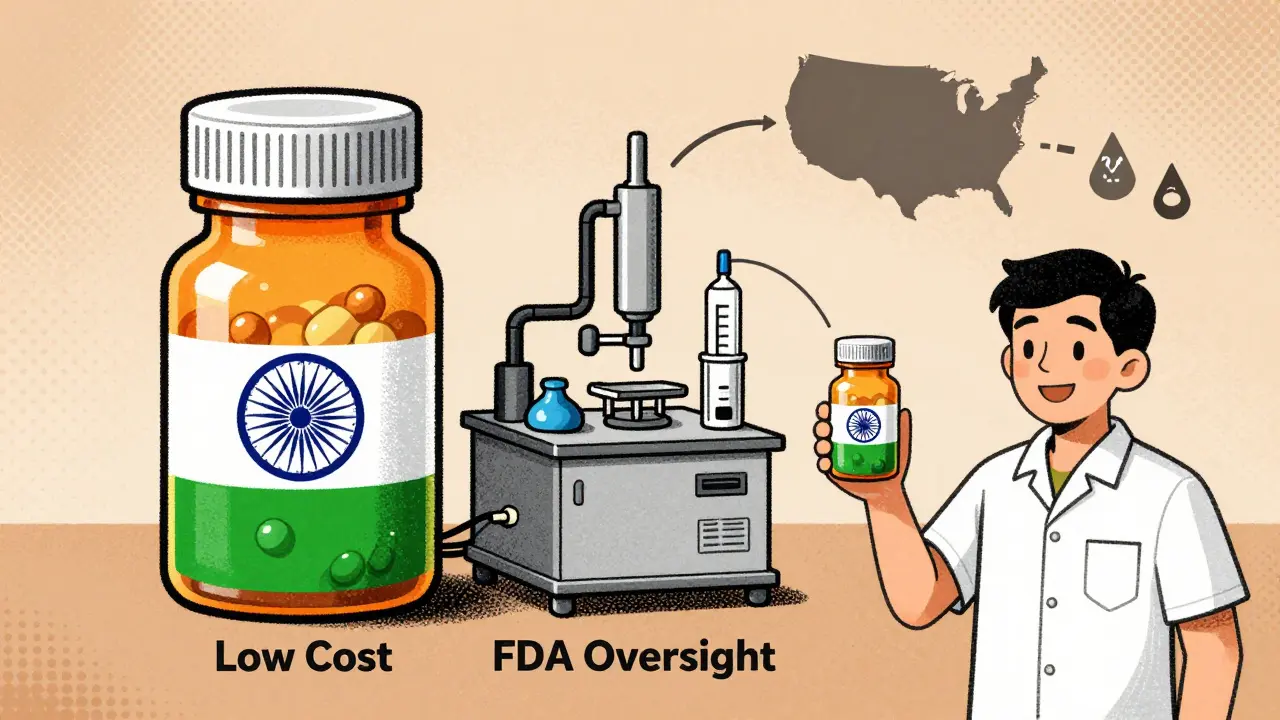
Hybrid Models Are Winning
The smartest companies aren’t choosing one side. They’re blending both. A 2024 Strategic Advisor Board study found 44% of mid-sized generic manufacturers now use a hybrid model: producing high-volume, low-risk ingredients overseas (like basic fillers or packaging), while keeping critical steps-formulation, final testing, and sterile filling-domestic. This cuts costs without sacrificing control. For example, a company might source raw API from India, but blend, compress, and package the final tablets in Ohio. That way, they save on bulk material costs but maintain FDA oversight on the final product.This approach also reduces risk. If one supplier fails, you’re not stuck. You’ve got backups. You’ve got flexibility. You’ve got speed. And most importantly, you’ve got accountability.
What Should You Do?
Here’s a simple decision framework:- Choose domestic manufacturing if: Your product is time-sensitive, high-value, or requires strict quality control. If you’re launching a new generic, testing a small batch, or making a drug used by vulnerable populations (like children or elderly patients), domestic is the safer, faster, more reliable choice.
- Consider overseas manufacturing if: You’re producing a high-volume, stable generic with long shelf life (like amoxicillin or lisinopril), you have the resources to manage logistics and inspections, and you’re willing to accept longer lead times. Use it for non-critical components, not the final product.
- Try nearshoring to Mexico if: You want lower costs than the U.S. but faster delivery than Asia. It’s ideal for mid-volume generics with moderate complexity.
- Use a hybrid model if: You want to balance cost, control, and resilience. This is the emerging standard for serious generic manufacturers.
There’s no universal answer. But there is a smart answer-and it’s not always the cheapest one.
Is overseas manufacturing always cheaper for generic drugs?
Not always. While labor costs overseas are lower, hidden expenses like shipping, tariffs, third-party inspections, inventory holding, and delays can erase 40-50% of the savings. For many generic drugs, the real cost difference is now only 12-15% when all factors are included, according to MIT’s 2024 supply chain analysis.
Can I trust quality from overseas manufacturers?
Some can, but you can’t assume they do. Many overseas factories meet FDA standards, but inspections are less frequent and harder to verify. Third-party audits help, but they’re not foolproof. One manufacturer reported a 37% defect rate on a batch that passed inspection. Domestic production gives you direct, real-time oversight-which is critical for patient safety.
How long does it take to get generics from overseas vs. domestic?
Overseas manufacturing typically takes 90-105 days total: 45-60 days for production, plus 30-45 days for shipping and customs. Domestic production averages 45-60 days from order to delivery. For time-sensitive drugs, that extra month can mean missed sales, delayed treatments, or stockouts.
What’s the minimum order size for overseas vs. domestic manufacturers?
Overseas manufacturers usually require 1,000-5,000 units minimum. Domestic manufacturers often accept runs as small as 100-500 units. This makes domestic production ideal for startups, niche drugs, or testing new formulations.
Is Mexico a good alternative to China for generic drug manufacturing?
Yes, increasingly so. Mexican manufacturing costs about 12-15% of U.S. labor rates but ships in just 7-10 days. It’s also under tighter U.S. regulatory alignment, with many facilities FDA-inspected. For companies wanting lower costs without long delays, Mexico is now the top nearshoring option.
What’s the biggest mistake companies make when choosing overseas manufacturing?
Assuming cost savings equal profit. Many companies focus only on the unit price and ignore lead times, inspection costs, communication delays, and inventory risk. The result? A cheaper product that arrives too late, fails inspection, or causes a recall. The smartest companies build in buffers for these hidden costs from day one.
Should I switch entirely to domestic manufacturing?
Not necessarily. A hybrid approach-making high-volume, low-risk components overseas and final production domestic-is the most resilient strategy. It balances cost savings with control. Most successful generic manufacturers today use this model, keeping critical steps like final testing and sterile filling in-house.
Bottom line: The best manufacturing strategy isn’t about geography. It’s about alignment. Align your production location with your product’s risk level, your timeline needs, your quality expectations, and your customer’s trust. The cheapest option today might be the most expensive tomorrow.
Comments
Vince Nairn
Man I used to think overseas was the way to go until my last batch of blood pressure meds got stuck in customs for 7 weeks
Patients started calling the clinic asking why their prescriptions weren't filled
Turns out the factory in Vietnam skipped the stability testing
Cost savings? More like cost nightmares
Now I do everything domestic for anything that affects real people
January 7, 2026 AT 22:43
Ayodeji Williams
LMAO why y’all even stressin 😂
China make everything cheaper even your socks and phone charger
Why u think your pills cost so much? 😭
Just buy 2x and keep em in the garage 🤷♂️
January 8, 2026 AT 06:20
Kyle King
Did you know the FDA is owned by Big Pharma?
They let domestic plants pass crap because they’re in bed with the CEOs
Meanwhile overseas factories are being framed
Think about it - why do you think they push ‘Made in USA’ so hard?
It’s not about safety - it’s about control
They want you dependent on their overpriced nonsense
The real cost is your freedom
And they know it
January 8, 2026 AT 13:33
Kamlesh Chauhan
Why even talk about this
Everyone knows China makes everything
U.S. can’t even make a decent t-shirt anymore
Why should pills be different
Just shut up and take your medicine
Who cares how it got here
As long as it works right
And if it don’t
Well that’s what lawsuits are for
😂
January 9, 2026 AT 11:36
Emma Addison Thomas
I’ve worked with manufacturers in both the UK and India
What struck me most wasn’t cost or speed - it was communication
Domestic teams would call me within hours if something went wrong
Overseas? Weeks of silence, then a polite email saying ‘we regret to inform’
It’s not about patriotism - it’s about reliability
And in pharma, reliability isn’t optional
January 10, 2026 AT 15:10
Mina Murray
Let me break this down for you because clearly you didn’t read the MIT study
First, the 12-15% savings only applies if you account for ALL hidden costs - which 90% of companies don’t
Second, the FDA inspects U.S. facilities 3x more often than foreign ones - that’s not opinion, it’s public data
Third, ‘nearshoring’ to Mexico isn’t a ‘middle ground’ - it’s the new standard because the math works
And fourth - you’re not saving money if your product gets recalled because someone in Guangzhou misread a spec sheet
Stop romanticizing overseas manufacturing
It’s not cheaper
It’s just more dangerous
January 11, 2026 AT 02:34
Rachel Steward
You think this is about cost? It’s not
It’s about control
And control is power
And power is concentrated in the hands of a few corporations who want you to believe ‘globalization’ is inevitable
But the truth? They’ve been outsourcing for 30 years to avoid regulation, union wages, and accountability
Now they’re pretending they care about patient safety
Meanwhile, they’re lobbying Congress to weaken FDA oversight on imports
They don’t want you to know that the same factory that made your blood pressure pill also made the tainted cough syrup that killed 70 kids in Gambia last year
They don’t want you to know that 80% of API ingredients come from China
And they really don’t want you to know that the FDA can’t even inspect 10% of those facilities
So yes - the ‘hybrid model’ sounds smart
But it’s just a PR shell
Behind it? The same broken system
And you’re still paying for it
January 13, 2026 AT 01:16
Christine Joy Chicano
I love how this post doesn’t just list facts - it tells a story
It’s not about ‘domestic vs overseas’ - it’s about trust
Trust in the process
Trust in the people behind the machines
Trust that when you swallow a pill, someone cared enough to check the temperature logs
Someone didn’t cut corners because the shipment was delayed
Someone didn’t assume ‘close enough’ is good enough
That’s what domestic manufacturing offers - not just speed or cost
But dignity
For the patient
For the worker
For the company that still believes quality matters
And yeah - sometimes it costs more
But some things shouldn’t be cheap
January 14, 2026 AT 16:41
Adam Gainski
My company switched to hybrid last year and it changed everything
We still source API from India - saves us 30% on bulk
But final blending, coating, and QC? All done in Ohio
We went from 12% batch rejection rate to 2%
And our delivery time dropped from 110 days to 50
Customer complaints? Cut in half
And the best part? Our team feels proud again
They can walk into the lab and say ‘I made this’
Not ‘I helped make this… somewhere’
It’s not perfect
But it’s the right balance
January 16, 2026 AT 15:47
Sai Ganesh
India has been making generic drugs for decades
WHO and USFDA both approve our facilities
Why do you think 80% of global generics come from us?
It’s not luck
It’s expertise
And yes - we have quality issues sometimes
But so do you
Don’t act like your labs are perfect
We’re not the problem - the system is
January 18, 2026 AT 06:45
Paul Mason
Look I’m all for American made
But you can’t just ignore the numbers
Cheaper = more patients get medicine
Simple as that
If I can get 100k pills for $50k instead of $120k
That’s 70k more people who get their meds
So yeah - maybe it takes a little longer
But lives are saved
And that’s what matters
January 18, 2026 AT 22:53
Katrina Morris
i just read this and thought… what if we just… made more stuff here?
like… why not? 🤔
we used to make everything here
remember when we made TVs and cars?
maybe pills are just the next thing
also i spilled coffee on my keyboard so sorry if this is messy
January 20, 2026 AT 21:28
steve rumsford
My cousin works at a plant in Indiana
They just got a $40M grant to upgrade their sterile fill line
They’re hiring 80 people
And guess what? They’re training them in 6 weeks
People think manufacturing is dead
It’s not
It’s just… coming back
And it’s way cooler than you think
January 22, 2026 AT 02:31
Andrew N
Everyone’s acting like domestic is the holy grail
But the data doesn’t support it
Most U.S. generic manufacturers still outsource 60% of their API
They just hide it behind ‘final manufacturing’
And the FDA doesn’t care as long as the final product passes
So you’re not really ‘domestic’
You’re just marketing it that way
And that’s dishonest
January 23, 2026 AT 16:16
Anthony Capunong
Enough with the ‘Mexico is the answer’ nonsense
It’s still foreign soil
And if we’re going to bring jobs back
Let’s bring them back to AMERICA
Not Mexico
Not Vietnam
Not India
AMERICA
Our country, our rules, our standards
Stop outsourcing your patriotism
And start making pills where they belong
On American soil
January 25, 2026 AT 05:26