
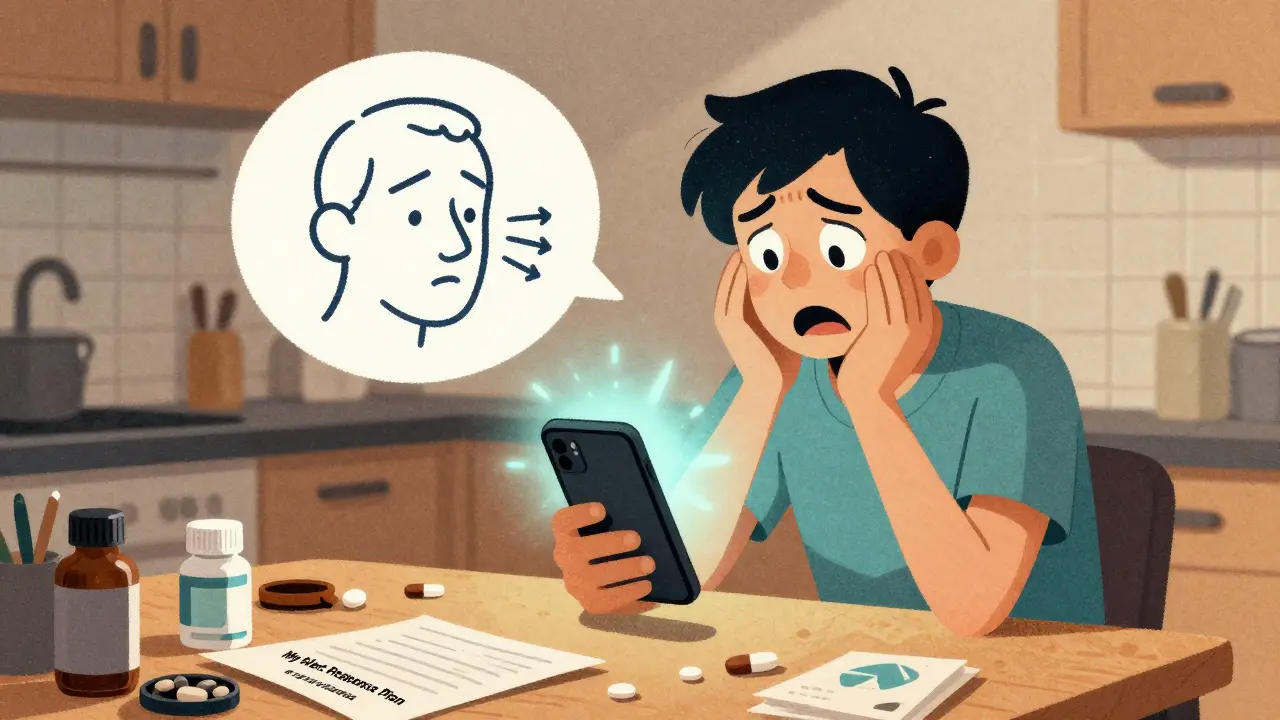
When a drug safety alert hits, your heart races. Your mind goes blank. You want to act-fast. But acting on panic can make things worse.
Drug safety alerts aren’t rare. They come from the FDA, health agencies, or your pharmacy system: “Risk of liver damage with Drug X,” “Recall due to contamination,” “New warning for elderly patients.” These aren’t theoretical. They’re real, and they land like a punch. In the first 30 seconds, your body reacts like it’s under attack: heart rate spikes to 110-130 bpm, breathing becomes shallow and rapid, and your brain shuts down logical thinking. That’s not weakness. That’s biology.
But you don’t have to let panic drive your next move. The difference between a harmful reaction and a smart response comes down to one thing: preparation. People who survive these moments without regret aren’t calm by nature. They’ve trained their brains to reset.
Stop the panic before it steals your judgment
The moment you see the alert, your amygdala-the brain’s alarm system-takes over. It screams, “Danger!” and silences your prefrontal cortex, the part that weighs options, checks facts, and plans. That’s why you might delete your prescription, call your doctor in tears, or stop the medication cold without understanding the risk.
Here’s what works: Pause for 90 seconds. Not to think harder. Not to research. Just to calm your body. The simplest tool? Controlled breathing. Try the 4-7-8 method: inhale through your nose for 4 seconds, hold for 7, exhale slowly through your mouth for 8. Do that three times. Studies show this drops your heart rate from panic levels to 70-85 bpm within 90 seconds. Your brain reboots. You’re no longer in fight-or-flight mode. You’re back in control.
Another quick fix: the 5-4-3-2-1 grounding technique. Look around. Name 5 things you see. Touch 4 things-your phone, your shirt, the chair, your keys. Listen for 3 sounds. Identify 2 smells. Taste 1 thing-a mint, a sip of water. This forces your brain out of panic mode and into the present. People in emergency rooms, pharmacies, and even cybersecurity teams use this to avoid costly mistakes. It works because your senses can’t lie.
Use a decision framework, not your gut
Once your breathing is steady, don’t guess. Use a structure. The DEAR MAN technique isn’t just for therapy-it’s for alerts. Break it down:
- Describe the alert. What exactly does it say? Don’t paraphrase. Quote it. “The FDA warns of increased risk of pancreatitis in patients over 65 taking Drug X.”
- Express how you feel. “I’m worried because my mom is 72 and takes this daily.”
- Assert what you need. “I need to know if the risk applies to her specifically.”
- Reinforce the outcome. “If we adjust her dose or switch meds, we avoid hospitalization.”
- Stay mindful of your goal: safety, not fear.
- Appear confident-even if you’re not. Speak clearly. Write it down.
- Negotiate options. “Is there a safer alternative? Can we monitor liver enzymes instead of stopping?”
This isn’t fluff. A 2022 study of 350 emergency responders showed that using structured communication like this reduced regrettable decisions by 52%. You’re not just calming down-you’re building a case for the right action.
Check the source. Not the noise.
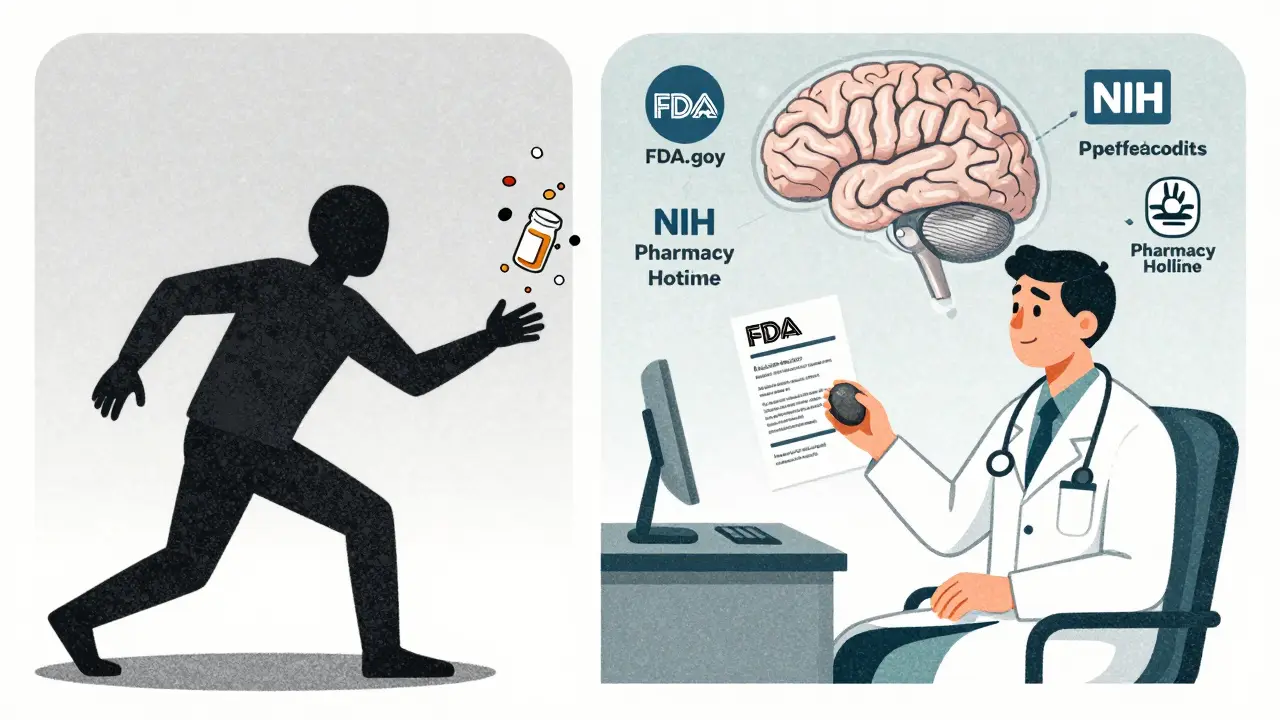
Not all alerts are equal. A tweet saying “Drug Y causes strokes!” isn’t the same as a FDA MedWatch bulletin. Always trace the alert back to its origin. Ask: Is this from a government agency? A peer-reviewed journal? Or a blog with ads for “natural cures”?
Real alerts include specifics: patient demographics, incidence rates, comparison data. For example: “Risk of liver injury: 1 in 5,000 patients over 6 months.” That’s useful. “This drug is dangerous” is not.
Use the National Institutes of Health’s Drug Information Portal or the FDA’s website. These are free, reliable, and updated daily. If your pharmacy sends an alert without a link to the source, call them. Ask: “Where did this come from?” If they can’t answer, treat it as unverified noise.
Build your alert response kit before you need it
Most people fail not because they don’t know what to do-but because they didn’t practice it until it was too late. The average person receives 67 alerts a week across devices. That’s constant noise. Without a system, your brain learns to ignore it… until it shouldn’t.
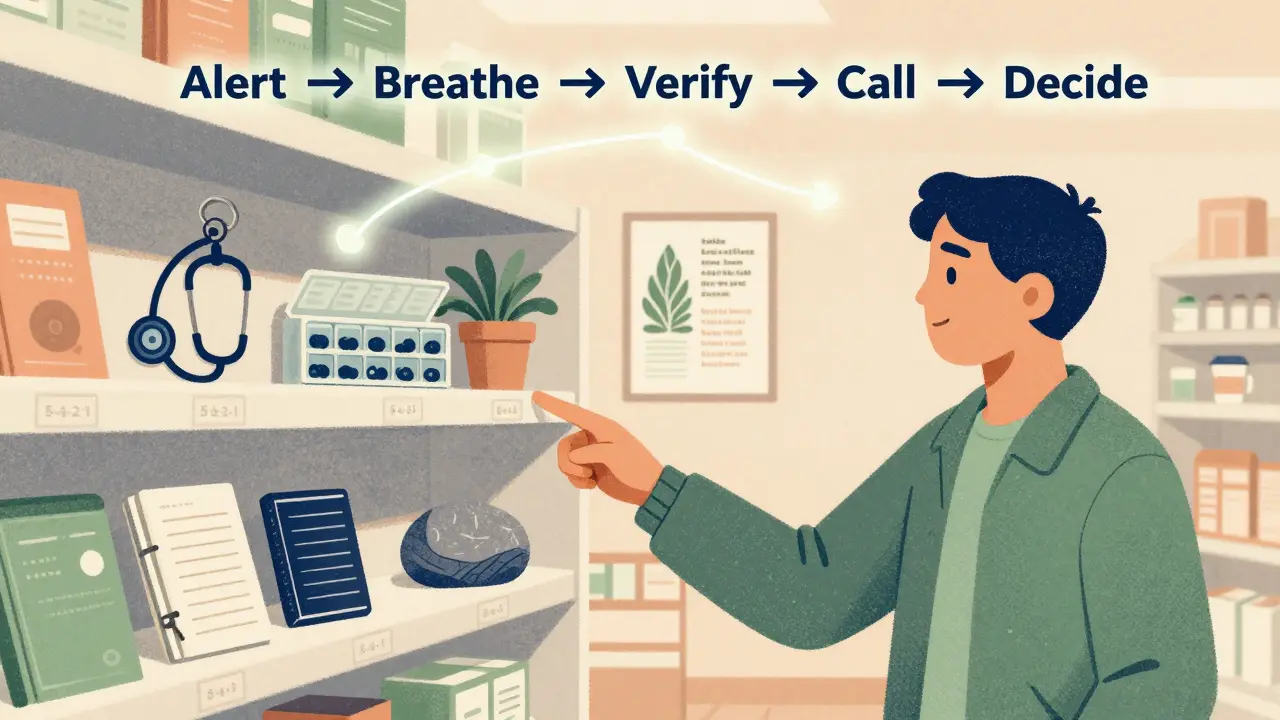
Build a physical or digital “alert response kit.” Include:
- A printed one-page cheat sheet with the 4-7-8 breathing steps and 5-4-3-2-1 technique
- A list of trusted sources: FDA.gov, NIH DrugBank, your pharmacy’s clinical hotline
- A simple decision flowchart: “Alert received → Breathe → Verify source → Contact provider → Decide”
- A small object for tactile grounding-a smooth stone, a textured keychain, a mint
Keep this kit by your phone, on your nightstand, in your wallet. People who use these kits respond 65% faster and with 42% greater accuracy in simulated alert scenarios, according to Abundance Therapy Center’s research.
Practice daily-even when nothing’s happening
Just like firefighters train for fires they hope never happen, you need to train for alerts you hope never come. Ten minutes a day, for 30 days, rewires your brain.
Try this routine:
- Set a timer for 10 minutes.
- Close your eyes. Breathe using the 4-7-8 method.
- Visualize receiving a drug alert. Feel the panic rise.
- Now, go through your kit: breathe, ground, verify, call.
- Do this every morning. No exceptions.
After eight weeks, brain scans show a 4.3% increase in gray matter in the prefrontal cortex-the area responsible for calm decision-making. That’s not magic. That’s neuroplasticity. Your brain is literally getting better at staying cool under pressure.
Know when to act-and when to wait
Not every alert means stop the drug. Some are warnings for rare side effects. Others are for specific populations. For example, an alert about kidney risk may only apply to patients with existing disease. A recall may only affect one batch number.
Ask your doctor these three questions:
- “Does this risk apply to me, based on my age, health, and dosage?”
- “What’s the chance this will actually happen to me?”
- “What happens if I stop? What happens if I keep taking it?”
Don’t let fear make you choose between two bad options. You’re not choosing between “safe” and “dangerous.” You’re choosing between “better” and “worse.” And you can only see that clearly when you’re calm.
The bigger picture: This isn’t just about you
Drug safety alerts are rising. The FDA issued 217 safety communications in 2023-up 40% from 2020. The EU’s DORA regulation now requires health systems to train staff in psychological response to alerts. Why? Because panic costs lives. A panicked nurse might misread a label. A scared patient might stop a life-saving drug. A rushed pharmacist might dispense the wrong batch.
When you learn to respond calmly, you’re not just protecting yourself. You’re helping your family, your care team, and the system work better.
What to do next
Start today. Not tomorrow. Right now.
- Open your phone’s notes app. Type: “My Alert Response Plan.”
- Write down the 4-7-8 breathing steps.
- Add the 5-4-3-2-1 technique.
- Link to FDA.gov and your pharmacy’s clinical line.
- Set a daily 10-minute reminder for the next 30 days.
You don’t need to be fearless. You just need to be prepared. And preparation turns panic into power.
What if I panic and stop my medication right away?
Stopping a medication abruptly can be dangerous-especially for drugs like blood pressure pills, antidepressants, or seizure medications. Withdrawal symptoms or rebound effects can be worse than the original condition. If you’ve already stopped, contact your doctor or pharmacist immediately. Don’t restart on your own. They’ll guide you on whether to resume, taper, or switch.
Are all drug safety alerts urgent?
No. Alerts range from high-priority recalls (e.g., contaminated batches) to low-priority updates (e.g., rare side effects in specific groups). The FDA labels them by severity: Class I (most serious), Class II (moderate), Class III (least serious). Your pharmacy should indicate the level. If they don’t, ask. Never assume an alert means “stop now.” Always verify the level and context.
Can I trust alerts from my pharmacy app?
Pharmacy apps are useful but not always primary sources. They may summarize or delay alerts. Always check the original source-like the FDA’s website or a peer-reviewed journal. If the app doesn’t link to the source, treat it as a notice, not a directive. Call your pharmacist and ask: “Where did this come from?”
How do I know if an alert is real or fake?
Real alerts include specific details: drug name, batch number, patient group, risk level, and official source (FDA, CDC, WHO). Fake alerts use emotional language (“DANGER!”), lack citations, and ask you to click links or call unknown numbers. Never click links in unsolicited alerts. Go directly to FDA.gov or your healthcare provider’s official site.
Do these techniques work for chronic anxiety too?
Yes. The same breathing, grounding, and decision frameworks that help during drug alerts also reduce daily anxiety. People with generalized anxiety disorder who practice these techniques daily report 59% fewer panic episodes overall, according to the American Psychological Association. This isn’t just for alerts-it’s for life.
Comments
Sidhanth SY
This is actually one of the most practical pieces I've read all year. I work in pharma in Bangalore and see panic reactions daily. The 4-7-8 breathing trick? Game changer. I teach it to new hires. Simple, no fluff, works.
January 30, 2026 AT 18:55
Yanaton Whittaker
AMERICA STILL LEADS IN MEDICAL SAFETY 🇺🇸🔥 Why are we letting foreign apps and blogs confuse people? FDA.gov is FREE and official. If your pharmacy app can't link to it, fire them. #StopTheNoise
January 30, 2026 AT 20:34
Kathleen Riley
The epistemological framework presented herein is both empirically grounded and phenomenologically coherent. The invocation of neuroplasticity as a mechanism for cognitive recalibration aligns with contemporary neurocognitive models of stress response modulation. One must, however, acknowledge the ontological limitations of self-reported behavioral metrics in the cited studies.
January 31, 2026 AT 12:48
Beth Cooper
Funny how they never mention that the FDA gets paid by Big Pharma to downplay side effects. That '1 in 5,000' number? Probably 1 in 500. I know a guy whose aunt died after taking Drug X. They called it 'rare.' Meanwhile, the CDC is hiding the real stats behind paywalls. 😏
February 1, 2026 AT 08:36
Donna Fleetwood
Y’all need to do this now. Not tomorrow. Right now. Open your notes app. Type 'My Alert Response Plan.' Copy the 4-7-8. Save the FDA link. Set the reminder. I did this last month and when my mom got her alert? She stayed calm. We called her doc. She’s fine. You got this 💪
February 1, 2026 AT 09:26
Melissa Cogswell
I’m a clinical pharmacist and this is spot-on. The DEAR MAN technique works better than most people realize. I’ve used it with patients during recall events. The grounding technique? Especially useful for elderly patients with anxiety. One thing to add: always check the batch number on your bottle. Most recalls are batch-specific. Don’t panic about the whole drug.
February 3, 2026 AT 05:00
Blair Kelly
You say 'controlled breathing' like it's a magic spell. Let me be clear: if you're panicking over a Class II alert, you're not 'stressed'-you're uneducated. The FDA has a public database. The NIH has a portal. If you can't navigate two websites, maybe don't self-medicate. This article is well-intentioned, but it infantilizes adults who should know better. Grammar matters. Accuracy matters. Panic is a choice.
February 4, 2026 AT 06:43
Rohit Kumar
In India, we have a saying: 'Jab darr aaye, tab socho.' When fear comes, think. This isn't just about drugs-it's about how we react to chaos in general. The 5-4-3-2-1 method? That's ancient Indian mindfulness, repackaged. The West calls it 'grounding.' We called it 'pratyahara.' The science is new. The wisdom? 5,000 years old.
February 5, 2026 AT 06:47
Lily Steele
I saved this to my phone. I keep it next to my pill organizer. When I saw my first alert last week? I breathed. I checked FDA.gov. Called my pharmacist. She said it didn’t apply to me. I didn’t cry. I didn’t panic. I just… handled it. This changed my life.
February 7, 2026 AT 02:07
Jodi Olson
The assertion that neuroplasticity results in a 4.3% increase in prefrontal gray matter is statistically negligible without context of sample size, control variables, and longitudinal tracking. Furthermore, the Abundance Therapy Center is not a peer-reviewed institution. While the techniques themselves are benign and potentially beneficial, the framing of this article as evidence-based medicine is misleading.
February 7, 2026 AT 12:15
Amy Insalaco
The ontological presupposition embedded within this construct-that cognitive recalibration via somatic regulation is sufficient to mitigate systemic pharmaceutical risk-is not only reductionist but epistemologically untenable. One cannot decouple individual psychological coping mechanisms from the structural commodification of health information by corporate entities, regulatory capture, and algorithmic obfuscation of risk stratification. The 4-7-8 breathing technique, while phenomenologically soothing, functions as a neoliberal panacea that absolves institutional accountability while pathologizing the individual’s legitimate distrust. One must interrogate the epistemic authority of the FDA-not just its communication protocols.
February 7, 2026 AT 13:58