
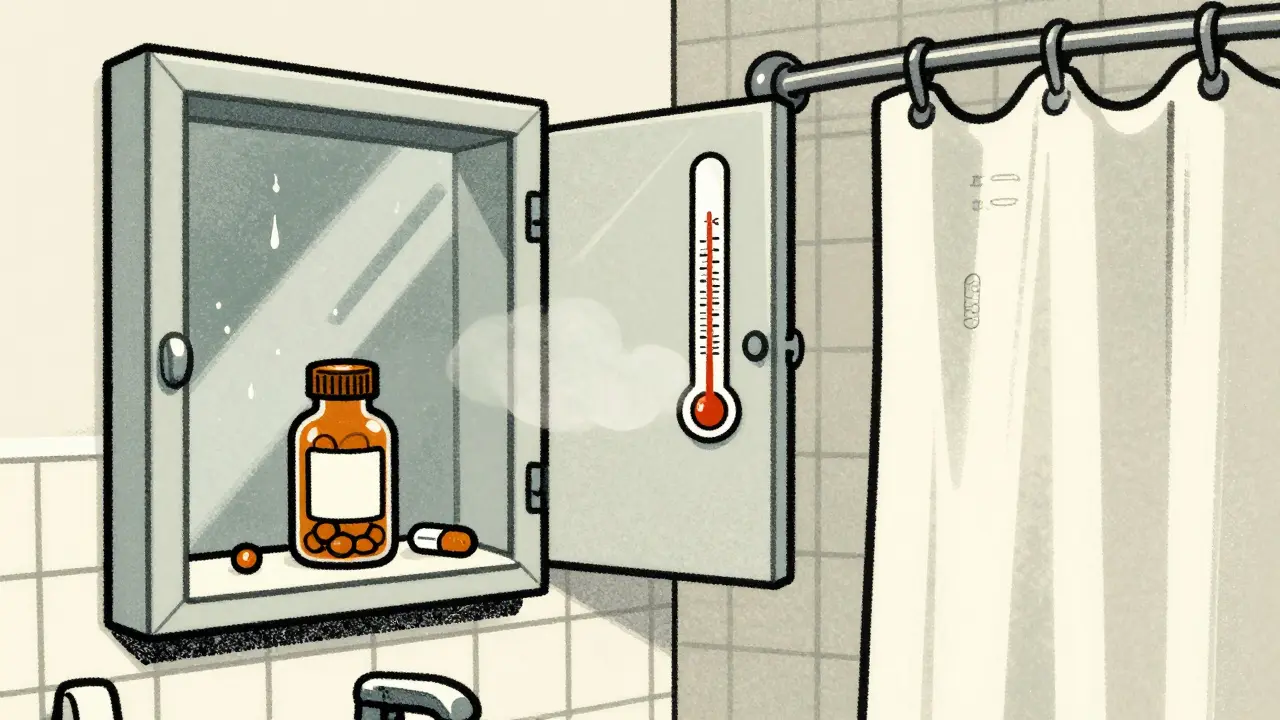
Ever opened your medicine cabinet and noticed your pills look different? Maybe they’re sticky, discolored, or smell odd. That’s not normal-and it’s not just about being past the expiration date. Heat and humidity can wreck your medications long before that date comes around. You might think your pills are safe as long as they haven’t expired, but if they’ve been sitting in a steamy bathroom or a hot car, they could already be losing power-or worse, turning harmful.
Why Your Medicine Cabinet Is a Bad Idea
Most people store meds in the bathroom. It’s convenient. But it’s also one of the worst places you can keep them. Showers spike humidity to 70-90%. That moisture doesn’t just fog up your mirror-it seeps into pill bottles. Capsules swell, tablets crumble, and coatings break down. Heat from the dryer or radiator pushes temperatures past 30°C (86°F), which is enough to start breaking down sensitive drugs. The FDA says expiration dates are only valid if the medicine was stored correctly. That means cool, dry, and dark. Not steamy, not sunny, not next to the sink. A 2020 NIH study found that 91% of healthcare workers knew this-but most patients still keep meds in the bathroom. That’s a dangerous gap.Not All Medications Are Created Equal
Some pills can handle a little heat. Tablets like ibuprofen, acetaminophen, or statins stay stable even at 30°C for months. They’re tough. But others? They’re fragile. Insulin is one of the most critical examples. If you leave it in a hot car for a few hours, it can lose up to 20% of its potency in just one day. That’s not a small drop-it means your blood sugar could spike dangerously. Diabetics who rely on insulin don’t get a second chance when their meds fail. Then there’s nitroglycerin. Used for heart attacks, it breaks down fast above 25°C. If it’s been sitting on a windowsill or in a purse on a summer day, it might not work when you need it most. Same with thyroid meds like levothyroxine-they lose effectiveness above 27°C (80.6°F). And don’t forget liquid antibiotics like amoxicillin suspension. At room temperature, they lose 30-40% of their strength in just 72 hours. That’s not just ineffective-it can lead to antibiotic resistance. Biologics-like monoclonal antibodies used for cancer or autoimmune diseases-are even more sensitive. They must stay refrigerated between 2-8°C (35.6-46.4°F). If they warm up even for a few hours, their protein structures unravel. Once that happens, there’s no fixing it. The drug is dead.What Happens When Medications Break Down?
You can’t always tell by looking. But sometimes, you can. - Tablets that stick together or feel softer than usual? That’s moisture damage. - Capsules with cracks or that crumble when you touch them? Heat or humidity got in. - Pills that smell like vinegar? That’s aspirin turning into salicylic acid. It’s not just weaker-it can irritate your stomach more. - Inhalers that feel bloated or make strange noises? High heat can build pressure inside. At 49°C (120°F), they can explode. - EpiPens that feel stiff or won’t click? Temperature exposure above 30°C increases failure rates by 15-20%. In anaphylaxis, that’s life or death. These aren’t hypotheticals. They’re documented cases. The Ohio State Wexner Medical Center has tracked EpiPen failures linked to heat. The Journal of Hospital Association of Hawaii confirmed insulin potency loss after just one day at body temperature. This isn’t theory-it’s real risk.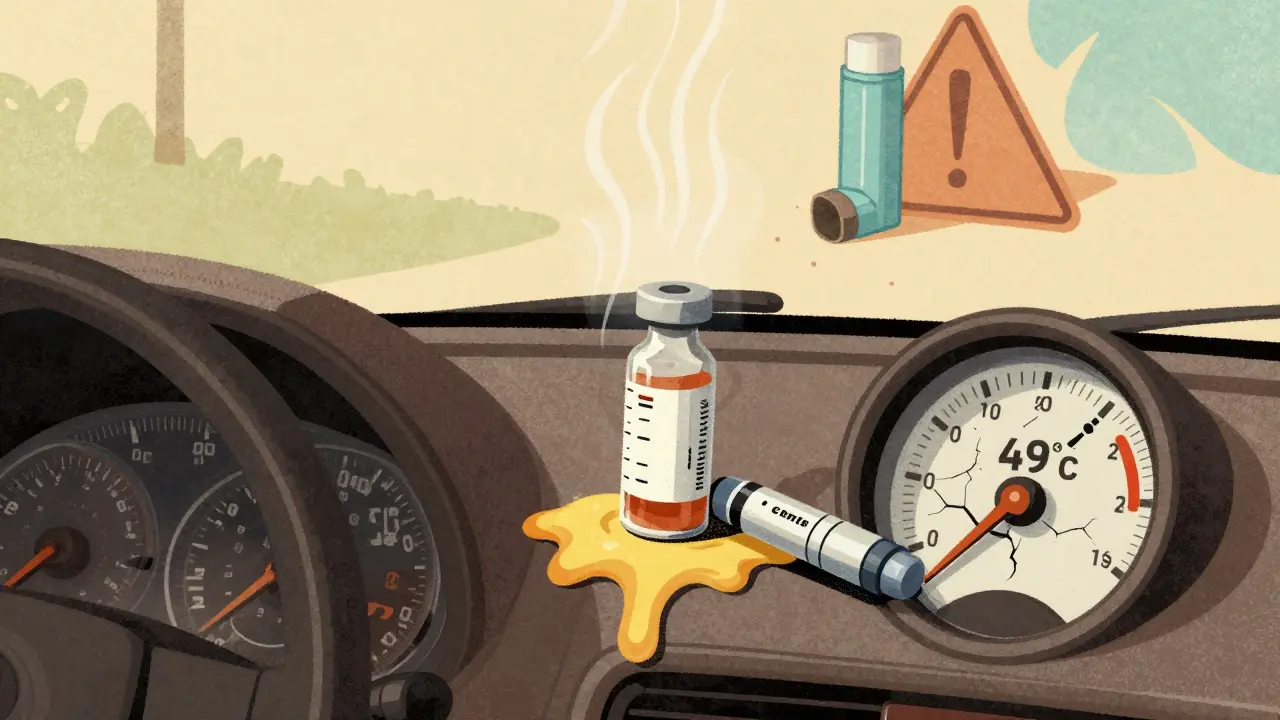
Where to Store Medications Instead
The best place? A cool, dry spot away from sunlight. A bedroom drawer. A shelf in your closet. Not the kitchen, even if it’s not near the stove. Kitchens get hot from ovens and humid from dishwashers. The average kitchen temp in summer can hit 32°C (90°F)-way above safe limits. For most pills, aim for 15-25°C (59-77°F) and humidity below 60%. Keep them in their original bottles. The caps are designed to seal out moisture. Don’t transfer pills to pill organizers unless you’re using them immediately. Those containers don’t protect against humidity. If you’re traveling, take only what you need. Leave the rest at home. For insulin, epinephrine, or other temperature-sensitive drugs, use a cool pack from the pharmacy. They’re inexpensive and designed for this exact purpose. Don’t rely on a regular ice pack-they can freeze the medicine, which also damages it.What to Do If You Suspect Your Meds Are Damaged
If your pills look, smell, or feel off-don’t take them. Even if they’re not expired. You can’t see how much potency is gone. And you can’t predict how it will affect your body. Call your pharmacist. They can tell you if the medication is still safe. For life-saving drugs like insulin, epinephrine, seizure meds, or heart medications, never risk it. Get a replacement. It’s cheaper than an ER visit. The FDA says using expired or damaged meds is risky and possibly harmful. That’s not a warning you can ignore. Sub-potent antibiotics can make infections worse. Weak heart meds can trigger arrhythmias. Degraded insulin can cause diabetic ketoacidosis. These aren’t minor issues-they’re medical emergencies waiting to happen.
Comments
Joy F
The bathroom medicine cabinet is a biohazard zone disguised as convenience. Moisture doesn’t just degrade pills-it rewrites their molecular destiny. Insulin? A protein hostage to humidity. Nitroglycerin? A ticking time bomb on your windowsill. We treat meds like groceries, but they’re not. They’re precision instruments. And we’re the idiots leaving them in saunas.
When your epinephrine fails because you left it in a glovebox during a 98°F road trip, it’s not bad luck-it’s systemic negligence. The FDA’s expiration dates are corporate fiction wrapped in bureaucratic lipstick. The real shelf life? Depends on whether your house has AC or if you live in a humidity swamp.
Climate change isn’t coming-it’s already prescribing your death, one degraded tablet at a time.
And yet, we still keep pills next to the shower. Because why think when you can just hope?
January 3, 2026 AT 11:14
Angela Fisher
They don’t want you to know this but the pharma companies are secretly testing your meds in hot cars and bathrooms to see how fast they break down. Why? So they can sell you more. They profit from your ignorance. That’s why they don’t put warning labels on bottles. They don’t want you to know your insulin is dead after one day in the sun. They want you to keep buying.
And don’t get me started on the desiccants-they’re a distraction. A placebo for the guilty. The real solution? Ban all meds that aren’t stored in underground vaults. Or better yet, make everyone wear temperature-monitoring patches. The government is hiding this. I’ve seen the documents.
They’re coming for your pills next. Then your water. Then your air.
🫠
January 5, 2026 AT 05:09
Neela Sharma
Medicine is sacred but we treat it like last night’s leftovers
Heat doesn’t just weaken pills-it steals hope
Every crumbling tablet is a whispered promise broken
Think of insulin not as a drug but as a lifeline woven by science
When it fails it’s not just chemistry-it’s a child missing school
A mother’s panic
A heartbeat too slow
Store your meds like you store your love-carefully
Not where it’s easy
But where it matters
And if it looks wrong
Let it go
Because life isn’t worth gambling with broken promises
January 6, 2026 AT 13:42
Wren Hamley
Interesting breakdown, but I’m curious about the kinetics. The Arrhenius equation governs degradation rates, right? So if you double the temperature, you don’t just double the decay-you exponentially accelerate it. For biologics, even a 5°C spike above 8°C can denature proteins faster than the body can compensate.
And the amoxicillin suspension data-30-40% loss in 72 hours-isn’t just about potency. It’s selective pressure. Subtherapeutic doses breed resistance. That’s not a side effect-it’s an evolutionary trap we’ve built into our own healthcare system.
Also, why aren’t we talking about the packaging? Most pill bottles are polyethylene terephthalate. It’s permeable to moisture over time. Even if you store it in a drawer, humidity still creeps in. The original bottle isn’t a shield-it’s a sieve.
We need vapor-barrier packaging. Not just desiccants. Real engineering. Not just ‘store in a cool place’ like we’re giving gardening advice.
January 7, 2026 AT 20:38
veronica guillen giles
So let me get this straight-we have people dying because they kept their EpiPen in their purse while shopping at Target, but we still think ‘just keep it in the bathroom’ is fine?
Meanwhile, the same people will spend $200 on a smart fridge that texts them when the milk is expired but won’t buy a $5 cool pack for their insulin.
Capitalism turns health into a lifestyle brand. You’re not failing because you’re ignorant-you’re failing because you’re busy trying to ‘optimize’ your life while ignoring the literal life-or-death stuff.
Just put it in the drawer. Jesus.
And yes, I’m talking to you, Karen who keeps her thyroid meds next to the coffee maker.
January 8, 2026 AT 17:49
Angela Goree
THIS IS WHY AMERICA IS FALLING APART!!!
THEY LET THIS HAPPEN!!!
THEY DON’T CARE ABOUT OUR HEALTH!!!
THE PHARMA COMPANIES ARE IN BED WITH THE GOVERNMENT!!!
THEY WANT US TO DIE SO THEY CAN SELL US NEW DRUGS!!!
THEY DON’T WANT US TO KNOW THAT INSULIN GOES BAD IN 2 HOURS!!!
THEY PUT THE BOTTLES IN BATHROOMS ON PURPOSE!!!
THEY KNOW WE’RE STUPID!!!
WE NEED A REVOLUTION!!!
STOP BUYING MEDS!!!
WE NEED TO BURN THE PHARMACIES DOWN!!!
!!!
!!!
!!!
January 10, 2026 AT 01:10
Haley Parizo
India has a different relationship with heat and medicine. In rural villages, people store pills in clay pots-naturally cool, porous, and moisture-absorbing. No AC needed. No fancy packaging. Just centuries of wisdom.
Western medicine thinks it’s above tradition. But here’s the irony: we invented the pill, then forgot how to keep it alive.
Climate change didn’t create this crisis. Arrogance did.
We treat health like a product, not a practice. We want quick fixes, not slow care. We want pills to be foolproof, but refuse to be thoughtful.
Maybe the answer isn’t smarter bottles.
Maybe it’s humbler humans.
January 11, 2026 AT 13:48
Shruti Badhwar
As a pharmacist in Mumbai, I’ve seen patients bring in tablets that have turned brown and sticky from monsoon humidity. They insist they’re still good because the expiry date is months away. We explain, they nod, then go home and take them anyway.
It’s not ignorance. It’s scarcity.
When you can’t afford a new prescription, you take what you have. Even if it’s crumbling. Even if it smells like vinegar.
The solution isn’t just better storage-it’s better access. Better insurance. Better education that doesn’t sound like a lecture from a white coat.
We need community pharmacists, not just warnings on bottles.
Because in the end, a pill is only as good as the person holding it-and the system that lets them hold it.
January 12, 2026 AT 10:15
Liam Tanner
My dad kept his nitroglycerin in his wallet for 12 years. Said it was ‘right there when he needed it.’ He lived to 89.
He also had a heart attack in 2017. The pill didn’t work.
He didn’t die from it. But he never took another one after that.
Point is-some people get lucky. Some don’t.
Don’t be the one who assumes you’re the exception.
Store it right. It’s not that hard.
January 14, 2026 AT 09:36