

When your hip starts hurting, it’s easy to blame aging, overuse, or a bad workout. But if the pain lingers, especially when you sit, stand up, or twist, it might be more than just soreness. Two common - and often confused - causes of chronic hip pain are labral tears and hip arthritis. Both can feel similar, but they need very different approaches. And the most effective way to manage them? Not surgery. Not pills. But activity modification.
What’s Really Happening in Your Hip?
Your hip joint is a ball-and-socket. The ball is the top of your thigh bone (femur), and the socket is your pelvis (acetabulum). Surrounding the socket is a ring of tough cartilage called the labrum. It’s not just padding - it’s a seal. It holds joint fluid in, keeps the ball snug in the socket, and absorbs shock. When this labrum tears - often from repetitive twisting, sports, or structural imbalances like femoroacetabular impingement (FAI) - you get pain, clicking, or a feeling of instability. Hip arthritis, on the other hand, is the slow wearing away of the smooth cartilage that covers the ball and socket. As it breaks down, bone rubs on bone. This leads to stiffness, swelling, and pain that gets worse with weight-bearing activities like walking or climbing stairs. Unlike a labral tear, which can happen suddenly or from one awkward movement, arthritis creeps up over years. Here’s the key insight: these two problems don’t always happen one after the other. They feed each other. A torn labrum increases pressure on the joint cartilage, speeding up arthritis. And once arthritis is present, the joint becomes less stable, making the labrum more likely to tear. Studies show that 70-90% of people with FAI have a labral tear, and over half of those with hip arthritis also have a tear - even if they never had a traumatic injury.Why Activity Modification Works When Other Things Don’t
Many people reach for painkillers or injections first. NSAIDs like ibuprofen can help with swelling, but they don’t fix the root issue. Corticosteroid shots might give you a few months of relief, but repeated use can actually damage cartilage. Viscosupplements - joint lubrication injections - offer only mild, short-term benefit for most people. The real game-changer? Changing how you move. Activity modification isn’t about resting. It’s about moving smarter. Research from the Cleveland Clinic and Yale Medicine shows that 40-60% of people with mild to moderate hip pain see significant improvement just by adjusting daily habits. That’s better than most drugs or even some surgeries for early-stage cases. The goal? Reduce pressure on the labrum and worn cartilage. That means avoiding positions that jam the hip joint.What to Stop Doing (And Why)
Certain movements are like turning a key in a lock that’s already broken. Here are the top three troublemakers:- Deep squats and lunges - When you go below 90 degrees of hip flexion, the femur presses hard against the front of the acetabulum. This crushes the labrum, especially if you have cam-type FAI (a bony bump on the femur). 92% of people with labral tears in one survey stopped these moves and saw major pain reduction.
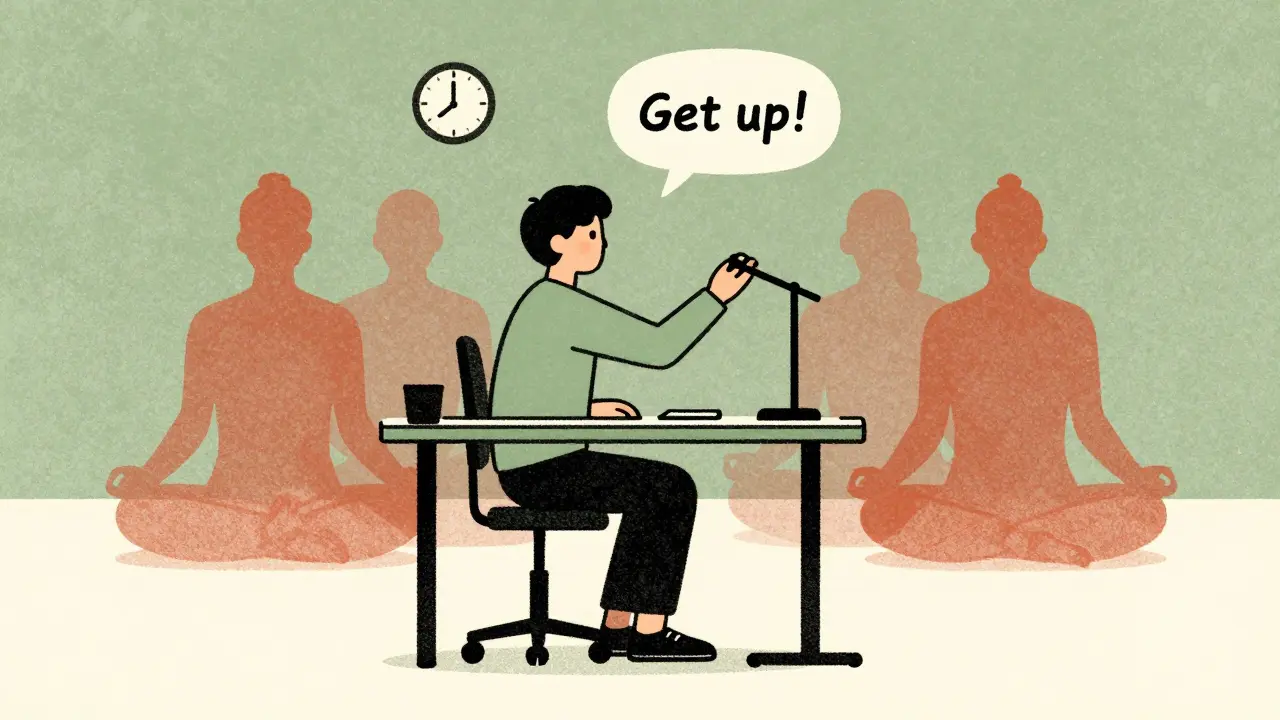
- Sitting cross-legged or in lotus pose - This combines hip flexion with internal rotation - the exact position that stresses the anterior labrum. In fact, 87% of people in an Arthritis Foundation survey said avoiding this single change helped the most.
- High-impact sports - Running, jumping, and tennis put repeated stress on the joint. One Reddit community found that only 29% of people with hip pain could keep running without worsening symptoms. Swimming and elliptical machines were far better choices.
What to Start Doing Instead
You don’t have to give up movement. You just need to tweak it.- Use a raised toilet seat - This reduces hip flexion by 15-20 degrees. A simple $15 device can cut pain during one of the most frequent daily movements.
- Place a wedge cushion in your car - Sitting in a car forces your hips into deep flexion. A foam wedge lifts your pelvis, keeping your hips at a safer angle. Motion studies show this reduces impingement risk by up to 15%.
- Modify your squat - If you need to bend down, keep your hips externally rotated (toes pointing slightly out) and don’t go below parallel. This keeps the femur from jamming into the socket.
- Sleep with a pillow between your knees - This prevents your legs from rolling inward during sleep, which can irritate the labrum overnight.
- Choose low-impact cardio - Swimming, cycling, and the elliptical are gold standards. They keep your heart healthy without pounding your hip.
When Surgery Makes Sense - And When It Doesn’t
Hip arthroscopy to repair a labral tear has an 85-92% satisfaction rate at five years - if you’re young, active, and have early-stage damage. But if you’re over 60 and already have Kellgren-Lawrence Grade 3 or 4 arthritis (severe joint space narrowing), surgery won’t stop the degeneration. In fact, 45% of older patients still end up needing a total hip replacement within five years, regardless of surgery. The big differentiator? Structural anatomy. If your MRI shows a cam-type FAI with an alpha angle over 55 degrees, surgical correction combined with labral repair gives you a 73% better outcome than just physical therapy. But if your joint is already worn down, surgery won’t rebuild cartilage. It might even make things worse by disturbing the joint further. That’s why experts like Dr. Brian White and Dr. Thomas Vail warn against overtreating labral tears in older adults. The tear might be a symptom, not the cause. The real problem is the arthritis.The Invisible Disability
One of the hardest parts of hip pain isn’t the pain itself - it’s the misunderstanding. You look fine. No cast. No crutches. But you can’t sit through a movie, climb stairs without wincing, or play with your kids like you used to. Sixty-eight percent of patients in a Hospital for Special Surgery survey said people didn’t believe how much it affected them. “It’s invisible,” one patient said. “I’m not lazy. I just can’t do what I used to.” This is why education matters. You’re not being dramatic. You’re not weak. Your hip is damaged. And the best way to protect it is to change how you move - every day, in every situation.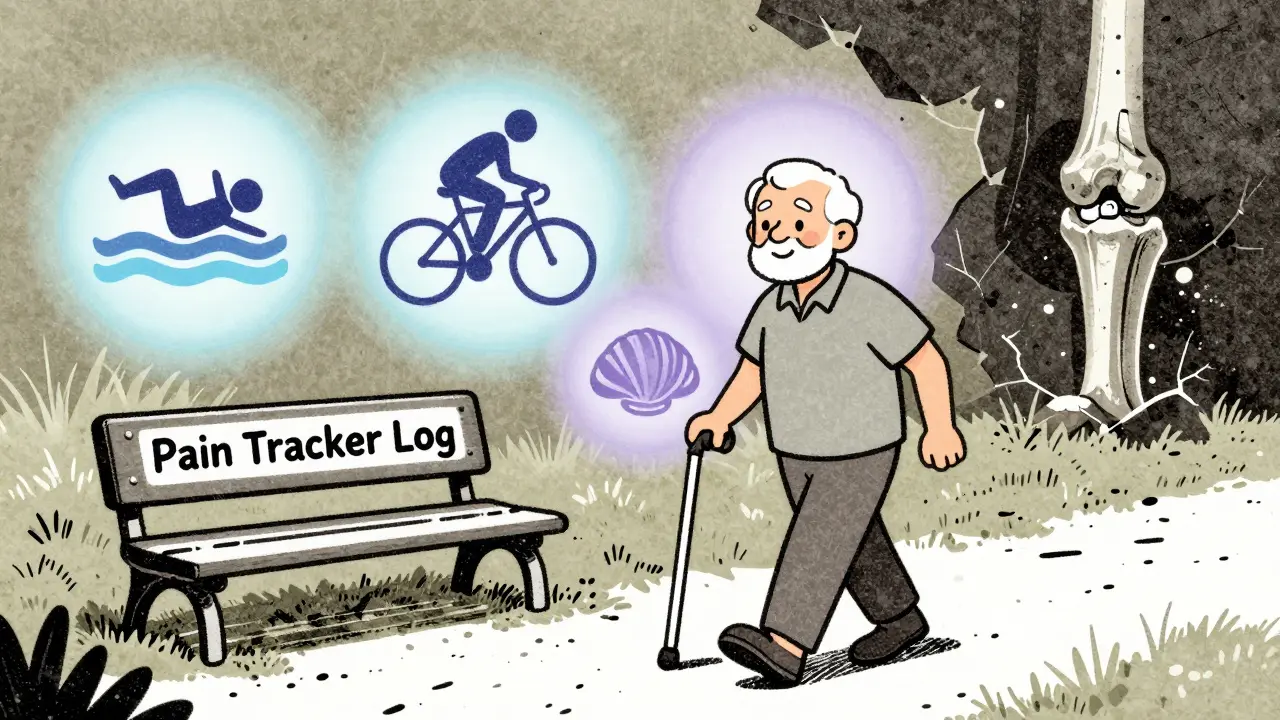
Real-World Tips That Actually Work
Here’s what works based on real patient data and clinical guidelines:- Limit sitting time - Get up every 30-45 minutes. Even a two-minute walk helps.
- Use a chair with armrests - Pushing up with your arms reduces hip strain by 25%.
- Wear supportive shoes - Flat, cushioned shoes reduce impact. Avoid high heels or worn-out sneakers.
- Strengthen your glutes - Weak hip abductors make your pelvis unstable. Exercises like clamshells and side leg raises (done with control, not speed) help significantly.
- Track your pain triggers - Keep a simple log: “Pain after 20 mins of sitting,” “Worse after grocery shopping.” Patterns reveal your personal red zones.
How Long Until You See Results?
Most people notice less pain within 4-6 weeks of consistent activity modification. But it takes 8-12 weeks to retrain your body’s movement patterns. Physical therapy usually involves 6-8 sessions focused on identifying your specific pain triggers and learning safer alternatives. Success isn’t about being pain-free. It’s about reducing pain enough to live. Many people go from being unable to walk to the mailbox to hiking short trails or playing with grandchildren without flinching. The goal isn’t perfection. It’s sustainability. You don’t need to give up everything. Just avoid the 2-3 moves that wreck your hip. Replace them with smarter ones. And stick with it.What’s Next?
If you’ve tried activity modification for 3 months and still have severe pain, it’s time to see a specialist. But don’t rush to surgery. Get a second opinion. Ask for a detailed MRI review. Make sure your doctor checks for FAI, cartilage wear, and labral damage - not just one thing. And if you’re over 60? Focus on preserving function, not chasing a cure. Weight management, low-impact exercise, and smart movement can delay hip replacement by years - sometimes a decade. Your hip doesn’t need to be perfect. It just needs to last.Can a labral tear heal on its own without surgery?
Labral tears rarely heal on their own because the labrum has poor blood supply. But many people find long-term relief without surgery by modifying activities, strengthening surrounding muscles, and avoiding movements that aggravate the tear. Studies show up to 60% of patients with mild tears improve significantly with conservative care - especially if they’re under 50 and don’t have advanced arthritis.
Is walking good for hip arthritis?
Yes - but only if done correctly. Walking is one of the best low-impact exercises for hip arthritis because it keeps the joint lubricated and strengthens muscles without high impact. Keep your pace moderate, wear supportive shoes, and avoid uneven surfaces. If walking causes sharp pain or limping, shorten your distance or switch to a pool or elliptical.
Can sitting too long cause hip pain?
Absolutely. Sitting for long periods keeps your hip in deep flexion, which increases pressure on the labrum and worn cartilage. Desk workers often report pain worsening after 30-45 minutes. Getting up every 30 minutes, using a cushion to lift your hips slightly, or standing desks can make a big difference.
What’s the difference between a labral tear and hip arthritis?
A labral tear is damage to the cartilage rim around the hip socket - often from trauma, overuse, or structural issues like FAI. Hip arthritis is the breakdown of the smooth cartilage covering the ball and socket, usually due to aging or wear. Labral tears cause clicking, catching, or sharp pain with movement; arthritis causes deep, aching pain that worsens with weight-bearing and improves with rest. They often occur together.
Should I get an MRI if I have hip pain?
Not always. Many people over 50 have labral tears on MRI with no symptoms. Imaging should be used to confirm a diagnosis when pain is persistent and matches physical exam findings. If your pain is mild and improves with activity modification, an MRI may not be needed. But if pain is severe, unexplained, or not responding to conservative care, an MRI helps rule out structural causes like FAI or advanced arthritis.
Can I still exercise with hip pain?
Yes - but you need to choose wisely. Avoid deep squats, lunges, high-impact running, and twisting motions. Focus on swimming, cycling, elliptical training, and strength exercises that target glutes and core without stressing the hip joint. A physical therapist can help you design a safe routine. Movement is medicine - but only if it doesn’t damage your joint further.
Comments
Cassie Widders
I switched to using a wedge cushion in my car and my hip pain dropped off a cliff. No more wincing when I get out.
Just one small change and it’s life-changing.
January 11, 2026 AT 12:59
Konika Choudhury
Why are we even talking about this like it’s new? In India we’ve been sitting on the floor for centuries and our hips don’t give out. It’s the Western lifestyle that’s broken.
Stop blaming your chair and start moving right.
January 12, 2026 AT 17:27
Darryl Perry
Activity modification is not a treatment. It’s a cop-out.
Unless you’re addressing the biomechanical root, you’re just delaying the inevitable.
Stop pretending you’re healing when you’re just hiding.
January 13, 2026 AT 12:55
Windie Wilson
Oh wow, so the solution to hip pain is… don’t sit like a human?
Who knew that bending your body at 90 degrees was the secret sin of modern civilization?
Next they’ll tell us not to breathe through our noses.
Thanks for the life-changing advice, Dr. Common Sense.
January 13, 2026 AT 16:51
Daniel Pate
It’s interesting how the body adapts to mechanical stress over time. The labrum isn’t just tissue-it’s a dynamic structure that responds to load distribution. If you remove the repetitive impingement, the joint environment stabilizes, even if the tear doesn’t fully heal.
That’s why symptom reduction ≠ structural repair. The nervous system learns new patterns. Pain is an output, not just an input.
Most people mistake pain for damage. It’s often just a warning signal that’s been stuck on repeat.
January 14, 2026 AT 07:03
Amanda Eichstaedt
I used to do deep squats like my life depended on it. Then I started having this clicking pain that felt like my hip was trying to pop out.
After six months of avoiding anything below parallel and sleeping with a pillow between my knees, the clicking is gone.
I didn’t even know how much I was punishing my body.
Now I do glute bridges and swim laps like it’s my job.
People think I’m lazy because I don’t run anymore. I’m just smart.
My hip didn’t break because I got old. It broke because I ignored the signs.
It’s not about being perfect-it’s about being consistent.
And honestly? I feel more alive now than I did when I was grinding through pain just to prove I could.
January 16, 2026 AT 04:10
Jose Mecanico
I’ve been doing the raised toilet seat thing for three weeks. It’s dumb simple but it works.
Worth every penny.
January 16, 2026 AT 11:02
Alex Fortwengler
They don’t want you to know this but physical therapy is a racket. The real solution? Stop sitting. Stop moving. Go live in a cave.
They sell you cushions and wedges because they make money off your pain.
Doctors don’t want you to heal-they want you to come back.
Labral tears? That’s just Big Pharma’s way of keeping you hooked.
Stop trusting the system.
January 18, 2026 AT 10:34
jordan shiyangeni
Let’s be clear: if you’re engaging in any form of physical activity that involves hip flexion beyond 90 degrees, you are actively sabotaging your joint integrity. This isn’t just ‘modification’-it’s basic biomechanical hygiene. You wouldn’t pour gasoline into your car’s oil tank and expect it to run smoothly, yet you expect your hip to endure decades of pathological loading without consequence. The fact that you need a ‘guide’ to avoid sitting cross-legged speaks volumes about the collective failure of modern education. Your body is not a toy. It’s a precision instrument. And you’ve been treating it like a broken Xbox.
Stop blaming your chair. Start blaming yourself.
January 19, 2026 AT 21:31
Abner San Diego
They say ‘activity modification’ like it’s some revolutionary idea.
Meanwhile, my grandpa worked construction for 50 years, never heard of a labrum, and still walks 3 miles a day at 82.
What’s the real problem here? Maybe it’s not the hip-it’s the fact that we’ve turned movement into a performance.
We sit like zombies, then go to the gym to ‘fix’ ourselves.
Maybe we just need to move more naturally-not follow a 12-step plan from a blog.
January 20, 2026 AT 07:06
steve ker
Western medicine overcomplicates everything
Just rest and stop being weak
January 21, 2026 AT 20:55
George Bridges
I’ve been following this advice for six months. I didn’t expect much, but the difference is real.
My wife says I walk differently now-like I’m not bracing for pain all the time.
It’s not a miracle. It’s just respect for your body.
Thanks for laying it out so clearly.
January 22, 2026 AT 10:25
Faith Wright
So you’re telling me the real villain isn’t age or injury… it’s my couch?
And the hero is a $15 toilet seat?
Well I guess I’ll stop pretending I’m a functional adult and start pretending I’m a 90-year-old with a walker.
At least then I’ll get the cushion.
January 24, 2026 AT 02:02
Rebekah Cobbson
One of my clients was convinced she needed surgery until she started using a wedge cushion and doing clamshells daily.
Three months later, she hiked a mountain trail with her granddaughter.
It’s not about being perfect-it’s about being intentional.
You don’t have to give up everything. Just give up the things that hurt you.
And if you’re not sure what those are? Start keeping a pain log.
It’s not glamorous. But it works.
January 25, 2026 AT 06:47