
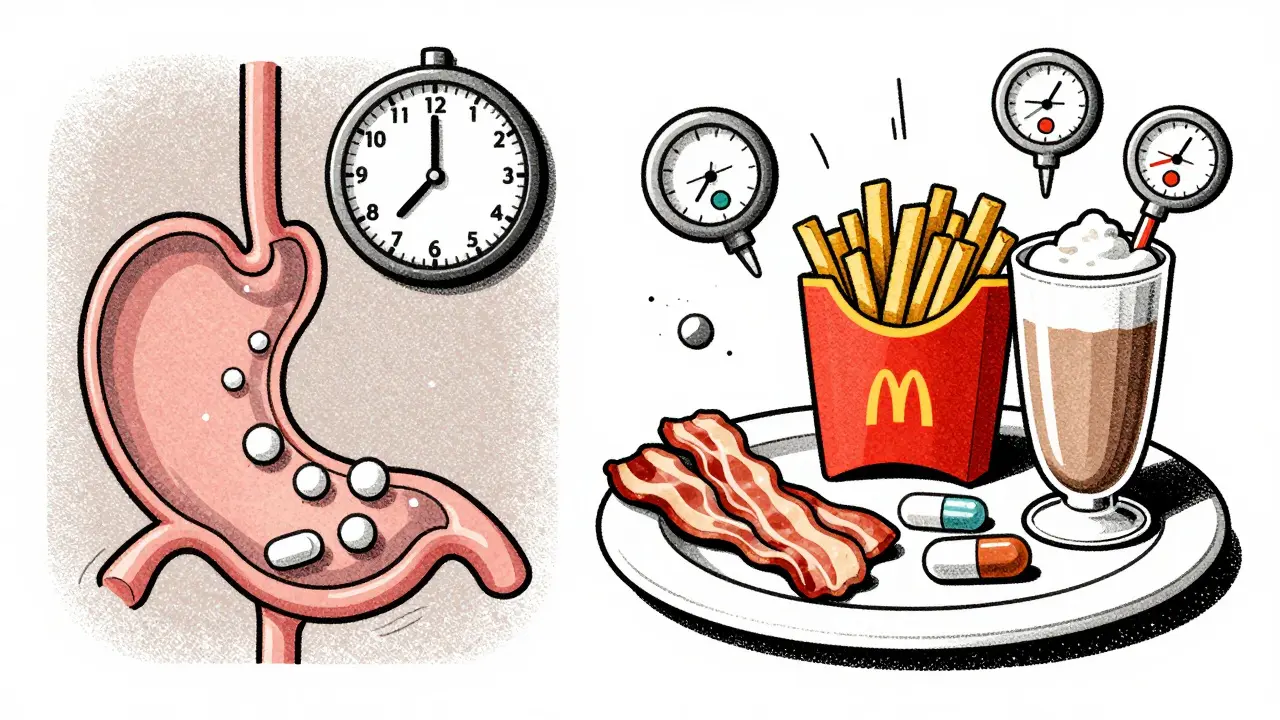
When you take a pill, your body doesn’t always respond the same way. Whether you’ve eaten recently or haven’t touched food in hours can change how much of that drug actually gets into your bloodstream. This isn’t just a minor detail-it’s a core part of how medicines are tested and approved. The same goes for exercise: whether you train on an empty stomach or after a meal can shift how your body burns fuel, how hard you can push, and even how your muscles adapt over time. fasted vs fed state testing isn’t optional-it’s essential for understanding real-world responses in both medicine and fitness.
What Exactly Are Fasted and Fed States?
The terms sound simple, but their definitions are tightly controlled. In pharmaceutical testing, a fasted state means no food for at least 8 to 12 hours, with only water allowed. A fed state isn’t just "after eating"-it’s a standardized meal, usually 800-1,000 calories with 500-600 of those from fat. That’s roughly a bacon cheeseburger with fries and a milkshake. This isn’t arbitrary. It’s designed to mimic the worst-case scenario for drug absorption, where food slows digestion and changes stomach acidity.
In exercise science, fasted training usually means waking up after an overnight fast-no breakfast, just water. Fed-state exercise happens 2-4 hours after eating a meal rich in carbohydrates, often 1-4 grams per kilogram of body weight. These aren’t guesses. They’re lab-tested protocols used in dozens of peer-reviewed studies.
Why the Pharmaceutical Industry Can’t Ignore Fed-State Testing
The FDA and EMA don’t just recommend fed-state testing-they require it for most oral drugs. Why? Because food can make or break a medication’s effectiveness.
Take fenofibrate, a cholesterol-lowering drug. In fed conditions, its absorption jumps by 200-300%. That means a patient who takes it on an empty stomach might get half the dose they need. On the flip side, griseofulvin, an antifungal, absorbs 50-70% less when taken with food. If you didn’t test both states, you’d risk underdosing or overdosing people based on what they ate that day.
Studies using SmartPill capsules-tiny sensors swallowed to track digestion-showed gastric emptying takes 13.7 minutes in a fasted state but 78.3 minutes after a meal. Stomach pH drops from 2.5 to 1.5 when food is present, and pressure inside the stomach spikes consistently above 240 mbar in fed conditions. These aren’t small changes. They directly affect how drugs dissolve and move through the gut.
Since 2021, the EMA has required fed-state testing for any oral drug where food effects are unknown. A review of 1,200 new drug applications found that 35% showed clinically significant changes in absorption due to food. That’s more than one in three drugs where dosing instructions could be wrong if only fasted tests were done.
The Exercise Science Debate: Fat Burner or Performance Killer?
For fitness enthusiasts, the fasted vs fed debate is personal. But the data tells a clearer story than Instagram posts.
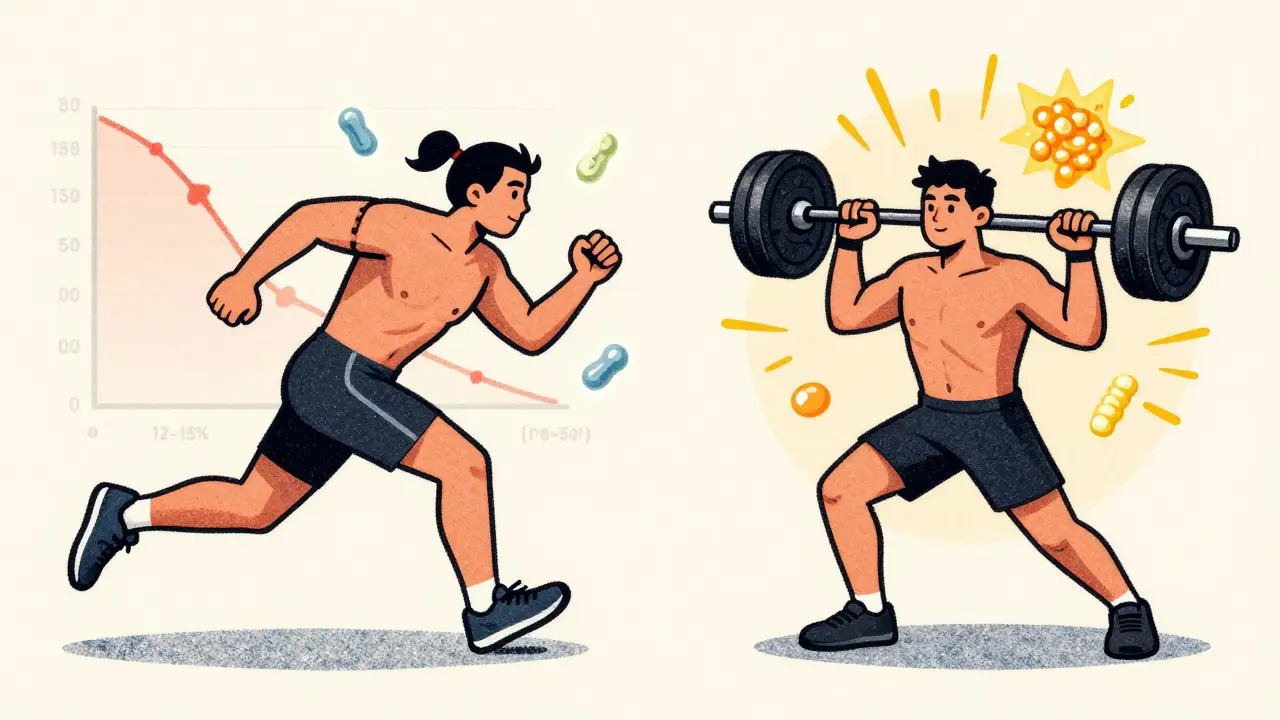
A 2018 meta-analysis of 46 studies found that fed-state exercise improved prolonged aerobic performance by 8.3%. That’s not trivial-it means you can sustain effort longer before fatigue hits. But for workouts under 60 minutes? No difference. So if you’re doing HIIT, strength training, or a short run, eating beforehand doesn’t help much.
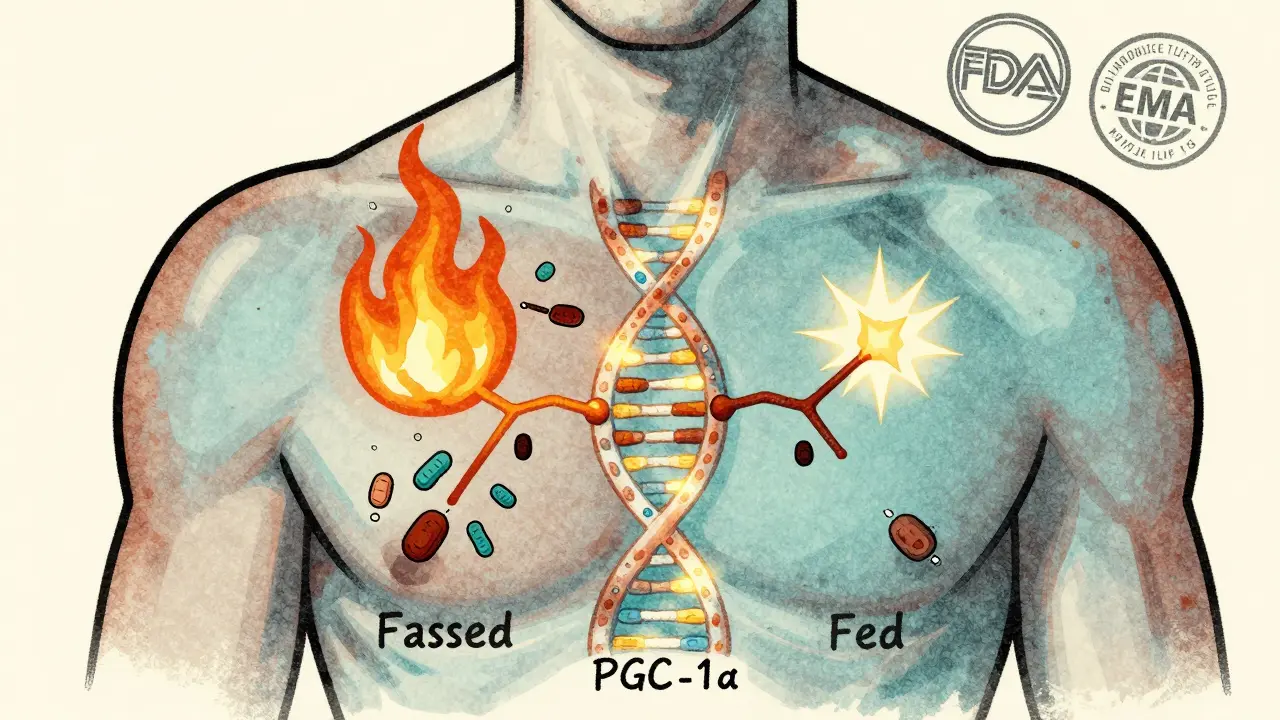
Where fasted training shines is in fat metabolism. Free fatty acid levels in the blood rise 30-50% higher during fasted exercise. Post-workout fat oxidation increases by 27.6%. Your body also ramps up PGC-1α, a gene regulator linked to mitochondrial growth, by 40-50% compared to fed exercise. This suggests fasted workouts may train your body to burn fat more efficiently over time.
But here’s the catch: you can’t push as hard. High-intensity work capacity drops by 12-15% in a fasted state. Your muscles rely on glycogen, and without recent carbs, that fuel is low. That’s why elite endurance athletes like ultramarathoner Scott Jurek train fed to maintain intensity. Meanwhile, CrossFit champion Rich Froning trains fasted to sharpen fat-burning efficiency.
Who Should Train Fasted? Who Should Eat First?
There’s no universal answer. It depends on your goal.
- If you’re training for endurance, competition, or high-intensity performance: eat before. The 8.3% performance boost matters when every second counts.
- If you’re focused on metabolic health, fat loss, or insulin sensitivity: fasted training may help. A 2022 review of 14 trials showed 5-7% greater improvements in insulin sensitivity with fasted workouts.
- If you’re new to exercise or prone to dizziness: start fed. Low blood sugar can cause lightheadedness, especially if you’re not used to it.
And individual variation is huge. A 2022 Reddit survey of 1,247 people found 68% performed better when fed. But in a keto-focused group (r/ketogains), 42% preferred fasted training for fat loss-though 31% reported dizziness and 22% noticed reduced intensity. This isn’t about right or wrong. It’s about personal response.
Genetics and Food: The Next Frontier
Not everyone responds the same way. A 2022 study in Medicine & Science in Sports & Exercise found that genetic variants in the PPARGC1A gene explain 33% of why some people thrive with fasted training and others don’t. This isn’t science fiction-it’s real, measurable biology.
That’s why the field is moving toward personalized protocols. One size doesn’t fit all. Future recommendations may include genetic testing or continuous glucose monitoring to tailor whether you train or take medication fasted or fed.
What About Long-Term Results?
Here’s where things get confusing. A 2021 study in the Journal of the International Society of Sports Nutrition found no difference in body composition after six weeks between fasted and fed training groups-even though acute fat burning differed. That suggests short-term metabolic shifts don’t always translate to long-term fat loss.
So if you’re hoping fasted training will melt away belly fat, don’t count on it alone. Total calorie balance still rules. But if you’re trying to improve how your body uses fat as fuel, fasted sessions can be a powerful tool.
Standardization Is Everything
Whether you’re a researcher or a fitness enthusiast, consistency matters. In pharmaceutical trials, meals must be within ±10% of the exact calorie and fat content. Exercise studies control sleep (minimum 7 hours), hydration (urine specific gravity under 1.020), and even activity the day before (24-hour sedentary period).
Real-world applications don’t always follow these rules. But if you want reliable results-whether you’re testing a new drug or tracking your own progress-you need to control the variables.
What’s Next?
The FDA’s 2023 draft guidance now requires fed-state testing to include diverse ethnic populations. Research shows Asian subjects have 18-22% slower gastric emptying than Caucasian subjects in fed conditions. Ignoring this risks inaccurate dosing for millions.
Meanwhile, the EMA is piloting continuous glucose monitoring during fed-state trials to track real-time metabolic responses. This isn’t just about drugs anymore-it’s about understanding how food shapes biology across the board.
The message is clear: fasted and fed states aren’t opposites. They’re two sides of the same coin. You need both to get the full picture-whether you’re developing a life-saving medication or trying to get fitter.
Why do some drugs work better with food?
Certain drugs, especially those that are fat-soluble, need dietary fat to dissolve properly in the gut. Food also slows stomach emptying and lowers pH, which can help stabilize the drug’s structure. For example, fenofibrate’s absorption increases by 200-300% when taken with a high-fat meal. Without food, the body may absorb too little to be effective.
Can I skip fed-state testing if I always take my medicine with food?
No. Regulatory agencies require testing under both conditions to determine how food affects absorption. Even if you plan to take a drug with food, regulators need to know how much less effective it might be if taken on an empty stomach-especially in cases of missed meals or vomiting. This ensures dosing instructions are safe for everyone.
Does fasted exercise burn more fat long-term?
Fasted exercise increases fat burning during the workout and boosts certain metabolic signals like PGC-1α. But long-term fat loss depends on total calorie balance, not just what fuel your body uses during exercise. Studies show no significant difference in body composition after weeks of fasted vs fed training. So while fasted workouts may improve fat metabolism, they won’t automatically lead to more weight loss.
Why is the fed meal in drug trials so high in fat?
A high-fat meal creates the most challenging condition for drug absorption. Fat delays gastric emptying, reduces stomach acidity, and increases bile production-all factors that can interfere with how a drug dissolves and moves through the gut. Testing under these extreme conditions ensures the drug will work reliably even if taken with a heavy meal.
Should athletes train fasted or fed?
It depends on the sport. Endurance athletes aiming for peak performance should train fed to maintain energy levels and intensity. For athletes focused on metabolic efficiency or fat adaptation-like ultra-runners or weight-class competitors-fasted training can be useful, but it should be periodized. Never do high-intensity sessions fasted if you’re trying to maximize power or speed.
Comments
Agnes Miller
So I tried fasted cardio for a month. Didn’t lose more fat, but I kept blacking out on the treadmill. Not worth it. Fed state for me now. Just eat a banana. Seriously.
February 15, 2026 AT 19:55
Geoff Forbes
Of course the FDA requires fed-state testing. Because obviously, the average American is going to take their statin with a Whopper and a side of regret. I mean, come on. We’re not talking about bioavailability here-we’re talking about cultural collapse.
February 17, 2026 AT 10:48
Kancharla Pavan
You people are missing the point entirely. In India, we’ve been fasting for centuries-not for some trendy gym bro experiment, but for spiritual discipline. And yet, you Westerners turn this into a pharmacological spreadsheet? The arrogance. You test drugs on people who eat fried chicken and then wonder why absorption is inconsistent? Of course it is. You’ve forgotten what food actually is. It’s not fuel. It’s ritual. And you’ve commodified it into a variable in a lab report.
Meanwhile, my grandmother took her ayurvedic herbs on an empty stomach at 4 a.m., and she lived to 98. No FDA. No SmartPill. Just tradition. You’re not studying science-you’re studying your own ignorance.
February 18, 2026 AT 21:20
PRITAM BIJAPUR
There’s a quiet beauty in the duality of fasted and fed states-it’s not just physiology, it’s metaphysics. 🌿 The body, in fasting, becomes a temple of self-reflection. In feeding, it becomes a cathedral of communion with the earth. We forget that drugs and food are not separate from our souls-they are extensions of our relationship with time, with hunger, with life itself.
When you take fenofibrate with a milkshake, you’re not just altering absorption-you’re participating in a modern myth: the illusion that control can be quantified. But biology laughs at our spreadsheets. 🤍
February 19, 2026 AT 01:47
Dennis Santarinala
Love this post. So many people treat this like a binary-fasted OR fed-but it’s more like a dial. Some days, I’m fasted. Some days, I eat a protein shake before lifting. Both are valid. The key? Consistency. Track how you feel. Not what some guru says. Not what the FDA says. What YOUR body says. 🙌
February 19, 2026 AT 07:27
Tony Shuman
Oh great. Now we’re standardizing meals for drug trials? Next they’ll mandate how many scoops of protein powder you eat before a workout. Meanwhile, in real America, people take their pills with coffee, soda, or whatever’s in the cup. This isn’t science-it’s bureaucratic theater. And it’s why nobody trusts doctors anymore.
February 21, 2026 AT 02:24
Logan Hawker
Let’s be real: the entire fed-state paradigm is a regulatory farce designed to sell more drugs. If your medication’s efficacy hinges on whether someone ate a bacon cheeseburger, maybe the drug’s just poorly formulated? Also, why is no one talking about how 78% of clinical trial subjects are white males? The EMA’s new ethnic diversity requirement? Too little, too late. We’ve been testing drugs on people who don’t exist for decades.
February 22, 2026 AT 02:48
Digital Raju Yadav
Western science is obsessed with control. In India, we don’t need SmartPills. We have Ayurveda. We have centuries of observational wisdom. You reduce the human body to pH levels and gastric emptying times? You ignore the pulse, the tongue, the constitution. This is not progress. This is reductionism masquerading as innovation. And now you want to export your flawed models globally? Shameful.
February 23, 2026 AT 19:44
Brenda K. Wolfgram Moore
Just wanted to say-I’m a nurse, and I’ve seen patients skip meds because they forgot to eat. Or took them with orange juice and had a bad reaction. This isn’t theoretical. It’s daily. I wish more people knew how much food affects meds. Thanks for explaining it so clearly.
February 25, 2026 AT 13:27
Linda Franchock
So let me get this straight: you’re telling me I should eat a 1000-calorie, fat-loaded meal before taking my antifungal… so I can absorb it better? And then you say fasted training burns more fat? So I should fast to burn fat… but eat a burger to take my pill? Are we just playing Russian roulette with our biology now? 😏
February 26, 2026 AT 10:02
James Lloyd
One thing missing from this discussion: circadian rhythm. Fasted state at 6 a.m. isn’t the same as fasted at 3 p.m. Your cortisol, insulin sensitivity, and gut motility all shift. Studies that treat ‘fasted’ as a universal state are oversimplifying. Same with meals-a 700-calorie breakfast isn’t the same as a 700-calorie dinner. Context matters more than labels.
February 27, 2026 AT 10:48
Philip Blankenship
I’ve been doing fasted strength training for two years. My lifts haven’t dropped. My recovery’s better. I feel sharper. But I also don’t do HIIT or long cardio on an empty stomach. It’s not all or nothing. I do fed for endurance, fasted for lifting. And I sleep 8 hours. That’s the real secret. No one talks about sleep. You can’t optimize one variable if you’re wrecking another.
February 27, 2026 AT 11:56
Adam Short
Of course the Americans care about fed-state testing. They eat like they’re in a food coma 24/7. Meanwhile, in the UK, we have a cuppa tea and a biscuit. That’s our fed state. No 1000-calorie cheeseburgers. Just tea. And yet, our drug regulators still require the same protocols. It’s cultural imperialism disguised as science.
February 28, 2026 AT 05:00
Sam Pearlman
Wait, so if I take my pill after a salad, does that count as fasted? What if I drank a protein shake? Is that food? What if I ate a single almond? Are we now going to have a fed-state police force? This is why I hate science. It’s never simple. It’s always ‘it depends.’
March 2, 2026 AT 01:34
Steph Carr
My Nigerian auntie takes her hypertension meds with a piece of pap and stew. No one told her about fed-state trials. She’s 82. Still cooking. Still walking. Still alive. Maybe the real lesson here isn’t about absorption-it’s about community, routine, and not overthinking food. Sometimes, the best science is the one that doesn’t need a lab.
March 3, 2026 AT 10:01