

Warfarin Estrogen Interaction Calculator
Estrogen-Warfarin Interaction Estimator
Based on clinical data from the INR Registry and American College of Chest Physicians guidelines.
When you're on warfarin, even small changes in your routine can throw off your blood thinning levels. One of the most common but often misunderstood triggers? Estrogen. Whether it's birth control pills, hormone replacement therapy, or menopause treatment, estrogen can shift your INR in ways that are hard to predict-and potentially dangerous.
How Estrogen Changes How Warfarin Works
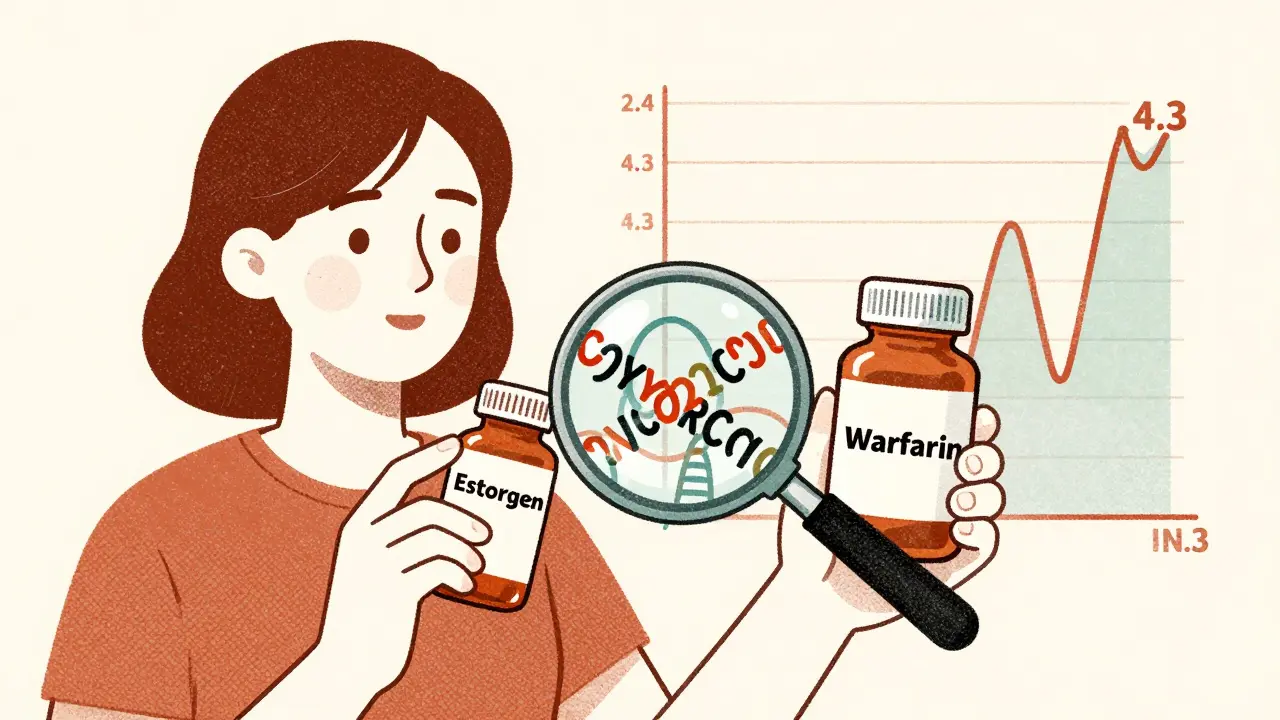
Warfarin doesn't just float through your body unchanged. It gets broken down by liver enzymes, mostly CYP2C9, CYP1A2, and CYP3A4. Estrogen compounds mess with these enzymes, but not in the same way every time. Natural estradiol (like the kind your body makes) can speed up warfarin breakdown, making it less effective. Synthetic ethinyl estradiol (found in most birth control pills) does the opposite-it slows down metabolism, letting warfarin build up and raising your risk of bleeding.This isn't just theory. In a 2009 case study, a 28-year-old woman started taking a birth control pill containing ethinyl estradiol. Within five days, her INR jumped from 2.4 to 4.3-well above the safe range. Her warfarin dose had to be cut from 5 mg to 3.5 mg just to get back to normal. That’s not rare. The INR Registry found women on estrogen-based contraceptives were nearly twice as likely to have INR levels over 4.0 compared to those not taking estrogen.
Why Some People See the Opposite Effect
You might hear stories where someone’s INR dropped after starting estrogen. That’s real too. One Reddit user reported their INR fell from 2.5 to 1.8 after beginning hormone replacement therapy. Their hematologist was surprised. Why the difference?It comes down to the type of estrogen, the dose, and your genes. Natural estrogens like estradiol can induce CYP enzymes over time, increasing warfarin clearance. Synthetic estrogens like ethinyl estradiol inhibit those same enzymes, especially CYP1A2 and CYP2C19. The result? Two opposite effects from two different compounds. Add in genetic variations-like CYP2C9*2 or *3 alleles-and things get even trickier. People with these variants already clear warfarin slower. Throw estrogen into the mix, and you’re playing with fire.
How This Compares to Other Drug Interactions
Not all drug interactions with warfarin are created equal. Antibiotics like ciprofloxacin or trimethoprim-sulfamethoxazole can spike INR by 2.5 to 3 times, often leading to serious bleeding. SSRIs like fluoxetine double the bleeding risk. Amiodarone? It can force warfarin dose reductions of 30-40%.Estrogen interactions are quieter-but no less important. Most cause INR shifts of 0.5 to 1.5 units. Sounds small? Not when you’re on warfarin. A 0.5-point rise can push you from a safe 2.5 to a risky 3.0. A 1.5-point jump can land you at 4.0, where bleeding risk spikes dramatically. According to the American College of Chest Physicians, these fluctuations are responsible for a measurable share of anticoagulation-related hospital visits.
Who’s Most at Risk?
It’s not just about taking estrogen. It’s about who you are. Women between 18 and 45 on birth control are at highest risk. So are postmenopausal women on hormone therapy, especially those with existing heart conditions or a history of clots. People with liver disease or those already on multiple medications are more vulnerable too.Genetics play a huge role. If you carry the VKORC1 -1639G>A variant, you need 30-50% less warfarin to stay in range. Add estrogen, and you’re even more sensitive. A 2017 study showed that patients with these genetic markers had much larger INR swings when estrogen was introduced. Yet, most doctors don’t test for this. That’s a gap.
What Doctors Should Do-And What You Should Ask For
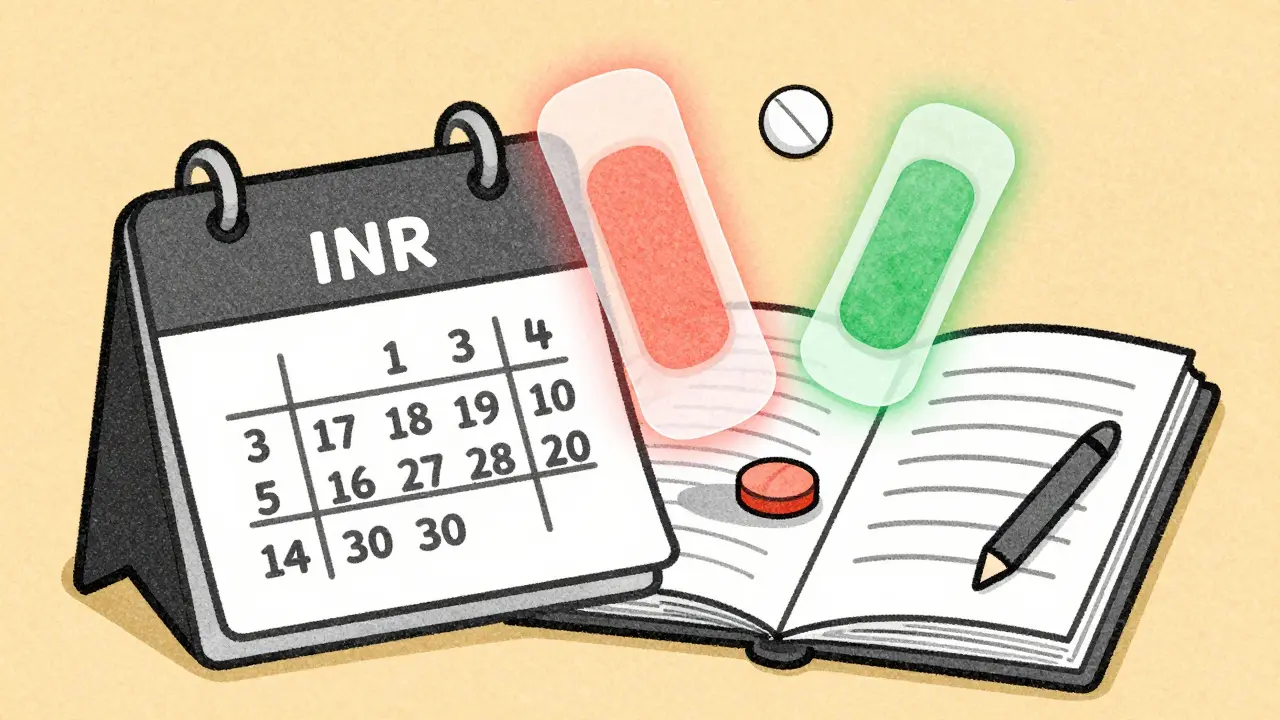
The American Society of Health-System Pharmacists says INR should be checked within 3 to 5 days after starting or stopping estrogen. Another check at 7 to 14 days is wise. Dose adjustments? Usually 10-25% up or down, depending on whether estrogen is boosting or suppressing warfarin.But here’s the problem: 57% of pharmacists say it’s hard to tell if an INR change is from estrogen, diet, illness, or something else. Vitamin K intake (from leafy greens), alcohol, fever, or even a new antibiotic can mimic estrogen’s effect. That’s why tracking matters. Keep a log: what you took, when you took it, and your INR results. Bring it to your appointment.
Ask your doctor: "Could my estrogen be affecting my warfarin? Should I get tested for CYP2C9 or VKORC1 variants?" The International Warfarin Pharmacogenetics Consortium has a dosing algorithm that uses your genes to predict the right warfarin dose. It’s 30-35% more accurate than guessing. If your clinic doesn’t offer genetic testing, ask why.
What About Newer Blood Thinners?
Direct oral anticoagulants (DOACs) like apixaban and rivaroxaban don’t interact with estrogen the same way. That’s why their use has exploded-from 15% of prescriptions in 2013 to 68% in 2022. But DOACs aren’t for everyone. If you have a mechanical heart valve, severe kidney disease, or antiphospholipid syndrome, warfarin is still your best-and sometimes only-option.That means estrogen-warfarin interactions aren’t going away. The American College of Cardiology expects 1.8 million Americans to still be on warfarin in 2030. For those people, understanding this interaction isn’t optional. It’s essential.
Real-World Tips for Managing This Interaction
- Never start or stop estrogen without telling your anticoagulation provider.
- Get your INR checked within 5 days of any change in estrogen therapy.
- Keep a consistent diet-don’t suddenly eat a salad every day or go vegan.
- Track your alcohol intake. Even moderate drinking can affect warfarin.
- Use an app or paper log to record your INR, doses, and any new medications or supplements.
- If you’re on birth control and your INR is unstable, ask if switching to a progestin-only pill might help.
Some women find that switching from combination pills (estrogen + progestin) to progestin-only options reduces INR swings. Others do better with a lower-dose estrogen patch instead of pills. These aren’t one-size-fits-all solutions-but they’re options worth exploring with your care team.
The Bottom Line
Estrogen doesn’t always make warfarin more dangerous. Sometimes it makes it less effective. The key is knowing which one you’re dealing with-and catching it early. This isn’t a warning to avoid estrogen. It’s a call to be smart about it. With proper monitoring, genetic awareness, and communication, you can safely manage both your hormones and your blood thinning.Warfarin is old, but it’s still vital. Estrogen is common. Together, they need careful attention. Don’t assume it’s just "normal fluctuation." Ask questions. Track your numbers. Advocate for yourself. Your next INR result could be the difference between staying safe and ending up in the ER.
Can I take birth control while on warfarin?
Yes, but it requires close monitoring. Estrogen in birth control pills can raise or lower your INR, depending on the type and your genetics. Your INR should be checked within 3-5 days of starting the pill and again at 7-14 days. Your warfarin dose may need adjustment. Progestin-only pills are often a safer alternative if estrogen causes instability.
Does hormone replacement therapy (HRT) affect warfarin?
Yes. Both oral and transdermal estrogen in HRT can alter warfarin levels. Oral estrogen is more likely to cause interactions because it passes through the liver first. Transdermal patches have a lower risk but aren’t risk-free. Always check your INR after starting or changing HRT. Dose changes of 10-25% are common.
Why did my INR go up when I started estrogen?
Synthetic estrogens like ethinyl estradiol inhibit liver enzymes (CYP1A2 and CYP2C19) that break down warfarin. This causes warfarin to build up in your blood, increasing your INR and bleeding risk. This is most common with birth control pills and some HRT formulations. Your doctor may need to lower your warfarin dose.
Can genetic testing help with estrogen-warfarin interactions?
Yes. Testing for CYP2C9 and VKORC1 gene variants can predict how sensitive you are to warfarin. People with certain variants need lower doses and are more vulnerable to interactions with estrogen. The IWPC dosing algorithm uses this data to improve accuracy by 30-35%. Ask your provider if genetic testing is available and appropriate for you.
Should I switch from warfarin to a DOAC if I’m on estrogen?
It depends. DOACs like apixaban or rivaroxaban have far fewer interactions with estrogen and are safer for many people. But if you have a mechanical heart valve, severe kidney disease, or antiphospholipid syndrome, DOACs aren’t recommended. Warfarin remains the standard for these conditions. Talk to your cardiologist or hematologist before switching.
How long does it take for estrogen to affect my INR?
Effects can appear as early as 3 days after starting estrogen, but full impact usually takes 5-7 days. That’s why INR checks are recommended within 3-5 days of starting or stopping estrogen therapy. Don’t wait until your next scheduled test.
Can I stop my estrogen pill if my INR gets too high?
No-don’t stop estrogen on your own. Abruptly stopping can cause rebound effects, including blood clots. Instead, contact your anticoagulation provider immediately. They may adjust your warfarin dose, switch your estrogen formulation, or recommend temporary monitoring until stability returns.
Are there any supplements I should avoid with estrogen and warfarin?
Yes. Supplements like garlic, ginkgo, ginger, and high-dose vitamin E can increase bleeding risk when combined with warfarin. St. John’s wort can lower warfarin levels. Even fish oil in large amounts can interfere. Always tell your provider about everything you take-including vitamins and herbal products.
Comments
Priyanka Kumari
Just wanted to say this post is incredibly well-researched and practical. As someone who manages anticoagulation for patients in a rural clinic in India, I see this exact issue all the time-especially with women on HRT who don’t realize their INR isn’t "just fluctuating." The genetic angle is critical and often ignored. We need more awareness like this.
Pro tip: Always pair estrogen changes with a 3-day INR check. It’s not optional. It’s survival.
Thanks for writing this.
January 13, 2026 AT 23:58
John Pope
Oh wow. Another ‘warfarin is dangerous’ fearmongering piece. Let me guess-next you’ll tell me breathing oxygen is risky because it oxidizes hemoglobin?
The truth? Estrogen’s effect on INR is *mild* for most people. The real problem is lazy clinicians who don’t bother to track trends. I’ve seen INRs swing 2.0 to 3.5 because someone ate kale for the first time in 6 months and panicked. Don’t blame estrogen. Blame the system that turns every bump into a crisis.
Also, DOACs aren’t magic. They’re just expensive. And if you have a mechanical valve? Good luck finding a doctor who’ll switch you. So stop pretending this is a problem we can ‘solve’ with genetics and apps.
January 14, 2026 AT 08:37
Clay .Haeber
So let me get this straight: you’re telling me my birth control is secretly a warfarin saboteur? 🤯
Thanks for making me feel like my hormones are a rogue AI trying to kill me. I mean, sure, I’ll get my INR checked-but also, can we please stop treating every woman’s body like a chemistry lab with a death wish?
Also, I switched to a patch. My INR didn’t budge. So maybe it’s not estrogen. Maybe it’s just… you. The medical industrial complex. The algorithm. The fact that your doctor has 7 minutes per patient.
Also, I’m 29 and I’ve been on this combo for 5 years. Still alive. So… maybe chill?
✌️🫶
January 14, 2026 AT 09:55
Alan Lin
Thank you for the meticulous breakdown. This is precisely the kind of clinical insight that saves lives.
As a physician in a tertiary care center, I’ve seen three patients admitted for intracranial hemorrhage in the past year due to undetected estrogen-warfarin interactions. All were women between 35 and 48. All had been told their INR changes were "normal."
Genetic testing is not a luxury-it’s a necessity. The IWPC algorithm is underutilized because of reimbursement barriers, not clinical irrelevance. We need policy change, not just patient education.
Also, please note: transdermal estrogen carries lower risk, but not zero. And yes, progestin-only options are preferable for many. But access is uneven. This isn’t just a medical issue. It’s a social justice issue.
Advocate. Track. Question. Repeat.
January 15, 2026 AT 07:28
Trevor Whipple
yo i was on warfarin for afib and started the pill and my INR went to 5.2 and i almost bled out. i thought it was the flu. turns out it was my birth control. my doc didn’t even ask me if i was on it. like wtf. i had to go to er. they gave me vit k. i cried. don’t be like me. tell your doctor EVERYTHING. even if you think it’s "nothing".
also i switched to depo. no more drama. 10/10 recommend.
January 16, 2026 AT 22:12
vishnu priyanka
Bro, I’m from India and I’ve seen this in my auntie-started HRT, INR went nuts, doc just said "take less warfarin" without checking anything. No genetic test. No tracking. Just vibes.
Meanwhile, my cousin in the US got tested for CYP2C9 and now she’s on a patch and her INR’s stable as hell. It’s not about money-it’s about awareness. We need more of this in developing countries too.
Also, if you’re on warfarin and you’re Indian? Your diet’s probably full of turmeric and curry leaves. Those can mess with INR too. It’s not just estrogen. It’s everything.
Stay safe. Log everything. Even if you think it’s dumb.
January 17, 2026 AT 23:43
Lethabo Phalafala
I’m a nurse in Johannesburg and I’ve seen this too many times. A woman on warfarin starts estrogen-INR spikes, she gets dizzy, she thinks she’s getting sick. She goes to the clinic. They give her antibiotics. She gets worse. By the time someone realizes it’s the estrogen? She’s in ICU.
It’s not the estrogen. It’s the silence. The stigma. The assumption that women are just "hormonal" and their symptoms aren’t real.
This post? It’s not just medical. It’s feminist. It’s urgent. Thank you.
Someone please print this and put it in every clinic in Africa.
January 17, 2026 AT 23:59
Avneet Singh
Oh please. This is the same tired narrative. Estrogen? Warfarin? Please. The real interaction is between the pharmaceutical industry and the medical establishment’s need to overmedicalize normal physiology.
INR fluctuations are normal. The body is not a lab. The warfarin dose should be adjusted based on clinical context-not genetic fairy tales and algorithmic dogma.
And DOACs? They’re even more dangerous in real-world use. No reversal agents. No monitoring. Just a pill and a prayer.
Stop treating women like fragile lab rats with hormones that need to be regulated like nuclear waste.
January 19, 2026 AT 14:06
Adam Vella
Let us not conflate pharmacokinetics with pharmacodynamics. The interaction between ethinyl estradiol and CYP1A2 inhibition is well-documented in the Journal of Clinical Pharmacology (2011, Vol. 51, Issue 4). The magnitude of INR elevation is dose-dependent and exhibits a biphasic pattern: an initial phase of enzyme inhibition followed by a delayed induction phase in some individuals with wild-type CYP2C9.
Moreover, the VKORC1 -1639G>A polymorphism confers a 35% reduction in warfarin clearance, which, when combined with estrogen-mediated enzyme suppression, results in a geometric increase in bleeding risk-not merely additive, but multiplicative.
It is not anecdotal. It is not speculative. It is biochemistry. To dismiss this as "hormonal drama" is not only scientifically ignorant-it is clinically negligent.
The American College of Chest Physicians guidelines are clear: INR monitoring within 72 hours is mandatory. Failure to adhere constitutes a breach of standard of care.
Let us not mistake accessibility for adequacy. Genetic testing is not a luxury. It is a pillar of precision medicine. And until our systems prioritize it, women will continue to bleed out in silence.
January 19, 2026 AT 19:58
Angel Tiestos lopez
bro i just wanna live my life 🥲
my doc said "just check your INR every 2 weeks" and i do. i eat salad. i drink wine. i take my pill. i don’t cry over numbers.
if my INR’s at 2.8? cool. if it’s 3.5? i call my nurse. she says "wait 3 days, don’t change anything." i do. it goes back.
we’re not machines. our bodies are messy. we’re not supposed to control every variable.
also i love my estrogen. it lets me be me. don’t make me feel guilty for existing.
❤️🫶
January 21, 2026 AT 00:58
Lance Nickie
nah the real issue is doctors don’t listen. i had the same thing. INR jumped. they blamed my diet. i said "i haven’t changed my greens in 3 years." they still didn’t check my birth control. took me 3 months to get them to test it. by then i was on a 2-week hospital stay.
so yeah. estrogen? maybe. but the real villain? your doctor’s ego.
January 21, 2026 AT 10:33
Nelly Oruko
Thank you for the clarity. As a woman who has lived with anticoagulation for 12 years, I can confirm: estrogen changes everything. But so does stress, sleep, and the moon. The key is not fear-it’s partnership. With your doctor. With your data. With yourself.
Track. Don’t guess.
Advocate. Don’t apologize.
You are not a statistic. You are a person with a right to safe, informed care.
January 22, 2026 AT 23:59