
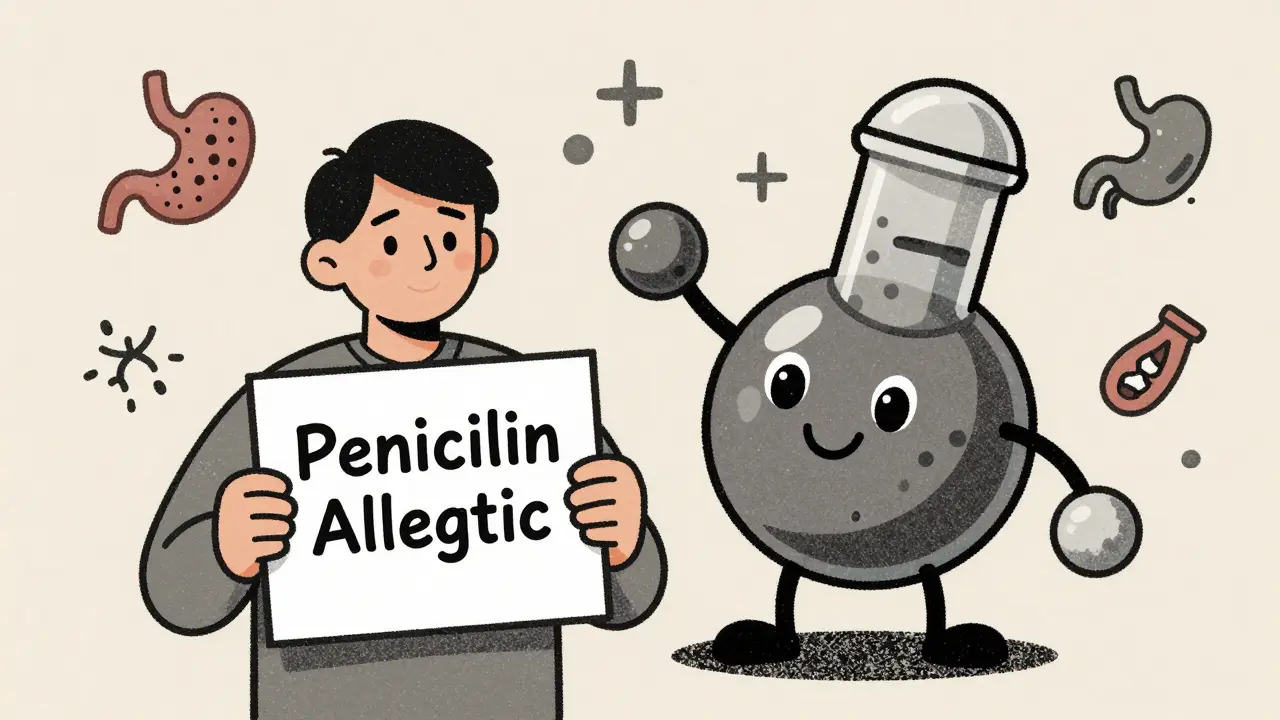
More than 10% of people in the U.S. say they’re allergic to penicillin. But here’s the twist: up to 90% of them aren’t. That’s not a typo. Most people who think they’re allergic to penicillin can safely take it again - if they get the right evaluation. The same goes for NSAIDs like ibuprofen and aspirin. What looks like an allergy is often just a side effect, a rash, or a stomach upset. But when a true allergy exists - and it does - the consequences can be life-threatening. That’s where desensitization protocols come in. They’re not magic. They’re science. And they’re changing how we treat patients who need critical drugs but can’t take them because of a mislabeled allergy.
What Really Counts as a Drug Allergy?
Not every bad reaction to a drug is an allergy. An allergic reaction means your immune system is involved. It’s not just nausea or dizziness. It’s your body treating the drug like an invader. Symptoms include hives, swelling of the lips or tongue, trouble breathing, low blood pressure, or anaphylaxis. These usually show up within an hour. That’s called an immediate-type reaction. It’s IgE-mediated, meaning your body makes antibodies that trigger a fast, dangerous response.
But here’s where things get messy. Many people report a penicillin allergy from childhood - maybe they got a rash after taking amoxicillin as a kid. That rash? Often not an allergy. It could’ve been a virus, a side effect, or even a reaction to another drug. The same goes for NSAIDs. People say they’re allergic to ibuprofen because it gave them a headache or upset stomach. That’s not an allergy. That’s an intolerance. True NSAID allergies are rare. They usually involve hives, swelling, or asthma flare-ups - not just a tummy ache.
Doctors used to take patient reports at face value. But now we know better. Labeling someone as penicillin-allergic without testing leads to worse outcomes. They get broader-spectrum antibiotics like vancomycin or ciprofloxacin. Those are more expensive, harder on the gut, and can lead to drug-resistant infections. Studies show patients with a penicillin allergy label cost hospitals about $500 more per admission. That’s not just a medical issue - it’s a financial one too.
Penicillin Allergy: The Most Misunderstood Drug Reaction
Penicillin and related drugs - like amoxicillin, ampicillin, and cephalosporins - are the most common cause of reported drug allergies. But skin testing for penicillin is one of the most accurate tools we have. The test uses two main components: penicillin G and a molecule called PPL (Prepared Penicillin Polylysine). But here’s the catch: PPL is outdated. Up to 70% of people who test positive to PPL don’t react to penicillin itself. They just react to the test chemical. That’s why the American Academy of Allergy, Asthma & Immunology (AAAAI) says PPL shouldn’t be used anymore.
The right way to test? Use benzylpenicillin (Penicillin G) and a minor determinant mixture (MDM). If both tests are negative, the next step is an oral challenge. Give the patient a full dose of amoxicillin under observation. If no reaction happens, they’re not allergic. Done. No more lifelong restrictions. No more unnecessary antibiotics. Just a simple, safe, effective test.
But what if the skin test is positive? That doesn’t always mean you can’t take penicillin again. Some people with positive tests still tolerate it. That’s why doctors now use a combination of history, testing, and challenge - not just one step. A positive test without a clear history of a severe reaction? It might not mean much.
NSAID Allergies: Different Mechanism, Different Rules
NSAID allergies don’t work like penicillin allergies. They’re often not IgE-mediated. Instead, they involve the way your body handles prostaglandins. When you take aspirin or ibuprofen, your body blocks enzymes that make inflammatory chemicals. In some people, that causes a buildup of other chemicals that trigger asthma, hives, or nasal swelling. This is called aspirin-exacerbated respiratory disease (AERD). It’s not a classic allergy, but it’s still dangerous.
For these patients, desensitization works differently. Instead of a one-time IV protocol, they need daily dosing. Start with 30 mg of aspirin. Increase by 30 mg every few hours. Go up to 60 mg, then 100 mg, then 325 mg. Do this daily for weeks. Once they’re desensitized, they can stay on a maintenance dose - often 325 mg daily - and their symptoms improve. They can even take other NSAIDs after that. It’s not just about letting them take one dose. It’s about changing their long-term tolerance.
This is why you can’t treat NSAID allergies the same way you treat penicillin allergies. One is a single-event protocol. The other is a long-term therapy. And the outcomes are different too. Desensitizing someone to aspirin can reduce their asthma attacks, clear their sinuses, and improve their quality of life. That’s not just avoiding a reaction - it’s treating a disease.
How Desensitization Works: The 12-Step Protocol
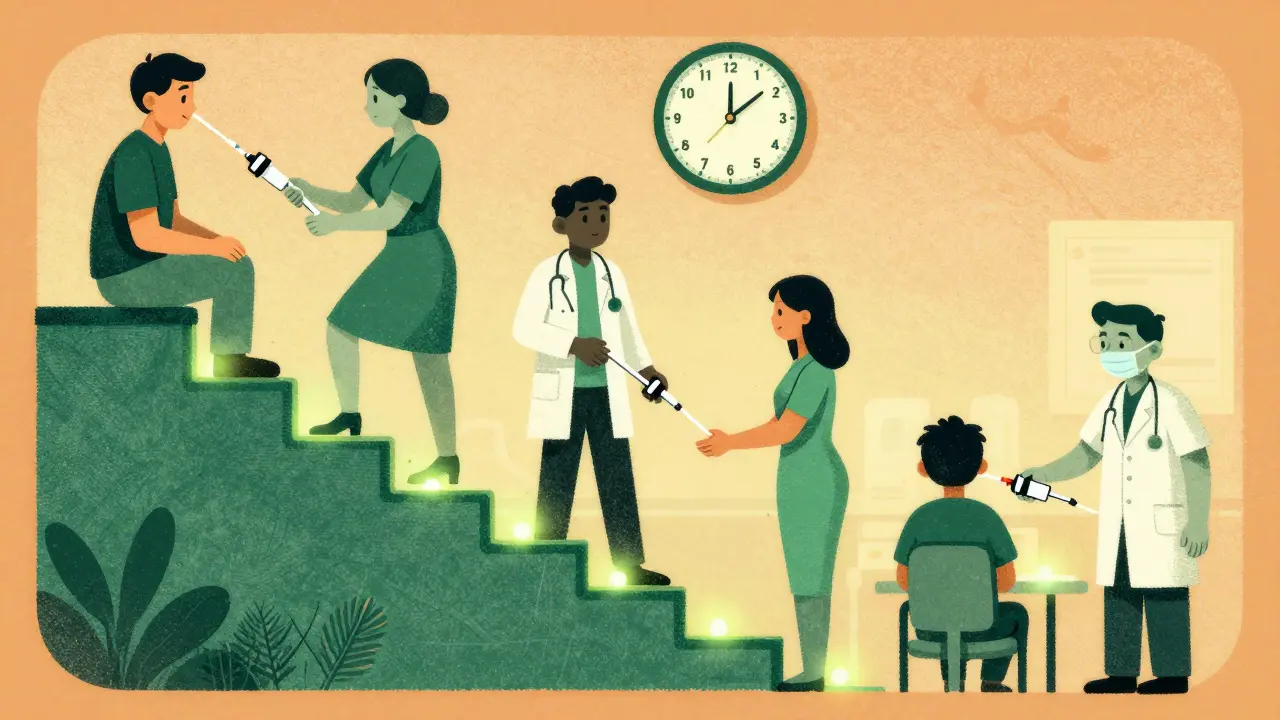
Desensitization isn’t a gamble. It’s a carefully controlled process. The most common method is the 12-step protocol, developed at Brigham and Women’s Hospital. It’s used for beta-lactam antibiotics like penicillin, cefazolin, and ceftriaxone.
Here’s how it works:
- Three solutions are prepared: one with the full therapeutic dose (Solution 3), one 10 times weaker (Solution 2), and one 100 times weaker (Solution 1).
- The patient starts with a tiny amount - one ten-thousandth of the target dose.
- Every 15 to 20 minutes, the dose doubles.
- By the end of 4 to 8 hours, they’ve received the full dose.
Some protocols are even faster. For certain cephalosporins, a 2-hour and 15-minute schedule has been used successfully. Doses are tripled every 15 minutes. No major side effects. No anaphylaxis. Just a smooth ramp-up.
The goal? Temporarily trick the immune system. By slowly flooding it with the drug, you prevent the massive release of histamine and other chemicals that cause reactions. It’s like training your body to ignore the drug. But here’s the catch: it only lasts as long as you keep taking it. Once you stop, the tolerance fades. You’ll need to go through the whole process again next time.
And yes - it’s risky. If a patient starts having trouble breathing or their blood pressure drops, you stop. You give epinephrine. You call for help. That’s why this is done only in hospitals, with allergy teams and emergency gear on standby. No home trials. No shortcuts.
Who Gets Desensitized - and Who Doesn’t?
Not everyone qualifies. There are strict rules:
- You must have a confirmed immediate-type reaction (within 1 hour) to the drug.
- You must need that specific drug - no safe alternative exists.
- You must be in a setting where emergency treatment is immediately available.
That’s why desensitization is most common in three situations:
- Severe infections: Like endocarditis or meningitis, where penicillin is the only effective antibiotic.
- Cancer treatment: Patients allergic to paclitaxel or docetaxel - common chemo drugs - can be desensitized to receive life-saving therapy.
- Chronic conditions: Like rheumatoid arthritis or heart disease, where NSAIDs or antibiotics are essential.
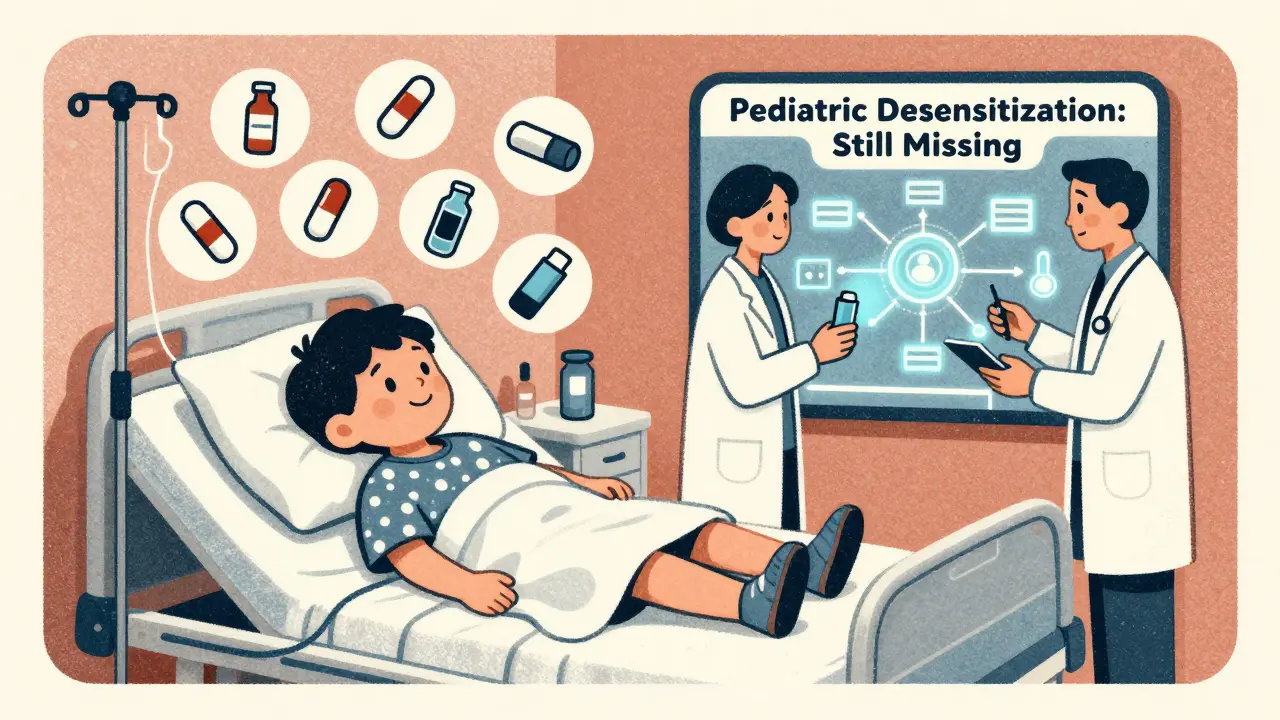
But here’s what’s missing: children. Most protocols were designed for adults. Pediatric allergists are still adapting them. A 2019 review in the Journal of Allergy and Clinical Immunology found that only a handful of studies focus on kids. That’s a problem. Kids with cancer, cystic fibrosis, or recurrent infections need these drugs too. But without pediatric-specific guidelines, doctors are guessing.
And what about non-IgE reactions? The field is expanding. Some patients with delayed rashes or liver reactions are now being desensitized too. That’s new. That’s experimental. But it’s happening.
The Big Problem: Underuse and Misinformation
Despite all this, desensitization is still rare. Why? Because most doctors don’t know how to do it. Most hospitals don’t have the team. Most patients don’t even know it’s an option.
Here’s the irony: a patient walks in saying, “I’m allergic to penicillin.” The doctor says, “Okay, we’ll use something else.” No testing. No challenge. No referral. Just avoidance. That’s the default. But avoiding penicillin doesn’t make them safer - it makes them sicker.
The fix? Better education. Better protocols. Better collaboration. Allergists need to work with infectious disease doctors, oncologists, and pediatricians. A patient with leukemia shouldn’t have to choose between a life-saving chemo drug and a misdiagnosed allergy. They shouldn’t have to wait months to get a referral. They need a pathway - right now.
And it’s not just about penicillin. It’s about aspirin. It’s about vancomycin. It’s about monoclonal antibodies. Every drug with a reported allergy needs a better story. We need to stop treating allergies as dead ends. We need to treat them as solvable problems.
What Comes Next?
The future of drug allergy management is clear: testing, not guessing. Desensitization, not avoidance. Collaboration, not isolation.
We’re moving toward standardized guidelines. The AAAAI, ICON, and ICALL are pushing for global protocols. But we’re not there yet. Until we have clear rules for kids, for non-IgE reactions, and for outpatient settings, many patients will remain stuck.
One thing is certain: if you or someone you know has been told they’re allergic to a drug - especially penicillin - don’t accept it as fact. Ask for a referral. Ask for testing. Ask if desensitization is an option. You might be surprised by what’s possible.
Comments
Prathamesh Ghodke
I grew up in Mumbai with my mom insisting I couldn't touch penicillin because I got a rash at 7. Turns out it was heat rash + chickenpox. Now I'm 32, had a UTI, and the doc nearly gave me vancomycin. I asked for a skin test. They laughed. Then I showed them this article. Two weeks later, I got the challenge. No reaction. I just saved myself $1,200 and a week of gut chaos.
Doctors still treat allergies like religious doctrine. It's 2024. We have tests. Use them.
March 16, 2026 AT 06:00
Stephen Habegger
This is why I love evidence-based medicine.
Most 'allergies' are just side effects.
Testing saves lives.
And money.
March 17, 2026 AT 05:41
Justin Archuletta
I had a rash on my arms after amoxicillin when I was 5. Mom freaked out. Doctor said 'allergy'. Done.
Fast forward 20 years. I get pneumonia. Docs are like 'oh no, penicillin allergy? We'll use Z-Pak'.
Z-Pak? That's like using a spatula to fix a leaking pipe.
Went to allergist. Skin test negative. Oral challenge. Fine.
Now I take amoxicillin like it's candy.
Why didn't anyone test me sooner?!
March 18, 2026 AT 03:49
Sanjana Rajan
Ugh. Another 'science says you're wrong' article.
My aunt died from anaphylaxis after penicillin. You think she 'misread' a rash?
Not everyone gets to play 'test roulette' with their life.
Some of us have real trauma.
Stop pretending everyone's just being dramatic.
March 19, 2026 AT 14:31
Kyle Young
It's fascinating how we've constructed a medical paradigm around fear rather than inquiry.
We label, we isolate, we avoid.
But the deeper question: why do we equate 'allergy' with 'permanent, immutable truth'?
Is it because we're uncomfortable with uncertainty?
Or because the system is designed to minimize liability, not maximize health?
Desensitization isn't just a protocol-it's a philosophical challenge to our entire approach to diagnosis.
March 21, 2026 AT 08:22
Aileen Nasywa Shabira
Oh wow. So now we're going to 'desensitize' people to drugs because doctors don't want to think?
Let me guess-next up: 'I think I'm allergic to oxygen' so we give them 1% increments over 8 hours.
And of course, this only works if you're rich, white, and have a specialist on speed dial.
Meanwhile, my cousin in rural Alabama is still on cipro because her PCP doesn't believe in 'allergy testing'.
This isn't innovation. It's elitist performative medicine.
March 21, 2026 AT 11:15
Kendrick Heyward
I can't believe people are still getting tested for penicillin allergies.
What if the test is wrong?
What if they get anaphylaxis during the challenge?
What if the doctor messes up?
It's just easier to say 'no penicillin' and move on.
Why risk it?
Life is short.
And I'm not dying because I took a different antibiotic.
:(
March 21, 2026 AT 11:50
lawanna major
There's a profound irony in how medicine handles drug allergies: we prioritize the appearance of safety over actual outcomes.
Labeling someone as allergic without verification isn't precautionary-it's negligent.
It's not just about avoiding a reaction; it's about preventing the cascade of downstream harms-antibiotic resistance, longer hospital stays, increased mortality.
And yet, the system continues to incentivize inertia.
The solution isn't more guidelines.
It's accountability.
Doctors who fail to investigate reported allergies should be required to justify their reasoning in writing.
Not because we distrust them.
But because we care about patients.
March 22, 2026 AT 19:34
Ryan Voeltner
The global standardization of drug allergy protocols remains one of the most underdeveloped areas in clinical practice.
While the United States has made strides with AAAAI guidelines, many regions lack infrastructure, training, or funding to implement even basic skin testing.
Desensitization, though effective, requires multidisciplinary coordination that is often absent in low-resource settings.
Until we address systemic inequities in access to allergists and diagnostic tools, we risk creating a two-tiered system where only the privileged can safely use life-saving medications.
March 24, 2026 AT 01:51
Linda Olsson
I read this and thought: who funded this?
Big Pharma?
Because if we start testing people and finding out they're not allergic, then we can sell them more penicillin.
But what if the test is flawed?
What if the 'challenge' causes a delayed reaction?
And what about the kids?
They're not lab rats.
They're children.
And we're turning their bodies into experiments for hospital efficiency metrics.
March 24, 2026 AT 17:25
Emily Hager
I'm a nurse. I've seen patients die because they were given vancomycin instead of penicillin.
I've also seen patients die because they were given penicillin without testing.
It's not about being right.
It's about being cautious.
And yes, sometimes cautious means saying 'no' even when the science says 'maybe'.
Because when you're wrong once, someone dies.
And that's not a risk I'm willing to take.
March 24, 2026 AT 22:13
Melissa Starks
I'm so glad someone finally wrote this. I’ve been trying to tell my doctor for YEARS that I think I was misdiagnosed. I got a rash as a kid after amoxicillin - it was summer, I was covered in mosquito bites, and I had strep. No one connected the dots.
My mom told me I was allergic. So I avoided penicillin. Then I got sepsis from a UTI. They gave me a drug that messed with my kidneys.
I finally got tested last year. Negative.
Now I take amoxicillin like it’s Advil.
Why didn’t anyone ask me about the rash? Why didn’t they say ‘maybe it wasn’t the drug’?
Because no one cares until it’s too late.
And now I’m telling everyone I know.
Don’t believe the label. Ask for the test.
You might be surprised.
And alive.
March 26, 2026 AT 17:48
Lauren Volpi
America’s healthcare system is a joke.
We spend billions on testing and protocols for people who can afford it.
Meanwhile, my cousin in Ohio can’t even get a referral because her insurance won’t cover it.
And now you’re telling me this is 'science'?
It’s a luxury.
Not a right.
Stop pretending this is about health.
This is about who gets to live and who gets to die.
March 27, 2026 AT 10:14