
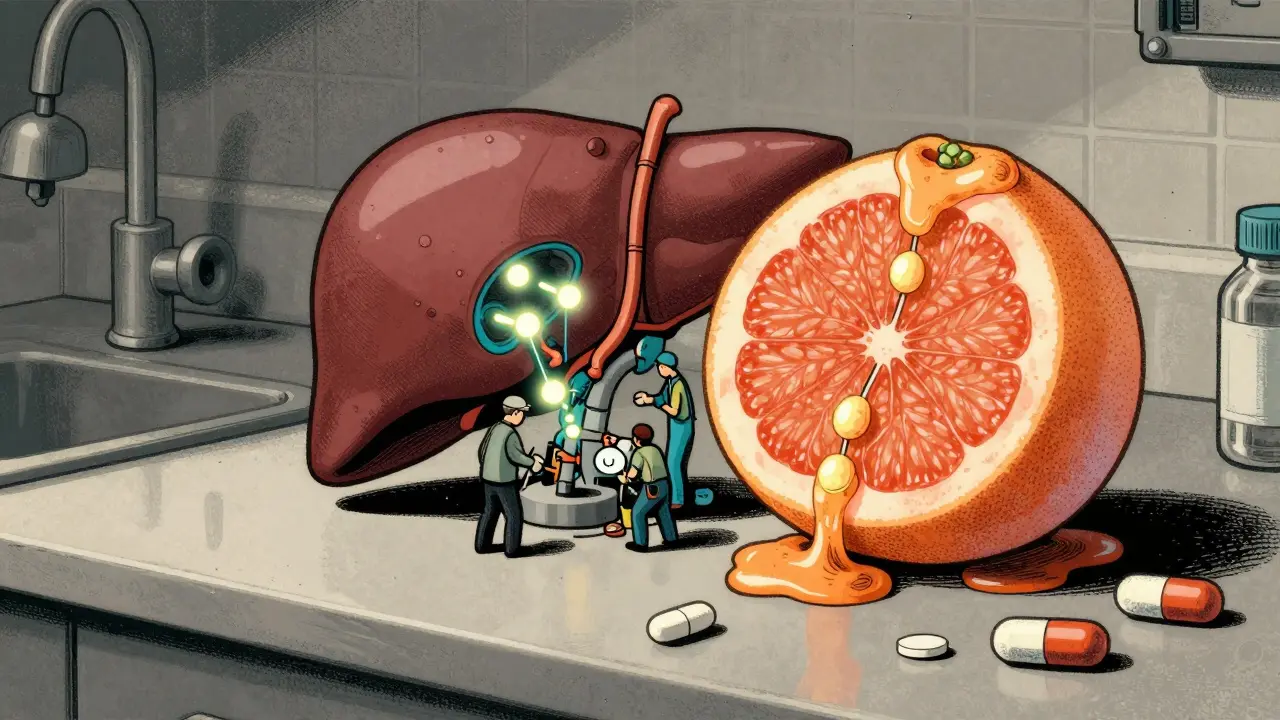
Every year, thousands of people end up in the hospital not because of a mistake by their doctor, but because they ate a grapefruit with their morning pill. It sounds harmless - even healthy. But when you’re taking warfarin or an SSRI, that half a grapefruit or a glass of juice can quietly change how your body handles your medication. And it doesn’t matter if you take your pill two hours later. The damage is already done.
How Grapefruit Breaks Your Body’s Drug Processing System
Your liver and gut have a team of enzymes called Cytochrome P450 (CYP450) that break down drugs so your body can get rid of them. The most important ones here are CYP3A4, CYP2C9, and CYP2D6. About 75% of all prescription drugs pass through these enzymes. Grapefruit doesn’t just slow them down - it shuts them off for days.
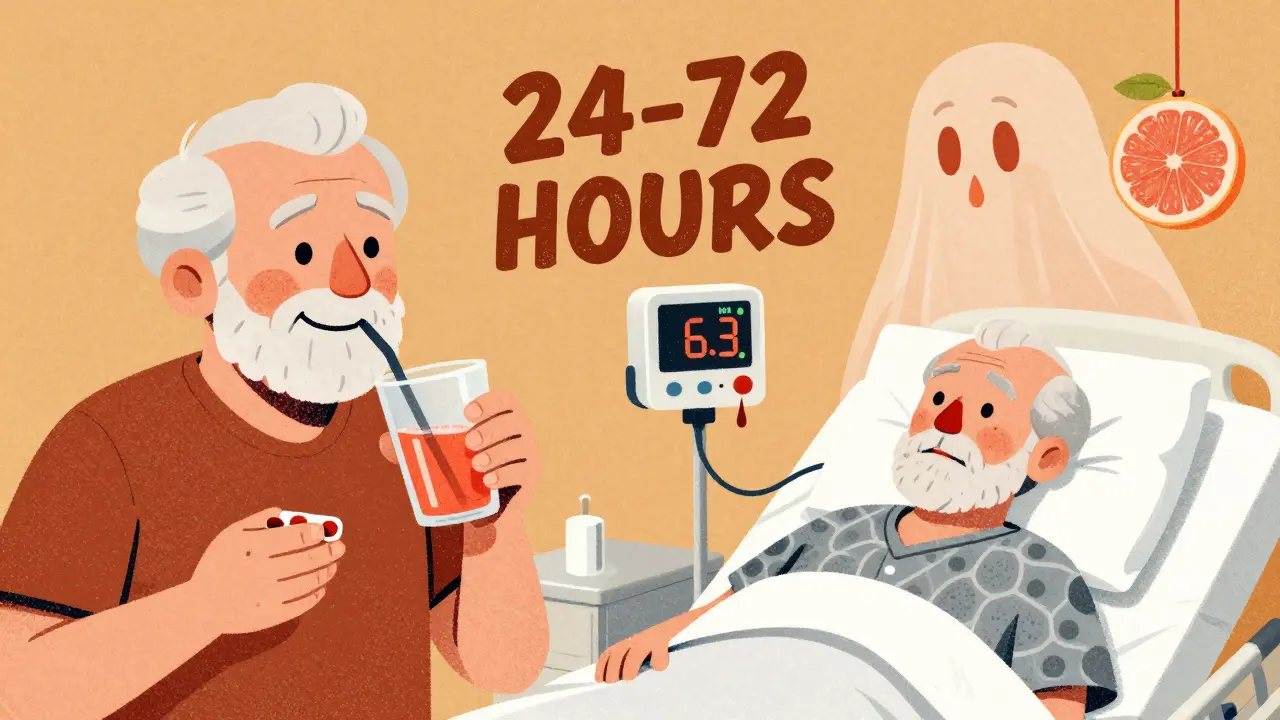
The culprits are chemicals in grapefruit called furanocoumarins, mainly bergamottin and DHB. These don’t just block the enzymes temporarily. They stick to them like glue, break them apart, and force your gut cells to make brand new enzymes from scratch. That process takes 24 to 72 hours. So even if you eat grapefruit at breakfast and take your pill at lunch, your body still thinks it’s in grapefruit mode.
This isn’t theoretical. In 1998, researchers found that bergamottin alone can knock out CYP3A4 activity by more than 40% in human gut tissue. A 2006 study showed that just 8 ounces of grapefruit juice cuts CYP3A4 levels by nearly half - and the effect lasts for days. That’s why timing doesn’t help. It’s not about when you take the pill. It’s about whether your enzyme system is still broken.
Warfarin: Thin Blood, Thick Risks
Warfarin is one of the most dangerous drugs to mix with grapefruit - not because it’s rare, but because the consequences are life-threatening. Warfarin keeps blood from clotting. Too little, and you risk a stroke. Too much, and you bleed internally. It’s a tightrope walk. And grapefruit? It pushes you off the rope.
Warfarin is mostly broken down by CYP2C9 (80-90%), but CYP3A4 handles the rest. Grapefruit inhibits both. Studies show that in people with certain genetic variants (like CYP2C9*2 or *3), grapefruit can raise warfarin levels by 15-25%. That’s enough to spike your INR - a measure of how long your blood takes to clot. An INR above 4.5 is dangerous. One case report from 2021 described a 72-year-old man who went from an INR of 2.8 to 6.3 after drinking grapefruit juice for three days. He ended up with a stomach bleed.
But here’s the twist: not everyone reacts the same. Some people take warfarin for years and drink grapefruit juice with no issue. Why? Because their genetics, diet, and liver health shape how their body handles it. The Clinical Pharmacogenetics Implementation Consortium (CPIC) recommends genetic testing for CYP2C9 if you’re on warfarin. It costs $250-$400, but it tells you if you’re in the high-risk group. If your test shows you’re a slow metabolizer? Skip the grapefruit entirely.
Still, most doctors don’t test. Most patients don’t know. And that’s the problem. According to 2023 data from the CMS Part D database, only 18% of warfarin prescriptions include a warning about grapefruit. That means over 80% of users are flying blind.
SSRIs: The Quiet Danger
Now let’s talk about antidepressants. SSRIs like sertraline, citalopram, and escitalopram are among the most prescribed drugs in the U.S. - over 4.7 million people take them. And many of them are metabolized by CYP3A4 and CYP2D6. That’s the same system grapefruit destroys.
Fluoxetine and paroxetine are mostly handled by CYP2D6. Grapefruit has a weaker effect on this enzyme, but it’s not zero. Sertraline? It’s broken down by CYP2C9, CYP2C19, and CYP3A4. That’s a triple threat. A 2015 study in the Journal of Clinical Psychopharmacology found that people who drank grapefruit juice daily had 27-39% higher levels of sertraline in their blood. That meant more dizziness, nausea, and in rare cases, serotonin syndrome - a dangerous spike in brain serotonin that can cause seizures, high fever, and even death.
But here’s the good news: not all SSRIs are equal. Escitalopram, for example, was tested in a 2024 study with 24 healthy volunteers. No change in blood levels. No side effects. That’s because it’s mostly handled by CYP2C19, which grapefruit barely touches. So if you’re on escitalopram, you’re likely safe. But if you’re on sertraline or citalopram? You’re at risk.
And here’s the real kicker: most patients don’t even know they’re at risk. A survey of medical students in 2022 found that 64% thought all SSRIs interact with grapefruit. That’s wrong. But 36% knew the truth - and they were the ones who had been told by a pharmacist who actually read the data.
What You Should Do Right Now
If you’re taking warfarin:
- Stop drinking grapefruit juice - period.
- Ask your doctor for a CYP2C9 genetic test. It’s not expensive. It’s not invasive. It’s life-saving.
- If you’ve had unexplained bruising, nosebleeds, or dark stools lately, get your INR checked immediately.
If you’re taking an SSRI:
- Check which one you’re on. If it’s sertraline, citalopram, or trazodone - avoid grapefruit.
- If it’s escitalopram, fluoxetine, or paroxetine - the risk is low, but still possible. Play it safe.
- Don’t assume “it’s just a little juice.” One glass a week is enough to build up inhibition over time.
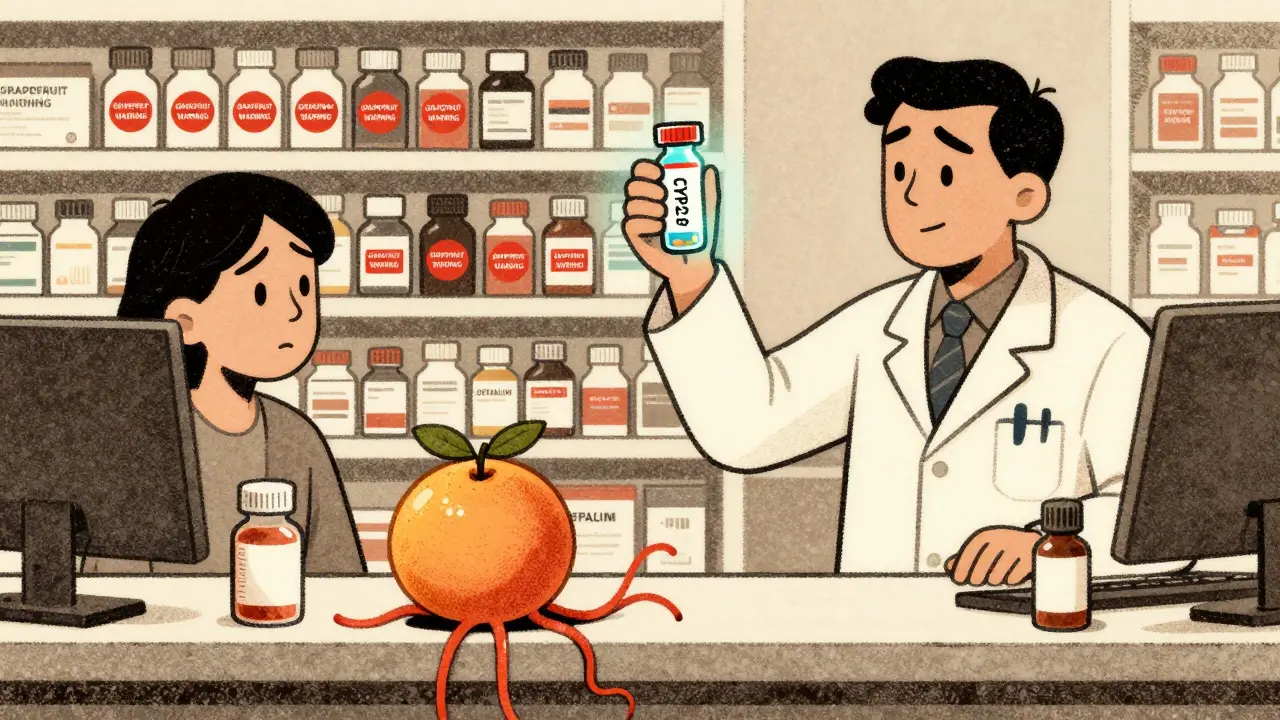
And if you’re not sure? Look at the pill bottle. If it says “avoid grapefruit,” don’t ignore it. If it doesn’t say anything? Ask your pharmacist. They’re trained to spot these things. And they see more of these interactions than your doctor does.
Why This Keeps Happening
Doctors don’t always know. Pharmacists are overloaded. Patients are told grapefruit is healthy. The FDA’s 2023 list includes only 3 SSRIs as high-risk - but that’s because the data is incomplete. A 2024 study showed that newer grapefruit varieties like Oroblanco and Sweetie have up to 300% more furanocoumarins than the old ones. That means the risk isn’t static. It’s getting worse.
And the numbers don’t lie. In 2023, 42% of U.S. adults were on at least one drug that could interact with grapefruit. Warfarin users? 1.2 million. SSRI users? 4.7 million. That’s nearly 6 million people. And only 8% of them got a clear warning on their prescription.
It’s not a conspiracy. It’s a gap. A gap between science and practice. Between research and real life. Between a doctor’s 10-minute visit and a lifelong interaction that can kill.
What’s Next?
The FDA is starting to catch up. Their 2024 draft guidance requires drug makers to test for CYP inhibition more thoroughly. That means future medications will come with clearer warnings. But that doesn’t help you today.
The best defense? Knowledge. If you’re on warfarin or an SSRI, treat grapefruit like a drug - because it is. Don’t rely on labels. Don’t assume it’s safe. Ask. Test. Check. Your life might depend on it.
Can I just avoid grapefruit juice and eat the fruit instead?
No. The harmful chemicals - furanocoumarins - are in both the juice and the pulp. Eating a whole grapefruit has the same effect as drinking juice. Even grapefruit-flavored sodas or supplements can contain these compounds. If you’re on warfarin or certain SSRIs, avoid all forms of grapefruit.
What about orange juice or other citrus fruits?
Sweet oranges (like Valencia or Navel) are safe. They don’t contain furanocoumarins. But don’t confuse them with Seville oranges, which are used in marmalade and do contain the harmful chemicals. Always check the label. If it says “bitter orange” or “Seville orange,” avoid it.
I’ve been drinking grapefruit juice for years with my meds. Should I be worried?
Maybe. If you haven’t had any side effects, you might be lucky - or your body might metabolize the drug differently. But that doesn’t mean you’re safe long-term. The risk builds up over time. Stop the juice and monitor for changes. If you’re on warfarin, get your INR checked. If you’re on an SSRI, watch for dizziness, nausea, or mood changes. Better safe than sorry.
Can I switch to a different medication to avoid this?
Possibly. For warfarin, newer anticoagulants like apixaban or rivaroxaban don’t interact with grapefruit. But they’re not right for everyone - they’re more expensive and can’t be reversed easily if you bleed. For SSRIs, switching from sertraline to escitalopram or fluoxetine might reduce risk. But never switch meds without talking to your doctor. Your mental or physical health matters more than a juice interaction.
Do other fruits have the same effect?
Yes. Seville oranges, pomelos, and tangelos also contain furanocoumarins. Some studies suggest that limes and lemons might have trace amounts, but not enough to matter. Stick to sweet oranges and avoid anything that looks or tastes like grapefruit. When in doubt, skip it.
Comments
Cory L
I never thought grapefruit could be this dangerous. I drink it every morning like it's water. Now I'm terrified. My dad's on warfarin and he loves his grapefruit juice. I'm gonna call him right now. This post just saved a life.
February 24, 2026 AT 13:29
kirti juneja
As someone from India where grapefruit is common in winter, I'm shocked this isn't common knowledge here. My aunt takes SSRIs and drinks juice daily. I'm forwarding this to her family group. Knowledge is power, and this is life-or-death info.
February 25, 2026 AT 17:04
Gabrielle Conroy
OMG this is so important!! I'm on sertraline and had no idea!! 🙈 I've been drinking grapefruit juice since college... I'm switching to orange juice TODAY!! Thank you for writing this!! 💕🙏
February 25, 2026 AT 18:26
Erin Pinheiro
Ive been on warfarin for 8 years and drink grapefruit juice every day and never had a problem. So this whole thing is just fearmongering. Doctors dont know everything. Maybe its just my genetics? I dont need to be scared by some blog post.
February 26, 2026 AT 14:19
Joseph Cantu
You think this is scary? Try this: the FDA doesn't even require drug companies to test for grapefruit interactions on new meds. Why? Because they're too busy making money. Big Pharma doesn't want you to know that a $2 fruit can kill you. They'd rather you take more pills. Wake up. This isn't science. It's a scam.
February 27, 2026 AT 17:27
Shalini Gautam
I'm from India and we have so many citrus fruits here. I always thought grapefruit was just a fancy western thing. But now I see how dangerous it is. My cousin is on an SSRI and she eats grapefruit like candy. I'm gonna send her this link. Better safe than sorry!
March 1, 2026 AT 04:53
Natanya Green
I just found out my mom's on warfarin and she drinks grapefruit juice every morning. I'm having a full panic attack right now. I'm calling the ER. I'm calling her doctor. I'm calling my therapist. I'm calling my cat. I'm calling everyone. THIS IS A CRISIS. Someone please tell me she's okay??
March 2, 2026 AT 05:34
Steven Pam
This is one of those posts that makes you stop and think. I used to think grapefruit was just a healthy breakfast. Now I see it's like a silent assassin in your medicine cabinet. But hey, knowledge is power. I'm switching to oranges. And I'm telling everyone I know. We got this.
March 4, 2026 AT 01:17
Timothy Haroutunian
Let me just say this: the entire premise of this article is flawed. It's based on cherry-picked studies from the early 2000s. Modern pharmacokinetics has evolved. The real issue is poor patient education, not grapefruit. Also, CYP3A4 inhibition is not as absolute as claimed. Many studies show variability. The author is overstating risk to drive clicks. This is fear-based journalism disguised as medical advice.
March 4, 2026 AT 11:40
Michael FItzpatrick
I'm a pharmacist and I see this every day. People think if they didn't have side effects last time, they're fine. But it's cumulative. One glass a week for years? That's enough to keep enzymes down. I've had patients with INRs of 7.8 because they "only had a sip." Don't gamble with your liver. Ask your pharmacist. We're here for this.
March 5, 2026 AT 04:05
Brandice Valentino
I mean, if you're on warfarin and you're still drinking grapefruit juice, you're basically playing Russian roulette with your internal organs. Like, are you even trying? This isn't rocket science. It's basic biology. And if you're too lazy to read the label? Then maybe you shouldn't be taking meds at all.
March 5, 2026 AT 06:02
Larry Zerpa
Let's be real. The real problem isn't grapefruit. It's that doctors don't educate patients. Why are we blaming a fruit? Why not blame the system that lets prescriptions go out without warnings? Why not blame the $12,000 genetic tests that insurance won't cover? This is a symptom of broken healthcare. Stop scapegoating citrus.
March 7, 2026 AT 04:23
Nandini Wagh
I'm just here wondering if this is why my cousin started crying uncontrollably after her morning smoothie. She's on citalopram. And now she's convinced the juice is haunted. Honestly? I think the grapefruit is just vibing with her serotonin. But I'll send her this anyway. Better safe than sorry.
March 9, 2026 AT 01:35
Jacob Carthy
Grapefruit is fine. I've been eating it with my pills for 15 years. If you're weak you'll die anyway. America's too soft. Stop being scared of fruit. Drink the juice. Live your life.
March 9, 2026 AT 17:24