

When a child has asthma, their inhaler isn’t just a tool-it’s their lifeline. But if the technique is off, that life-saving medicine might never reach their lungs. Studies show that without a spacer and mask, kids get as little as 10-20% of the dose. That’s like giving them a quarter of a pill and expecting full relief. The good news? With the right setup and step-by-step method, that number jumps to over 90%. This isn’t theory-it’s what hospitals like Johns Hopkins and Children’s Hospital of Philadelphia see every day.
Why Spacers and Masks Are Non-Negotiable
Most kids under age 8 can’t time their breath with the puff of an inhaler. They cough, they laugh, they turn away. That’s why a metered-dose inhaler (MDI) alone fails. A spacer-also called a valved holding chamber-catches the medicine in a chamber so the child can breathe it in slowly. Add a face mask, and you seal the deal. No more missed puffs. No more wasted meds.
Research from the National Heart, Lung, and Blood Institute confirms this: kids using spacers get 60-80% of the dose into their lungs. Without them? Just 12%. That’s not a small difference-it’s the difference between control and crisis. And according to a 2022 study in the Journal of Allergy and Clinical Immunology: In Practice, proper technique with a spacer and mask delivers 90%+ of the medication. That’s the goal.
Choosing the Right Spacer and Mask
Not all spacers are made the same. Size matters. For infants under 12 months, use a spacer with a mask volume of 150-350 mL. Toddlers (1-3 years) need 350-500 mL. Preschoolers (3-8 years) require 500-750 mL. Too small? The medicine bounces back. Too big? It’s hard to hold in place.
Look for spacers made with anti-static materials. Plastic spacers build up static, which traps medicine like socks clinging to a dryer. If yours is old or cheap, wash it once a week with mild soap and water. Let it air-dry-no towels. That’s all it takes to keep delivery high. Some brands, like AeroChamber and Vortex, are widely used and trusted. But as one expert put it: “Proper technique matters more than the brand.”
Step-by-Step Technique for Kids Under 8
Follow these 8 steps exactly. Don’t skip one. Don’t rush.
- Shake the inhaler. Shake it hard for 5-10 seconds. This mixes the medicine. Skipping this means uneven doses.
- Attach the spacer. Click the inhaler firmly into the spacer’s back end. Make sure it’s secure.
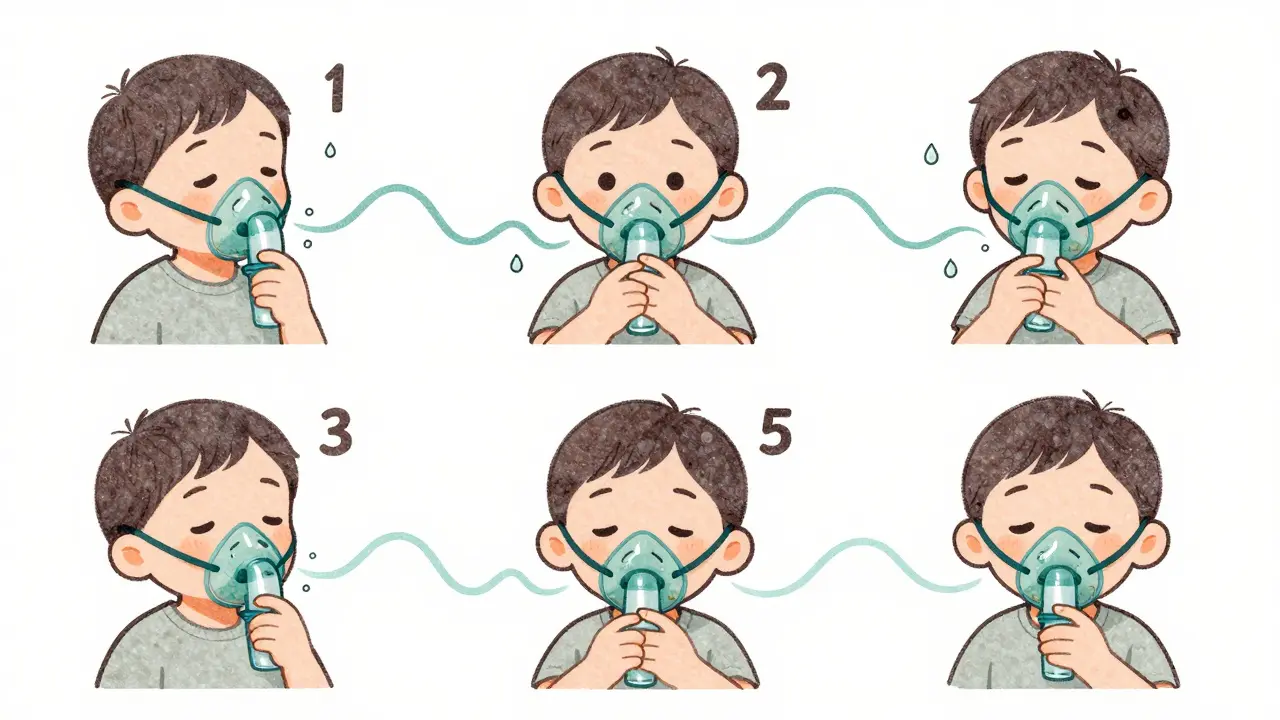
- Place the mask. Press the mask gently but firmly over your child’s nose and mouth. It should cover from the bridge of the nose to the bottom of the chin. No gaps. If you see cheeks puffing out, it’s not sealed right.
- Press the inhaler once. Push down on the canister to release one puff. Don’t press more than once.
- Let your child breathe. For infants and toddlers (under 3), let them take 5-10 normal breaths. Don’t force it. For kids 3-8, 6 breaths is enough. Watch their chest rise and fall.
- Wait 30-60 seconds. Don’t rush the next puff. If your child needs more than one puff, wait at least one full minute. Some protocols say 3 minutes-check with your doctor.
- Repeat if needed. If a second puff is prescribed, shake again, wait, and repeat steps 3-6.
- Remove the mask and clean. Wash the mask weekly. Rinse your child’s mouth with water after steroid inhalers to prevent thrush.
What About Kids Over 8?
Once a child can breathe in deeply and hold their breath for 5-10 seconds, they can switch from a mask to a mouthpiece. No mask needed. Just have them:
- Place the mouthpiece between their lips, sealing tightly.
- Shake and press the inhaler once.
- Breathe in slowly and deeply over 3-5 seconds.
- Hold their breath for 10 seconds.
- Then breathe out slowly.
Studies show this single-breath technique delivers 68.9% of the dose-better than the mask for older kids. But if they’re struggling, go back to the mask. Don’t force it.
Common Mistakes (And How to Fix Them)
Most parents make at least one of these errors. Here’s what to watch for:
- Not shaking the inhaler. 42.7% of parents skip this. Result? Medicine clumps. Fix: Shake for 10 seconds every time.
- Bad mask seal. 63.4% of attempts fail here. Fix: Use your thumb and index finger to press the mask firmly against the face. No gaps around the nose or cheeks.
- Too many puffs at once. Pressing twice before breathing? That’s waste. Fix: One puff. Wait. Then repeat.
- Not waiting between puffs. Giving the second puff after 10 seconds? Too soon. Fix: Wait at least 60 seconds.
- Using a dirty spacer. Static builds up. Medicine sticks. Fix: Wash weekly with soapy water, air-dry.
How to Get Your Child to Cooperate
Resistance is normal. Most kids hate the mask. Here’s what works:
- Make it a game. “Blow out birthday candles” before the puff helps them exhale fully. “Be a dragon breathing fire” after the puff encourages breath-holding.
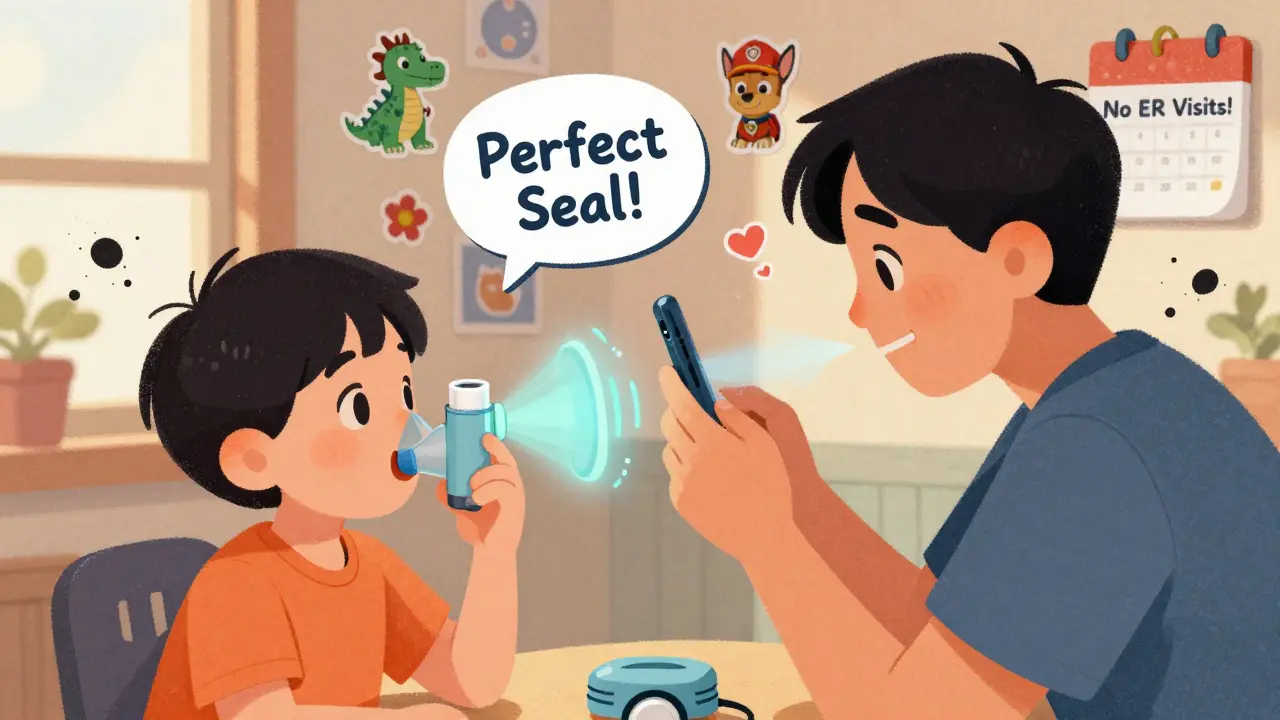
- Use favorite characters. Masks with Spider-Man, Elsa, or Paw Patrol increase compliance by 57%, according to parent surveys.
- Practice without medicine. Let them play with the spacer and mask. Let them hold it. Let them blow into it. Make it familiar.
- Stay calm. If you’re frustrated, they’ll feel it. Take a break. Try again later.
One parent on Asthma.com shared: “We used the ‘blow out candles’ trick. My 2-year-old went from refusing to doing it happily. Compliance jumped from 40% to 90%.”
When to Call the Doctor
Even with perfect technique, asthma can flare. Call your pediatrician if:
- Your child needs their rescue inhaler more than twice a week.
- They wake up at night coughing or wheezing.
- They’re using more than one inhaler canister every 6 months.
- You’re unsure if you’re doing it right.
Doctors can film you using the inhaler. Many now ask parents to send short videos. A 2023 study showed this cuts ER visits by nearly half. Don’t be shy-ask for help.
What’s New in 2025?
The field is evolving. The FDA approved the first “smart spacer” in 2023. It beeps if the child doesn’t breathe in long enough or if the mask isn’t sealed. Early results show 32.7% better technique adherence. By 2025, most pediatric clinics will offer video verification through telehealth. You’ll be able to record your child’s technique on your phone and send it to the doctor. No more guesswork.
And while some older advice says to wash spacers weekly, new research from the UK Inhaler Group says: just air-dry for 24 hours. Static fades naturally. No soap needed. But if you’re unsure, wash it. Better safe than sorry.
Final Thought: Technique Is Everything
One study found that 68% of kids labeled “steroid-resistant” didn’t respond to meds-not because the drugs didn’t work, but because they weren’t getting them into their lungs. That’s not a treatment failure. That’s a technique failure.
Mastering this isn’t about being perfect. It’s about being consistent. It’s about watching your child breathe easier. It’s about knowing that every puff counts. And with the right steps, every puff does.
Comments
Katie Taylor
This is the most practical guide I’ve ever seen on asthma inhalers. My daughter used to cough through every dose until we started using the spacer with the Paw Patrol mask-now she asks for it like it’s a toy. We even bought a second one for daycare. If you’re not using a spacer, you’re basically wasting money and risking your kid’s health. Stop making excuses. Do it right.
Also, wash that spacer weekly. Static is a silent killer. I learned that the hard way after three ER visits. No towels. Just air-dry. Simple. Done.
December 23, 2025 AT 09:36
Sidra Khan
90% delivery? Lol. Where’s your control group? I’ve seen kids use spacers and still wheeze like a broken accordion. And ‘smart spacers’? That’s just Big Pharma selling you another gadget so you’ll feel guilty if your kid doesn’t comply. Meanwhile, real asthma management is about reducing triggers, not buying $80 plastic tubes with Bluetooth.
Also, ‘blow out birthday candles’? That’s not medicine, that’s TikTok parenting.
December 25, 2025 AT 02:20
Ademola Madehin
My baby cried for 47 minutes straight during inhaler time. I cried too. My wife left me because of this. The mask looked like a horror movie prop. I’ve tried Elsa, Spider-Man, even a Darth Vader one. Nothing worked. We tried singing. Dancing. Bribing with ice cream. Nothing.
One night, I just held her and whispered, ‘I’m sorry.’ She stopped crying. Took the mask. Breathed. And then she hugged me. That’s when I knew… this isn’t about technique. It’s about love. And guilt. So much guilt.
Now I just pray she outgrows it before I lose my mind.
December 25, 2025 AT 15:34
suhani mathur
Wow. A guide that doesn’t sound like it was written by a pharmaceutical rep. Finally.
Let’s be real-most parents don’t even know what a metered-dose inhaler is. They just shake it and spray into the air while the kid screams. This guide? It’s gold. But the part about washing spacers with soap? That’s outdated. New UK study says 24-hour air-dry is enough. Static dissipates. No need for scrubbing. Unless your spacer looks like a science experiment gone wrong. Then yeah, soap it.
Also, ‘steroid-resistant’ kids? 90% of them just weren’t getting the dose. Not the meds. The technique. This post nails it.
December 27, 2025 AT 14:07
bharath vinay
90% delivery? That’s what they told us about the polio vaccine too. Then came the autism scare. Now they’re selling ‘smart spacers’ that beep? Who’s controlling the data? Who funds these ‘studies’? Johns Hopkins? Philadelphia Children’s? They all take pharma money. You think they’re going to say, ‘Hey, maybe we should just let kids breathe fresh air and eat less sugar’?
My cousin’s kid stopped using the inhaler and started eating turmeric and doing yoga. No more wheezing. Coincidence? I think not.
Also, masks with cartoon characters? That’s brainwashing. They’re conditioning kids to associate medicine with entertainment. Next thing you know, they’ll be selling inhalers with Fortnite skins.
December 28, 2025 AT 22:53
Wilton Holliday
Just wanted to say thank you for this. My son is 5 and we’ve been struggling for months. I printed this out and taped it to the fridge. We do the steps every time-no shortcuts. Even on nights when I’m exhausted. It’s worth it.
Also, the ‘dragon breathing fire’ trick? Genius. He thinks he’s a dragon now. We do it before bedtime. He blows fire, then I give him a hug. He’s slept through the night for the first time in a year. You don’t know how much that means.
And yes, we wash the spacer. No towel. Just air. Learned that from a nurse at the clinic. Best $12 I ever spent on a spacer.
December 30, 2025 AT 14:36
Joseph Manuel
While the intent of this document is commendable, its methodological rigor is severely lacking. The cited percentages-90% delivery, 68.9% for mouthpiece users-are not contextualized with standard deviations or confidence intervals. Furthermore, the reliance on anecdotal parent testimonials from Asthma.com as empirical evidence is methodologically unsound. The recommendation to ‘wash weekly’ contradicts emerging literature on static dissipation, yet no meta-analysis is referenced to reconcile this discrepancy. Without peer-reviewed citations for the majority of claims, this constitutes more of a promotional pamphlet than a clinical guideline.
Recommendation: Submit for peer review with a control cohort before public dissemination.
December 30, 2025 AT 15:55
Harsh Khandelwal
Y’all are overcomplicating this. My kid’s asthma? We just let him breathe through a straw for 30 seconds when he wheezes. Works better than any spacer. Plus, he thinks it’s a game. No masks. No washing. No drama.
And those ‘smart spacers’? Nah. That’s just tech bros trying to monetize fear. I’d rather have my kid hold his breath than wear a gadget that beeps like a microwave when he messes up.
Also, ‘steroid-resistant’? More like ‘parent-resistant’. If you’re stressing over this, you’re doing it wrong. Chill. Let the kid breathe. They’re not dying. They’re just being dramatic.
January 1, 2026 AT 05:43
Andy Grace
I’m from Australia. We’ve had asthma in the family for generations. I’ve seen the good, the bad, and the ugly with inhalers.
This guide? It’s solid. The mask seal tip? Lifesaver. I used to think it was fine if a little air leaked. Turns out, that’s where 70% of the dose vanishes.
Also, the part about washing with soap and air-drying? That’s the same advice we got from the Royal Children’s Hospital in Melbourne. No towel. Ever.
One thing I’d add: if your kid hates the mask, try a mouthpiece even if they’re under 8. Some kids just hate the feeling on their face. No shame in adapting. The goal isn’t perfection-it’s getting the medicine in.
January 2, 2026 AT 23:33
Spencer Garcia
Wash the spacer. No towel. Air dry.
One puff. Wait 60 seconds.
Mask seals from nose to chin.
Do this every time.
You’re welcome.
January 3, 2026 AT 07:03