
Thyroid Medication Safety Calculator
This calculator estimates the potential risk of thyroid hormone imbalance when combining ashwagandha with levothyroxine medication based on medical evidence.
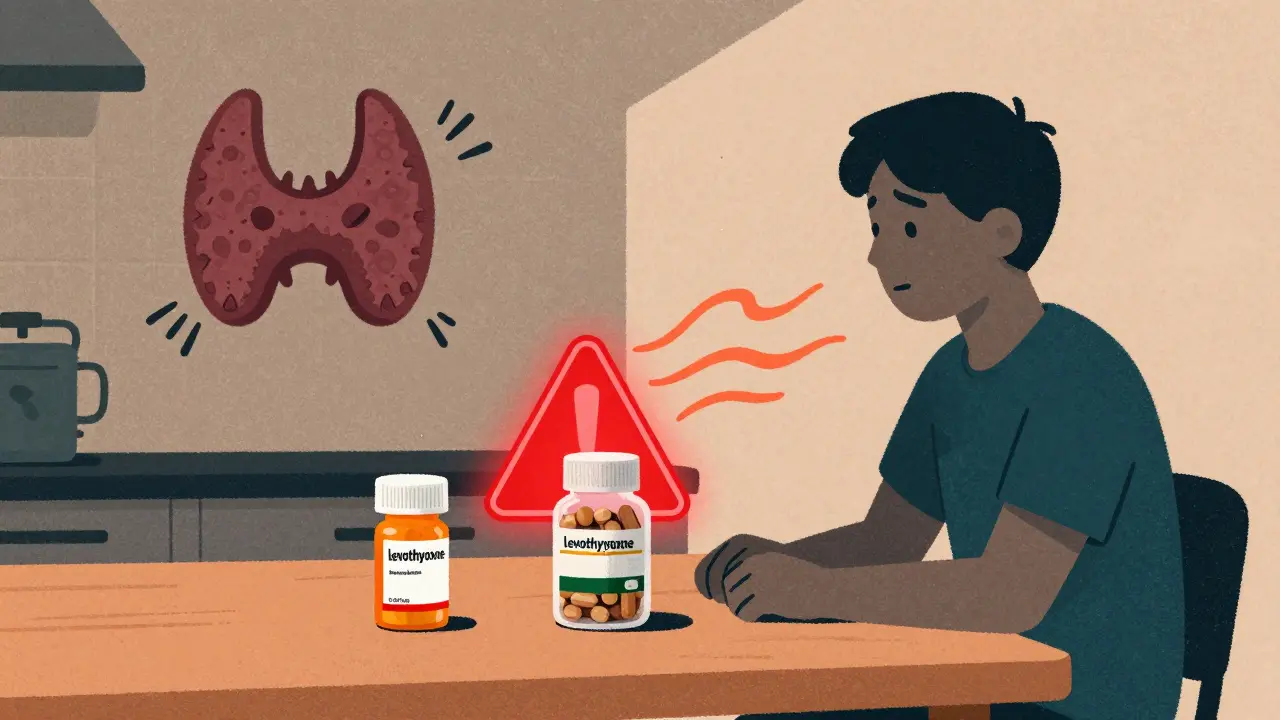
If you’re taking thyroid medication like levothyroxine and thinking about adding ashwagandha for stress or sleep, stop. This isn’t just another supplement combo-it’s a potential trigger for dangerous hormone imbalances. Thousands of people are unknowingly pushing their thyroid levels into dangerous territory by mixing this popular herb with their daily pill. The result? Palpitations, insomnia, weight loss, and even hospital visits-all because a natural remedy was assumed to be harmless.
What Ashwagandha Actually Does to Your Thyroid
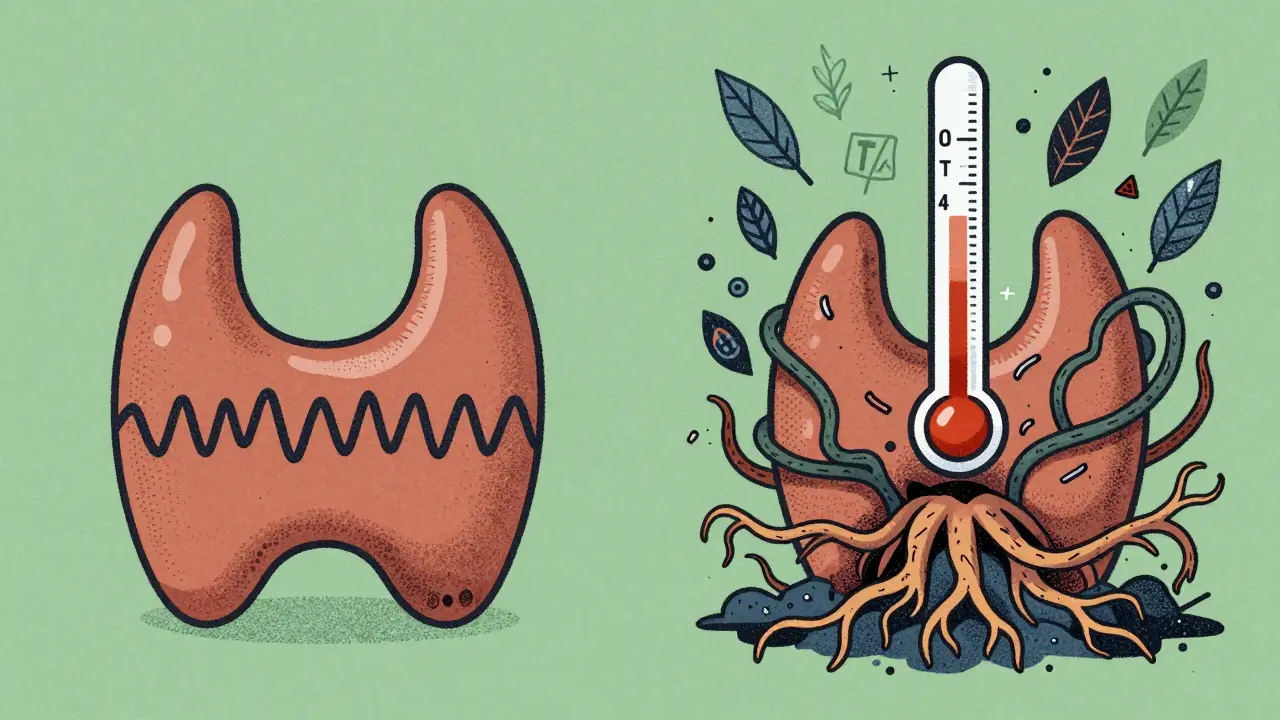
Ashwagandha isn’t just a calming herb. It’s a powerful endocrine modulator. In clinical studies, it’s been shown to raise T3 (the active thyroid hormone) by over 40%, T4 by nearly 20%, and even increase TSH in some cases. This isn’t theoretical. A 2018 double-blind trial with 50 people with subclinical hypothyroidism found that 600 mg of standardized ashwagandha daily significantly boosted thyroid hormone levels. For someone with an underactive thyroid who isn’t on medication, that might sound helpful. But for someone already taking levothyroxine? It’s like turning up the volume on a speaker that’s already at max.The active compounds-withanolides like withaferin A and withanolide D-are what drive this effect. They interact with the hypothalamic-pituitary-thyroid axis, essentially telling your body to produce more thyroid hormone. In a healthy person, that’s fine. In someone on medication? Your body doesn’t know the difference between what’s coming from a pill and what’s coming from a supplement. It just sees more hormone and shuts down its own production. That’s why your TSH drops so low.
Why This Isn’t Just a Theory-It’s Happening
The American Association of Clinical Endocrinologists documented 12 confirmed cases of thyrotoxicosis linked to ashwagandha and thyroid meds. In those cases, T4 levels soared above 25 mcg/dL-more than double the normal upper limit. TSH? Crushed below 0.01 mIU/L. That’s not just abnormal. That’s medically dangerous.Real people are reporting this. On thyroid forums, users describe waking up with heart racing, unable to sleep, losing weight without trying. One user on the Thyroid Help Forum took 500 mg of ashwagandha with 100 mcg of levothyroxine and saw their TSH plunge from 1.8 to 0.08 in six weeks. They ended up in the ER. Another survey of 1,247 thyroid patients found nearly 1 in 5 who used ashwagandha developed symptoms of hyperthyroidism. Twenty-nine of them needed hospital care.
The FDA’s adverse event database recorded 47 cases of thyroid dysfunction tied to ashwagandha between 2019 and 2022. Over half of those involved people already on thyroid meds. This isn’t rare. It’s underreported.
The Supplement Problem: No Rules, No Consistency
Here’s the kicker: ashwagandha supplements aren’t regulated like drugs. The FDA doesn’t test them for purity, potency, or even whether they contain what’s on the label. ConsumerLab tested 15 brands in 2021 and found withanolide content ranged from 1.2% to 7.8%. That’s a six-fold difference. One bottle might have enough to boost your thyroid. Another might do nothing. You have no way of knowing.Meanwhile, your thyroid medication? Levothyroxine is dosed in precise micrograms-25, 50, 100, 150 mcg. Your doctor calibrated it based on blood tests, symptoms, and your body’s needs. Add an unregulated herb that can spike your hormone levels unpredictably, and you’re playing Russian roulette with your metabolism.
What Experts Are Saying
Endocrinologists are unified on this: don’t mix them. Mayo Clinic, UCLA, Cedars-Sinai, and the Endocrine Society all warn against combining ashwagandha with thyroid meds. Dr. Angela Leung from UCLA put it bluntly: “Ashwagandha can tip the delicate balance of thyroid hormone replacement, potentially causing iatrogenic hyperthyroidism.”Even those who acknowledge ashwagandha’s benefits for stress or mild hypothyroidism agree: if you’re on medication, the risk outweighs any possible upside. Dr. Mary Hardy from Cedars-Sinai says the therapeutic window for thyroid meds is narrow. Add an unregulated herb, and you’re crossing a line no doctor can safely monitor.
What If You’re Not on Medication?
Some people with untreated hypothyroidism report feeling better on ashwagandha alone. Reddit users have documented T4 increases from 5.2 to 8.7 mcg/dL over three months. That’s significant. But here’s the catch: you don’t know if your thyroid is truly underactive, or if you have Hashimoto’s, or if your low T4 is caused by something else-like nutrient deficiency, stress, or inflammation. Self-treating with ashwagandha might mask a real problem. It might even trigger an autoimmune flare.Thyroid function isn’t something to experiment with. Even if you feel better, you could be setting yourself up for long-term damage. The goal isn’t just to feel energetic-it’s to keep your hormones in a safe, stable range.
What Should You Do?
If you’re on thyroid medication, the safest move is to avoid ashwagandha entirely. No exceptions. No “just a little.” No “I’ll take it at night.” The risk isn’t worth it.If you’re already taking it, stop. Then wait. Ashwagandha stays in your system for weeks-up to three weeks after you quit-because of its long half-life (about 12 days). That means even if you stop today, your thyroid levels might still be affected for weeks. Don’t get blood work done until at least 30 days after stopping. Otherwise, your results will be skewed, and your doctor won’t know if your meds need adjusting.
If you’re considering ashwagandha for stress or sleep, talk to your doctor first. There are safer alternatives. Magnesium, glycine, or even low-dose melatonin won’t mess with your thyroid. Stress management techniques like breathwork, walking in nature, or mindfulness have zero interaction risk.
The Bigger Picture
This isn’t just about one herb. It’s about a system that lets unregulated supplements flood the market with misleading claims. The Dietary Supplement Health and Education Act of 1994 lets companies sell ashwagandha without proving it’s safe to use with medications. The FDA has issued 12 warning letters to manufacturers for making illegal thyroid claims-but enforcement is weak.Meanwhile, 3.4 million Americans are on thyroid meds and also using ashwagandha. That’s a public health blind spot. The NIH is funding a $2.3 million study to look at this interaction more closely, with results expected in late 2024. The European Medicines Agency already requires warning labels on ashwagandha products. The U.S. hasn’t caught up.
Until then, the safest advice is simple: if you’re on thyroid medication, leave ashwagandha on the shelf. Your hormones are too important to risk.
Comments
Patrick Merrell
This is exactly why people die from 'natural' supplements. You think it's harmless because it's from a plant? That's like saying arsenic is safe because it's in the soil. Ashwagandha isn't tea. It's a biochemical grenade wrapped in yoga vibes.
January 26, 2026 AT 10:20
SWAPNIL SIDAM
I take ashwagandha for sleep. My doctor said it's fine. I don't understand why everyone is scared. My thyroid is normal. Maybe the problem is not the herb but the fear?
January 27, 2026 AT 16:14
Nicholas Miter
I've been on levothyroxine for 7 years. Took ashwagandha for 3 months last year because I was stressed. Didn't feel anything different, but my TSH dropped from 1.2 to 0.1. Doctor flipped out. Stopped it. TSH went back to normal in 6 weeks. Don't risk it. There's no upside worth the headache.
January 29, 2026 AT 06:29
Suresh Kumar Govindan
The FDA's inaction is a deliberate policy failure. The DSHA of 1994 is a corporate loophole masquerading as consumer freedom. This is not an isolated incident-it is systemic negligence. The pharmaceutical-industrial complex profits from both the pills and the panic.
January 30, 2026 AT 01:04
Aishah Bango
I used to think 'natural' meant safe. Then I saw my cousin in the ER with a heart rate of 140 after taking ashwagandha with her Synthroid. She didn't even know it could do that. If you're on thyroid meds, don't touch it. No exceptions. Not even for 'just one capsule'.
January 30, 2026 AT 08:20
Angie Thompson
I switched to magnesium glycinate after reading this and OMG my sleep is better AND my heart isn't racing at 2am. Also, I started walking in the park every morning and I feel like a new person. No herbs. No drama. Just fresh air and quiet. 🌿✨
January 31, 2026 AT 05:32
Geoff Miskinis
The fact that people think they can self-medicate with unregulated botanicals while on life-sustaining pharmaceuticals is not ignorance-it's a cultural pathology. You wouldn't mix vodka with insulin. Why is this any different?
January 31, 2026 AT 15:31
Sally Dalton
I'm so glad someone wrote this. I was about to start ashwagandha because my friend swore by it. I'm so relieved I read this first. My endo always says 'listen to your body' but I never thought my body would be lying to me through a supplement bottle. Thanks for the clarity 💛
February 1, 2026 AT 04:13
Betty Bomber
I took ashwagandha for 2 weeks. Felt great. Then my anxiety spiked. Turned out my T4 was through the roof. Stopped it. Waited 5 weeks. Bloodwork back to normal. Lesson learned. Don't assume 'natural' = 'safe'.
February 1, 2026 AT 16:08
Mohammed Rizvi
So let me get this straight-you're telling me the same herb that helps people with low thyroid levels can accidentally turn someone on medication into a human espresso machine? And we're still selling it in gas stations next to energy drinks? The system is broken, folks.
February 2, 2026 AT 20:45