

Antibiotic-Dairy Interaction Checker
Select your antibiotic to see if dairy will affect absorption and learn the correct timing.
When you take an antibiotic like doxycycline or ciprofloxacin, you might not think twice about having a glass of milk or a bowl of yogurt. But that seemingly harmless habit could be making your treatment less effective-maybe even useless. The problem isn’t about stomach upset or side effects. It’s about absorption. Calcium in dairy products binds to certain antibiotics in your gut, forming a compound your body can’t absorb. That means the drug never reaches your bloodstream where it needs to fight the infection.
Which Antibiotics Are Affected?
Not all antibiotics react the same way with dairy. The big ones to watch out for are tetracyclines and fluoroquinolones. Tetracycline, doxycycline, and minocycline fall into the tetracycline class. These were among the first antibiotics where this interaction was discovered back in the 1950s. Today, they’re still widely prescribed for acne, Lyme disease, and respiratory infections. Fluoroquinolones like ciprofloxacin and levofloxacin are used for urinary tract infections, sinus infections, and even anthrax exposure. Both classes are highly vulnerable to calcium interference.Here’s the catch: not every antibiotic is affected. Penicillins like amoxicillin and ampicillin? Fine with dairy. Most cephalosporins like cefalexin? Also okay. Azithromycin? No problem. So if your doctor prescribes one of these, you don’t need to change your breakfast routine. But if it’s doxycycline or ciprofloxacin, you’ve got a strict window to follow.
How Calcium Blocks Antibiotics
The science behind this is called chelation. Calcium ions (Ca²⁺) in milk, yogurt, or cheese latch onto the antibiotic molecule like a magnet. This creates a large, solid complex that your intestines can’t absorb. Think of it like putting a lock on the drug-your body can’t open it. Studies show that when tetracycline is taken with milk, its absorption drops by 20% to 75%. With yogurt? It can plunge as high as 92%. That’s not a small drop-it’s enough to leave your body with only half the dose you paid for.Why does yogurt cause more damage than milk? It’s not just about more calcium. Yogurt has a lower pH and contains more bioavailable calcium, meaning your body absorbs the calcium faster and more efficiently. That gives it more time to bind to the antibiotic. Even a small amount matters. Research shows that as little as 200 mg of calcium-about 6 ounces of milk-is enough to trigger this reaction. That’s just one glass.
How Long Should You Wait?
Timing isn’t optional. It’s medical necessity. For tetracyclines, you need to wait at least 2 hours before or 4 hours after consuming dairy. Fluoroquinolones require a minimum 2-hour gap. Why the difference? Tetracyclines bind to calcium more tightly and for longer. The drug stays in your stomach longer, giving calcium more time to interfere. Fluoroquinolones move through faster, so a shorter wait is sometimes enough.Here’s what that looks like in real life:
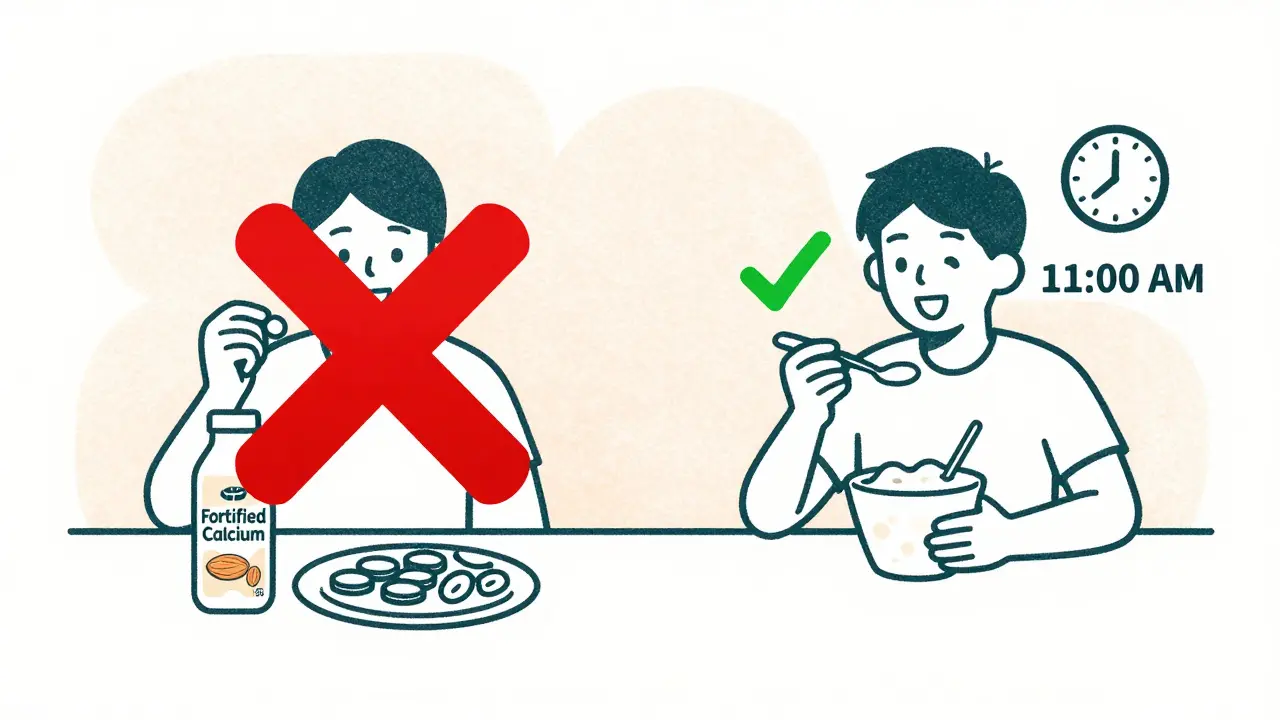
- If you take your antibiotic at 7 a.m., don’t have milk in your coffee until at least 9 a.m. (for fluoroquinolones) or 11 a.m. (for tetracyclines).
- If you eat yogurt at breakfast, wait until lunchtime or later to take your doxycycline.
- If you take your pill at night, avoid cheese or ice cream after dinner until at least 2-4 hours later.
And it’s not just milk and yogurt. All dairy counts: cottage cheese, ice cream, butter, cream, whey protein shakes-even calcium-fortified orange juice or almond milk with added calcium. If it has calcium, it can interfere.
What About ‘Dairy-Free’ Alternatives?
Many people assume that if it’s labeled “dairy-free,” it’s safe. That’s a dangerous myth. Almond milk, soy milk, and oat milk often have calcium added to match cow’s milk levels. One cup of fortified almond milk can contain 300-450 mg of calcium-more than a glass of cow’s milk. If you’re on doxycycline and drink a fortified almond milk latte 30 minutes after your pill, you’re still blocking absorption. Always check the label for added calcium. If it’s there, treat it like dairy.Same goes for antacids, iron supplements, and multivitamins. Many contain calcium, magnesium, or aluminum-all of which can bind to antibiotics. If you take a daily supplement, don’t take it at the same time as your antibiotic. Space them out by at least 2-4 hours.
Why This Matters Beyond Just Effectiveness
This isn’t just about your pill not working today. It’s about the bigger picture: antibiotic resistance. When you don’t get the full dose, the bacteria don’t die completely. The survivors become stronger. They adapt. They multiply. And now you’ve helped create a strain that’s harder to treat-not just for you, but for everyone. The World Health Organization estimates that 1.27 million deaths in 2021 were directly tied to antibiotic-resistant infections. Poor timing with dairy is a preventable contributor to that crisis.Doctors and pharmacists see this daily. A 2023 report from the American Pharmacists Association found that antibiotic-dairy timing errors are the third most common preventable cause of treatment failure in outpatient care. That’s 12.7% of all cases where a patient didn’t get better-not because the drug was wrong, but because they drank milk with it.
Real-Life Challenges
Patients often struggle with this rule. One common complaint? Nausea. Tetracyclines can irritate the stomach, so people take them with food to feel better. But if the only food they can tolerate is yogurt or cereal with milk, they’re stuck between discomfort and ineffectiveness. A 2022 Healthline survey found that 29% of patients intentionally ate dairy with their antibiotics to reduce nausea-even though they knew they weren’t supposed to.Another issue? Scheduling. Taking a pill at 7 a.m. and then not having milk until 11 a.m. throws off breakfast routines, work schedules, and even sleep patterns. Some patients skip doses entirely because the timing feels impossible. That’s why newer formulations like doxycycline monohydrate (sold as Oracea) were developed. These are designed to be taken with food, including dairy, without losing effectiveness. But not all doxycycline is the same-check your prescription label.

What Should You Do?
Here’s a simple, practical checklist:- Know your antibiotic. Is it a tetracycline or fluoroquinolone? If yes, dairy timing matters.
- Read the label. Look for warnings about calcium, antacids, or dairy.
- Wait 2-4 hours. Take your antibiotic at least 2 hours before or 4 hours after any dairy or calcium-fortified product.
- Check supplements. Don’t take multivitamins, iron, or antacids with your antibiotic unless spaced apart.
- Ask your pharmacist. If you’re unsure, call them. They can confirm if your specific antibiotic is affected.
- Use a timer. Set a reminder on your phone: “Take pill,” then “Wait 2 hours,” then “Eat breakfast.”
And if you’re on a long-term antibiotic like doxycycline for acne? Talk to your doctor. There may be alternatives that don’t interact with dairy. Or you might be able to switch to a formulation like Oracea that allows more flexibility.
What About Lactose Intolerance?
Interestingly, people with lactose intolerance may have an accidental advantage. Since they naturally avoid dairy, they’re less likely to accidentally interfere with their antibiotic. A 2020 study from Jundishapur University found that lactose-intolerant patients taking tetracyclines had 18% higher drug absorption rates than those who consumed dairy regularly. It’s not a recommendation to avoid dairy for health reasons-but it does show how much impact even small amounts can have.Final Takeaway
Antibiotics are powerful tools. But they only work if your body can absorb them. Dairy isn’t the enemy-it’s just a timing issue. You don’t have to give up milk forever. You just need to wait. Two hours. Four hours. That’s all it takes to make sure your treatment works the way it should. Skip the yogurt with your pill. Wait. Then enjoy your breakfast without guilt. Your body-and the future of antibiotics-will thank you.Can I drink milk with doxycycline?
No. Milk, yogurt, and other dairy products contain calcium, which binds to doxycycline and prevents it from being absorbed. Wait at least 2 hours after taking doxycycline before consuming dairy. For best results, wait 4 hours. Some newer forms like doxycycline monohydrate (Oracea) can be taken with food, but always check your prescription label.
Does yogurt affect antibiotics more than milk?
Yes. Yogurt typically causes greater absorption reduction than milk because it has higher calcium bioavailability and a lower pH, which enhances calcium’s ability to bind to antibiotics. Studies show ciprofloxacin absorption drops by 92% with yogurt versus 70% with milk. Avoid all dairy forms-yogurt, cheese, ice cream-within the critical window.
Is almond milk safe with antibiotics?
Only if it’s not fortified with calcium. Many almond milks have added calcium to match cow’s milk levels-sometimes 300-450 mg per cup. That’s enough to block absorption. Always check the nutrition label. If calcium carbonate or calcium phosphate is listed, treat it like dairy and wait 2-4 hours after taking your antibiotic.
What if I accidentally take my antibiotic with dairy?
Don’t panic. One accidental dose won’t ruin your entire treatment. But don’t double up on your next dose-that can cause side effects. Just take your next scheduled dose on time, and avoid dairy for the rest of that dosing window. If you’re concerned, call your pharmacist. For serious infections like Lyme disease or Rocky Mountain spotted fever, contact your doctor immediately.
Are all antibiotics affected by dairy?
No. Antibiotics like amoxicillin, azithromycin, and most cephalosporins (e.g., cefalexin) are not significantly affected by dairy. You can take them with food or milk without reducing effectiveness. But tetracyclines (doxycycline, tetracycline) and fluoroquinolones (ciprofloxacin, levofloxacin) are highly sensitive. Always confirm with your pharmacist or prescription label.
Can I take calcium supplements with antibiotics?
No. Calcium supplements, antacids, and iron pills all contain minerals that bind to antibiotics and block absorption. Wait at least 2-4 hours between taking your antibiotic and any supplement containing calcium, magnesium, aluminum, or iron. This includes multivitamins that list these minerals.
Why does timing matter so much for antibiotics?
Antibiotics need to reach a certain concentration in your blood to kill bacteria. If dairy blocks absorption, your body gets only half the dose-or less. That’s not enough to fully eliminate the infection. The surviving bacteria can mutate and become resistant. This isn’t just about your treatment failing-it’s about making future infections harder to treat for everyone.
What if I forget and take my antibiotic with food?
If you took your antibiotic with a light meal (not dairy), it’s usually fine-unless the drug specifically says “take on empty stomach.” For tetracyclines and fluoroquinolones, dairy is the main concern. If you had a sandwich with cheese or milk in your coffee, wait until your next scheduled dose and avoid dairy then. Don’t take an extra dose to “make up” for it.
Comments
Dusty Weeks
bro i took doxycycline with my morning yogurt and now my acne is worse 😭 i thought probiotics were good?? turns out they’re just tiny calcium traitors 🥛💀
January 1, 2026 AT 21:53
Sally Denham-Vaughan
this is such a good reminder! i used to chug almond milk with my pills like it was nothing. now i read every label like a detective. also lowkey grateful my lactose intolerance saved me from myself 🙏
January 3, 2026 AT 03:55
Bill Medley
The biochemical mechanism of chelation is well-documented. Calcium ions form insoluble complexes with tetracyclines and fluoroquinolones, reducing bioavailability by up to 92% in clinical studies.
January 3, 2026 AT 16:17
Richard Thomas
It’s funny how something so small-a glass of milk-can unravel an entire medical intervention. We treat antibiotics like magic bullets, but they’re fragile things, dependent on timing, context, the quiet chemistry of our bodies. We don’t just take pills. We participate in a system. And when we ignore the rhythm-breakfast, calcium, absorption-we’re not just failing ourselves. We’re disrupting a balance that’s been fine-tuned by evolution, science, and centuries of trial. The resistance crisis isn’t just about overuse. It’s about carelessness disguised as convenience.
January 5, 2026 AT 10:40
Paul Ong
just set a phone alarm for pill and then 2 hours later eat breakfast no big deal
January 7, 2026 AT 01:08
Andy Heinlein
this is wild i had no idea almond milk had calcium added 😳 i thought it was the healthy choice but turns out its just a sneaky calcium trap lmao thanks for the heads up
January 7, 2026 AT 07:48
Ann Romine
In my country, we don’t drink milk with antibiotics because our grandmothers said so. Turns out they were right. Traditional wisdom often knows more than we give it credit for.
January 7, 2026 AT 20:53
Todd Nickel
The 2023 American Pharmacists Association report cited in the article is particularly telling. Out of 12.7% of outpatient treatment failures attributed to dairy-antibiotic interactions, it’s not that patients are negligent-they’re often misinformed. Pharmacies rarely reinforce this during dispensing. The burden is placed on the patient to know, yet the information is buried in dense pamphlets or forgotten in the rush of a 7-minute consultation. Systemic failure meets individual confusion. We need better labeling, clearer signage at pharmacies, and mandatory counseling for tetracycline and fluoroquinolone prescriptions-not just a footnote on the bottle.
January 8, 2026 AT 17:51
Austin Mac-Anabraba
Let’s be real. The pharmaceutical industry doesn’t want you to know how fragile these drugs are. If people realized a glass of milk could neutralize their $80 prescription, they’d stop trusting pills altogether. They’d start questioning the whole system. That’s why they bury this info in fine print. Dairy isn’t the enemy. The profit model is.
January 9, 2026 AT 12:43
Phoebe McKenzie
I can't believe people still do this. You take a $100 antibiotic and then ruin it with a $1 yogurt? You're not just wasting money-you're helping create superbugs that will kill your kids one day. Stop being lazy and read the damn label. This isn't rocket science.
January 9, 2026 AT 16:11
gerard najera
Timing is everything.
January 9, 2026 AT 18:30
Stephen Gikuma
They say dairy blocks absorption. But who controls the calcium standards? Who decides what's 'fortified'? Maybe this is all a distraction. What if the real problem is the government letting corporations add calcium to everything to make us dependent on more drugs? Think about it.
January 11, 2026 AT 05:31