
Kidney Disease Antacid Safety Checker
This tool helps you determine if an over-the-counter antacid is safe for you based on your kidney function stage and specific medication. Always consult with your nephrologist before making changes to your medication.
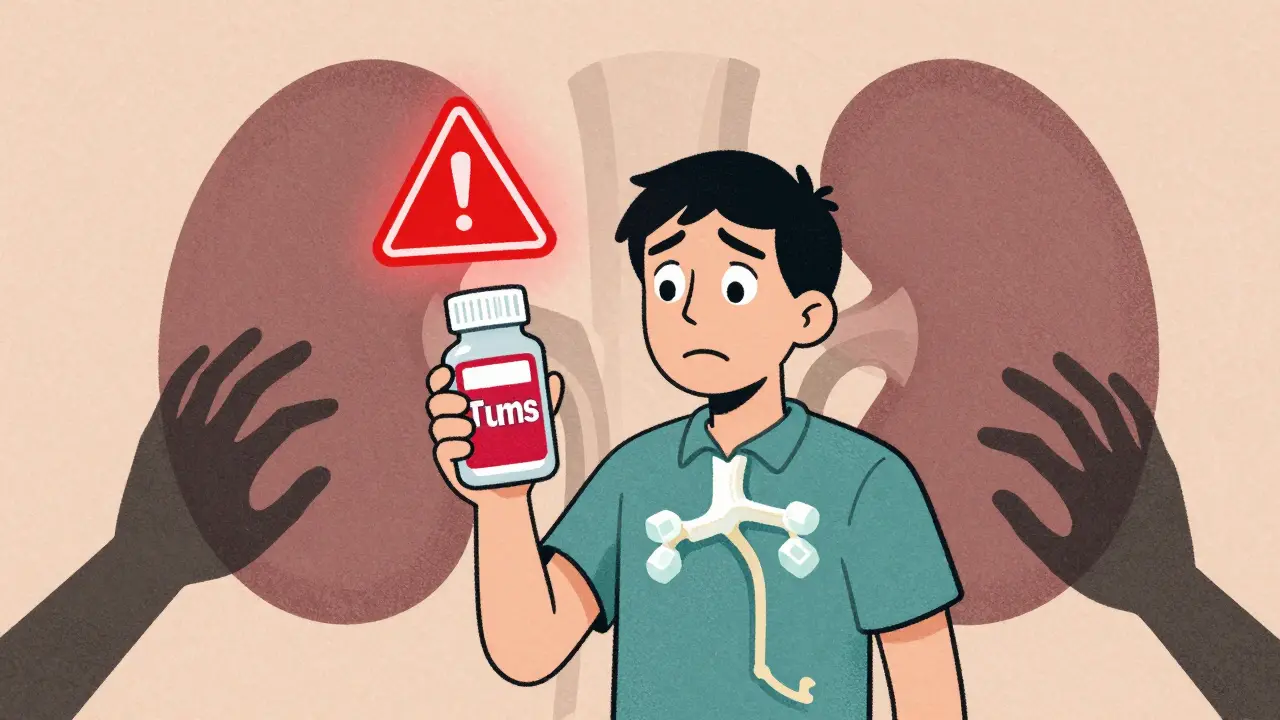
When you have kidney disease, even something as simple as taking an antacid for heartburn can be dangerous. Many people don’t realize that over-the-counter antacids like Tums or Milk of Magnesia aren’t just for indigestion-they can seriously affect your kidneys and electrolytes. For people with chronic kidney disease (CKD), these common meds can turn into silent threats, causing high calcium, high magnesium, or even aluminum poisoning. The line between helpful and harmful isn’t clear unless you know the details.
How Antacids Work-And Why They’re Used in Kidney Disease
Antacids were originally designed to neutralize stomach acid. Calcium carbonate, magnesium hydroxide, and aluminum hydroxide react with hydrochloric acid to reduce burning and discomfort. But in people with kidney disease, these same ingredients do something else: they bind to phosphate in the gut. When kidneys fail, they can’t remove excess phosphate from the blood. That buildup leads to weak bones, itchy skin, and dangerous calcification in blood vessels and the heart.
That’s why doctors sometimes use antacids as phosphate binders. Calcium carbonate (Tums) and aluminum hydroxide (Amphojel) form insoluble complexes with dietary phosphate, stopping it from being absorbed. This helps keep serum phosphate levels between 2.7 and 4.6 mg/dL, the target range recommended by KDIGO guidelines for CKD patients. But here’s the catch: these are not safe for everyone, and they’re not meant to be taken long-term without monitoring.
The Hidden Dangers: Aluminum, Calcium, and Magnesium Risks
Not all antacids are created equal when it comes to kidney disease. Each type carries its own set of risks.
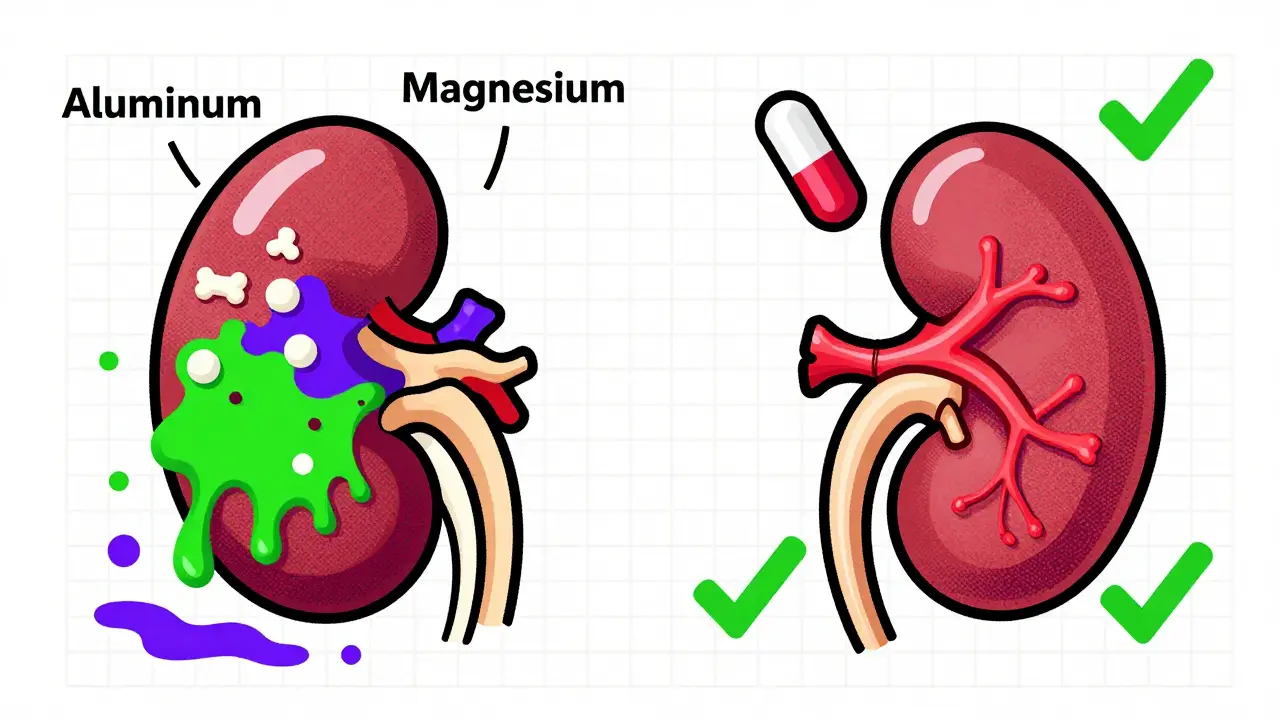
Aluminum-based antacids like aluminum hydroxide were once common phosphate binders. But they’re now considered dangerous. Aluminum can build up in the body when kidneys can’t clear it. Levels above 40 mcg/L can cause bone disease; above 60 mcg/L, it can lead to dialysis dementia-memory loss, speech problems, and muscle weakness. The FDA has required warning labels since 1990, and most nephrologists avoid them entirely unless it’s a last-resort, short-term fix. They’re strictly off-limits if your creatinine clearance is below 30 mL/min.
Calcium-based antacids like Tums or calcium citrate are more commonly used. But they’re not harmless. In CKD, your body already struggles to regulate calcium. Too much calcium from antacids can push serum levels above 10.2 mg/dL, increasing the risk of vascular calcification by 30-50%. A 2019 study in the Journal of the American Society of Nephrology found that CKD patients with calcium levels above this threshold had significantly higher rates of heart attacks and strokes. The NEJM reported in 2018 that calcium antacids led to 40% more hypercalcemia cases than non-calcium binders in stage 4 CKD patients.
Magnesium-based antacids like Milk of Magnesia are even riskier. Magnesium is normally excreted by the kidneys. When kidney function drops below 10 mL/min, magnesium builds up. Levels over 4 mg/dL cause muscle weakness and low blood pressure. Above 10 mg/dL, it can stop your breathing or trigger cardiac arrest. The National Kidney Foundation warns that magnesium antacids have caused fatal outcomes in dialysis patients who used them for constipation without knowing the danger.
Prescription Phosphate Binders vs. Over-the-Counter Antacids
Prescription phosphate binders exist for a reason: they’re safer and more effective for long-term use.
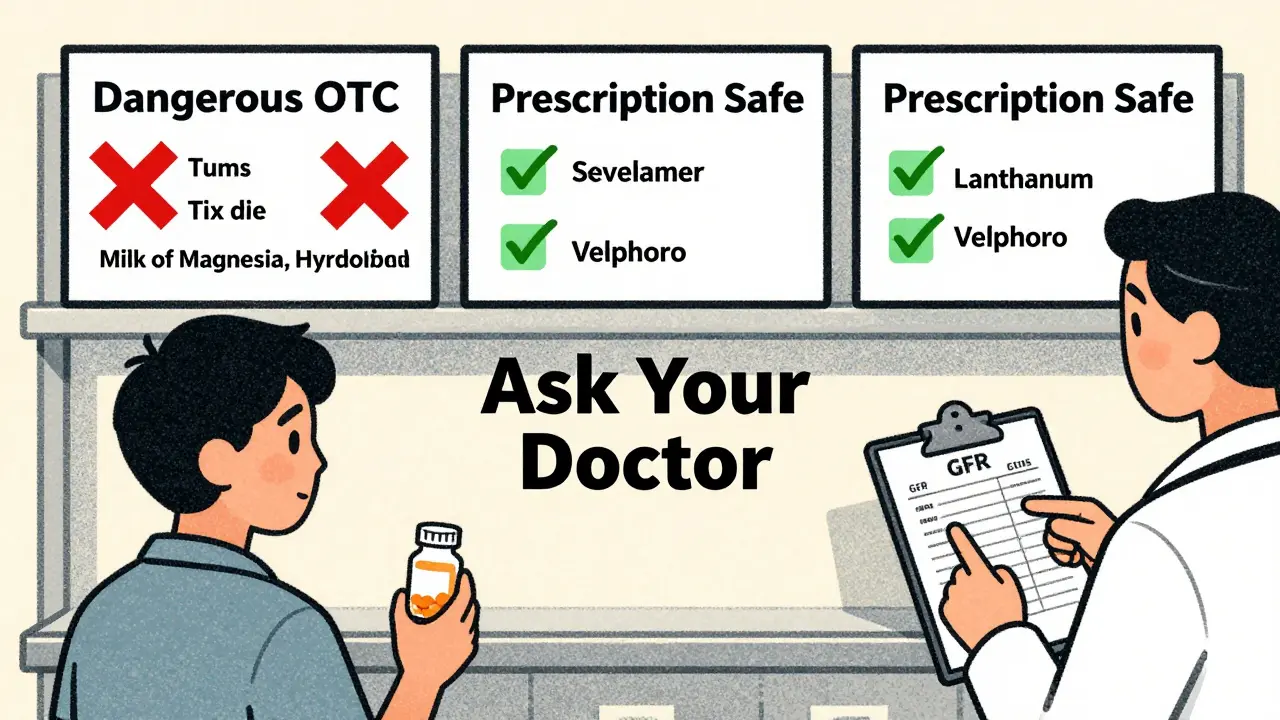
- Sevelamer (Renagel): A non-calcium, non-aluminum binder. Reduces phosphate by 25-35% per meal. No risk of aluminum or calcium toxicity. Costs about $2,000-$2,500 per month.
- Lanthanum carbonate (Fosrenol): Similar efficacy to sevelamer. Also avoids calcium and aluminum. Costs $2,500-$3,500 monthly.
- Sucoferric oxyhydroxide (Velphoro): Iron-based. Fewer pills per dose. Costs around $4,000 monthly.
By comparison, generic calcium carbonate costs about $10 a month. That’s why many patients-especially those without good insurance-rely on it. But cost shouldn’t override safety. A 2022 study in the Clinical Journal of the American Society of Nephrology found that 57% of emergency visits related to antacids in CKD patients involved aluminum or magnesium products. Most of these cases were preventable.
Who Should Use What-and When
Not every CKD patient needs the same approach. Your kidney function level determines your risk.
CKD Stage 3 (GFR 30-59 mL/min): Calcium carbonate may be used cautiously. Take it with meals to bind phosphate. Dose: 600-1,200 mg elemental calcium per meal. Monitor serum calcium monthly. Keep it under 10.2 mg/dL. Avoid magnesium and aluminum completely.
CKD Stage 4-5 (GFR under 30 mL/min): Prescription binders only. No OTC antacids for phosphate control. If you need heartburn relief, calcium carbonate may be used occasionally-but only if taken at least 2 hours before or after your prescription binder. Never take it daily. Always check with your nephrologist first.
Also, antacids interfere with other medications. They can reduce absorption of antibiotics, thyroid meds, and seizure drugs like phenytoin by up to 40%. The Cleveland Clinic recommends taking other drugs either one hour before or four hours after an antacid.
What Patients Are Really Experiencing
Real stories show how dangerous this gap in knowledge is.
A 62-year-old woman with CKD stage 4 started taking Tums daily for heartburn. Six months later, her calcium hit 11.2 mg/dL. A CT scan showed new calcium deposits in her arteries. She didn’t know Tums was a phosphate binder.
A man on Reddit shared he used Milk of Magnesia for constipation. His magnesium level spiked to 8.7 mg/dL. He woke up paralyzed in his legs and ended up in the ER.
A 2022 survey by the American Association of Kidney Patients found that 68% of CKD patients couldn’t tell the difference between prescription binders and OTC antacids. Forty-two percent had used antacids without telling their kidney doctor. Only 24% had ever received written instructions about which antacids were safe.
What You Need to Do Right Now
If you have kidney disease and take antacids:
- Stop using aluminum or magnesium antacids immediately. They’re not safe for you.
- If you’re using calcium carbonate daily, talk to your nephrologist. It may be fine in early CKD-but not if your GFR is below 30.
- Ask for a serum calcium, magnesium, and phosphate test. If you’ve been taking antacids for more than a few weeks, you need these checked.
- Learn the difference between your prescription binder and OTC antacids. If you’re unsure, bring the bottle to your next appointment.
- Never take antacids within four hours of other medications. They can make your other drugs less effective.
Also, know the warning signs:
- High calcium: Nausea, confusion, frequent urination, bone pain.
- High magnesium: Muscle weakness, dizziness, low blood pressure, trouble breathing.
- Aluminum toxicity: Memory loss, speech problems, bone pain, anemia.
What’s Changing in 2026
New tools are emerging. Tenapanor (Xphozah), approved in 2023, blocks phosphate absorption differently-without binding. It’s not a phosphate binder at all, just a pill that stops the gut from absorbing it. Early data looks promising, especially for patients who struggle with pill burden.
The NIH is funding a major 5-year study called ASK-D, tracking 5,000 CKD patients to create clearer guidelines. And the FDA is expected to update labeling on OTC antacids by 2025 to explicitly warn kidney patients against using them as phosphate binders.
Meanwhile, clinics are rolling out AI tools that analyze your GFR, diet, lab results, and meds to recommend the safest binder for you. These aren’t science fiction-they’re in use today.
Bottom line: Antacids aren’t harmless. In kidney disease, they’re a medical tool with serious side effects. Don’t assume they’re safe just because they’re on the shelf. Your kidneys can’t protect you from them. Only you-and your doctor-can.
Can I still take Tums if I have kidney disease?
You may be able to take calcium carbonate (Tums) occasionally for heartburn, but only if your kidney function is stage 3 or earlier (GFR above 30 mL/min). Never use it daily as a phosphate binder without your nephrologist’s approval. Avoid it completely if your GFR is below 30, and always take it at least 2 hours apart from your prescription phosphate binder. Monitor your blood calcium levels monthly.
Why are aluminum antacids so dangerous for kidney patients?
Kidneys normally remove aluminum from the body. In advanced kidney disease, aluminum builds up in the blood and tissues. Levels above 40 mcg/L can damage bones; above 60 mcg/L, it can cause brain damage known as dialysis dementia. Symptoms include memory loss, confusion, speech problems, and muscle weakness. The FDA banned long-term use of aluminum antacids in kidney patients decades ago, and they should never be used as a first-line treatment.
Is Milk of Magnesia safe if I have CKD?
No. Milk of Magnesia (magnesium hydroxide) is not safe for anyone with CKD stage 4 or 5 (GFR below 30 mL/min). Magnesium builds up quickly when kidneys fail. Levels above 10 mg/dL can cause respiratory failure, cardiac arrest, or death. Even in stage 3, it’s risky. Always use prescription laxatives instead, and never use it without discussing it with your nephrologist.
What’s the best phosphate binder for someone on a budget?
Calcium carbonate (generic Tums) is the cheapest option at around $10 per month. But it’s only appropriate for early-stage CKD (stage 3) with no signs of vascular calcification. If your GFR is below 30, it’s too risky. For advanced CKD, ask your doctor about generic sevelamer or lanthanum carbonate-some patient assistance programs offer them for under $50/month. Never use antacids as a long-term phosphate binder without supervision.
How do I know if I’m having an antacid-related complication?
Watch for these signs: persistent nausea, confusion, muscle weakness, low blood pressure, trouble breathing, or bone pain. If you’ve been taking antacids and notice any of these, get your blood tested for calcium, magnesium, phosphate, and aluminum levels. Emergency visits for antacid toxicity in CKD patients are common and often preventable. Don’t wait for symptoms to get worse.
Comments
Greg Scott
Man, I had no idea Tums could be this dangerous. I’ve been popping them like candy for my acid reflux. Gonna call my nephrologist tomorrow. Thanks for laying this out so clearly.
February 19, 2026 AT 22:41
Jayanta Boruah
While the article presents a compelling narrative grounded in clinical evidence, it fails to address the systemic socioeconomic pressures that compel patients to self-medicate with OTC antacids due to pharmaceutical cost barriers. The implicit assumption that all patients have access to $2,000/month binders is not only naïve but ethically indefensible. A more rigorous analysis would contextualize adherence within structural inequity rather than individual negligence.
Furthermore, the dismissal of calcium carbonate as a viable option in Stage 4 CKD contradicts recent 2023 KDIGO supplementary guidelines which permit its use under strict, monitored conditions with concurrent phosphate restriction. The article’s alarmist tone risks inducing therapeutic nihilism among patients who may otherwise benefit from cautious, evidence-based use.
Additionally, the omission of non-pharmacologic interventions-such as dietary phosphate chelation via plant-based protein substitution or low-phosphate cooking techniques-represents a significant gap in holistic care. This is not merely a pharmacologic problem; it is a nutritional and behavioral one requiring multidisciplinary intervention.
February 21, 2026 AT 04:06
Chris Beeley
Let me tell you something-this whole ‘antacid danger’ narrative is just Big Pharma’s way of pushing expensive binders on people who can’t afford them. You think I’m gonna pay $4,000 a month for Velphoro when I can get Tums for $10? Please. The FDA’s been in bed with pharmaceutical giants since the ‘90s. Aluminum toxicity? That’s a scare tactic. I’ve been taking Milk of Magnesia for 12 years and I’m still standing. My doctor? He’s just scared of liability. Real talk: if you’re not dialysis-dependent, your kidneys can handle it. Stop letting corporations dictate your health choices.
And don’t even get me started on those ‘AI tools’-they’re just algorithms trained on biased datasets from Ivy League hospitals. My cousin in Lagos is using lime juice and ginger for his CKD and he’s doing better than half the patients in this article. Western medicine is a scam. Wake up.
Also, why are they not talking about glyphosate? It’s in your water, your food, your antacids. It’s the real culprit. But you won’t hear that from the FDA. Because they’re owned. Just sayin’.
February 21, 2026 AT 18:28
Tommy Chapman
So people are dumb for using Tums? Wow. Real insightful. You’re telling me someone on a fixed income should choose between food and a $2,500 pill? That’s not healthcare, that’s a death sentence wrapped in a lab coat. If you’re gonna write about this, at least suggest solutions instead of just scaring people.
And yeah, I know someone who took Milk of Magnesia and ended up in the ER. But I also know someone who died because they couldn’t afford the ‘safe’ option. You wanna save lives? Fix the system. Don’t just lecture us.
February 23, 2026 AT 07:28
Irish Council
Aluminum in antacids = brain rot. Magnesium = stopped breathing. Calcium = calcified arteries. And yet the FDA lets these sit on shelves next to aspirin. Coincidence? I think not. The same people who approved aspartame are the ones who approved Tums. They don’t care if you die. They care about the stock price. I’ve seen the documents. They’re not hiding them. They’re just not printing them.
February 23, 2026 AT 11:08
Freddy King
Here’s the real kicker: the entire paradigm of phosphate binding is built on a flawed assumption-that reducing serum phosphate is always beneficial. But recent Mendelian randomization studies suggest phosphate may be a biomarker, not a causative agent. The whole ‘bind and conquer’ model might be a red herring. We’re treating a lab value, not a disease. And that’s why we’re seeing no mortality benefit from binders in RCTs. We’re just moving numbers around while the real problem-endothelial dysfunction, uremic toxins, inflammation-goes unaddressed.
Also, why is no one talking about gut microbiome modulation? Butterscotch and fiber might be more effective than sevelamer. Just sayin’.
February 24, 2026 AT 13:06
Ashley Paashuis
This is such an important topic, and I’m glad it’s getting attention. Many patients don’t realize that what seems like a harmless over-the-counter remedy can have life-altering consequences. I’ve worked with several CKD patients who didn’t know Tums was a phosphate binder-until their calcium levels shot up. It’s heartbreaking. Education is key, and I hope clinics start including this in routine patient handouts. A simple one-pager could prevent so many ER visits.
February 26, 2026 AT 01:45
Laura B
I’m from Nigeria and we don’t even have access to prescription binders. We use lime, ginger, and sometimes crushed papaya seeds. It’s not perfect, but it’s what we have. I wish more of these discussions included global perspectives-not just US-centric solutions. Maybe we need low-cost, locally sourced alternatives instead of just pushing expensive pills.
February 27, 2026 AT 23:39
Robin bremer
OMG I JUST REALIZED I’VE BEEN TAKING TUMS EVERY DAY 😱 I’M GONNA DIE 😭 I’M CALLING MY DOCTOR RN 🤯🙏
March 1, 2026 AT 00:17
Robert Shiu
Hey everyone, I just want to say-you’re not alone. I was scared too when I found out I’d been taking calcium carbonate for months. But I talked to my nephrologist, got tested, and we switched me to a generic sevelamer program through a nonprofit. It’s not perfect, but I’m alive. If you’re worried, reach out. You’ve got this. One step at a time.
March 2, 2026 AT 12:50
Jeremy Williams
The ethical imperative here extends beyond clinical guidelines. The commodification of health information-where critical safety data is buried in dense medical literature while OTC products are marketed with vague, reassuring language-reflects a deeper failure of public health communication. Regulatory agencies must enforce plain-language warnings on packaging, not just in footnotes. A patient should not need a medical degree to understand the risk of a $10 bottle of pills.
Moreover, the absence of universal healthcare in the U.S. turns this into a class issue: those with insurance can afford safe binders; those without are forced into dangerous trade-offs. This is not a medical problem. It is a moral one.
March 4, 2026 AT 07:24
Scott Dunne
It’s rather disheartening to see how American healthcare has devolved into a spectacle of fearmongering and pharmaceutical dependency. In Ireland, we’ve long recognized that natural remedies and dietary management form the backbone of renal care. To prescribe $4,000 pills as the only solution is not medicine-it’s corporate exploitation dressed in white coats.
March 5, 2026 AT 01:30